Absence and presence

In the end, it’s not really the topic of grades that’s so huge for me— It’s the topic of no grades: what can happen, what I’ve seen happen, in their absence.

graduation JuliaThis is Julia Miller, who graduated from Touchstone long enough ago that she’s about to graduate again, from high school. Behind her, draped on the greenhouse, you can see the flag her Older Student Program group made the previous fall, just before going on their fall hiking trip. If you look closely, behind Julia’s right elbow, you can see the word CREATIVITY and the beginning of the word RESPONSIBILITYtwo of the values that group chose as their watchwords for the year. She’s about to dance–

graduation julia dance cropped–mostly as a joke, but I love the way this photograph shows her blooming along with the petunias, and reaching for the literal and figurative skies.

As they go through their experience, students in an ungraded situation aren’t thinking, “no grades no grades no grades.” They’re making connections from topic to topic and theme to theme and school to home (and vice versa); they’re trying out different voices and different genres and new strategies for understanding the world; they’re thinking a lot about the community of each other.

Teachers who aren’t giving grades aren’t thinking “no grades no grades no grades.” They’re making connections themselves, learning about their topics, watching and planning for ways to include other adults and experiences outside the classroom; imagining the world of each student from inside that student’s perspective; nourishing the community that can do more for each individual than any teacher’s plans.

As we went along, the missing grades barely figured in what I said about the teaching and learning I shared with each year’s class. At parent meetings, I never said, “First, I want you to know that I’m not giving grades.” It was taken for granted, invisible.

Still, that absence of grades was constantly at work in the presence of other energies and outcomes.

I saw the benefits: for kids whose learning experience had never been assessed with grades; but also for kids who had come to my school after experience with grades elsewhere.

Now and then, a transplant–or his parents–couldn’t make that transition. Most were like people woken from a long and troubled sleep. They stretched; they looked around; slowly, or quickly, they became active, in a new way, in the scene of their lives.

Still, I don’t have available the experimental control, in which the same teachers worked with similar kids and gave grades. I don’t know how that would have worked for any of us.

Close friends have said that I would probably have blown all my fuses and quit; that I would have left teaching very early in the game, if I’d been forced to translate my students’ growth and learning into graded assessments.

I wonder: how many teachers have been driven out of teaching by the necessity of an activity ultimately so alien to their original hopes and intentions? How many others, not questioning grades, have nonetheless abandoned teaching out of disappointment with the state of mind grading has induced in their students? What have we lost with this attrition, these departures?

My own history meant that I didn’t take the absence of grades for granted. I first started questioning the effectiveness of grading long before I was a teacher, long before my husband and I went looking for schools for our children. I became skeptical of grades at a time when I was being graded myself, and getting good grades. Not always, but sometimes, I could feel how addictive that was; I could glimpse how few risks I was taking; I felt, often, the price of that labeling.

Beyond that, I remember watching the effects of grades on some of my friends. I knew their talents and strengths, and wondered why their grades didn’t represent them more accurately. In fact, there didn’t seem to be any way for some of my friends to live in their strengths, in the classrooms we were encountering. Looking back I can see how the learning was often shaped to be easily measurable, easily graded.

If you’ve read previous posts, you know that I had some wonderful teachers. I don’t blame them individually. I was in the first wave of the post-war baby boom, and our classes were large. To some degree, increased testing and grading pressure attempted to manage that suddenly increased demand.

Like them, still, many teachers don’t have a choice of not assigning grades. Some give the grades they have to give, but play down the importance of those grades in any way they can, putting their energy into those other products and outcomes I tried to describe in the previous post:

  • Teacher support, and student goal-setting, guided by targeted, individualized, meaningful assessments
  • Learners who know and understand and respect themselves as learners
  • Authentic and rewarding group learning
  • Deep meanings held in community
  • Powerful connections with significant content

One of those “teachers without a choice” lives under the same roof with me, and his frustrations were part of what finally goaded me into writing about not giving grades. So I want to end this series of posts, at least for the time being, with a nod to him and to all those teachers past and present, saddled with the obstacle of grades and making the best of it, for their students’ sake.

I think I’ve said this before, and I never forget it for a minute: I was lucky.

But that’s enough (finally, or at least for now) about no grades. Next time, I want to start thinking about structures to help teachers and students meet each other halfway, beginning, I think, with the seasonal feast of the Skimathon!
Five More Thoughts About Grading

The story so far: If the product of a learning experience takes the form of a grade, other possible products and outcomes have less reality and less power for the learner.

Voices speaking out against grades want to shift the focus of learners and teachers, to give priority to those other products and outcomes. I’m going to focus on just a few.

# 1  Teacher support, and student goal-setting, guided by targeted, individualized, meaningful assessments

Focused effort matters, and thoughtful assessment can support that. Very briefly, here are some of the kinds of feedback individual kids could come to expect in my classroom, in place of grades:

  • one-on-one working conferences to look at pieces of writing, reading comprehension progress, math quiz outcomes, etc.;
  • group mini-lessons based on common confusions or not-quite-there efforts or emerging possibilities or spontaneous break-throughs, acknowledging and moving forward from all those;
  • quick skills checks in the form of miniboard warm-ups;
  • written responses to specific assignments;
  • long narrative progress reports twice a year;
  • conversations in preparation for portfolio sharing, and the portfolio conferences themselves;
  • feedback from classmates, students in the wider school community, parents, and other adult audiences.

The previous post has examples of some of these. The feedback for students in younger classes varied from this in developmentally appropriate ways, but always with the same goals: not judgment, but celebration and support.

Each of these activities provided an opportunity for student and teacher to observe patterns in comprehension and skill, or difficulty, and to set goals both short-term and long-term. At the same time, each of these assessment activities was an opportunity to revisit, share, and reconsider the important questions inherent in our content.

#2  Learners who belong to themselves

I remember a conversation with the high-school-aged daughter of a friend. She told me about her classes for that year by telling me her grades. She couldn’t tell me what was interesting to her; couldn’t say what she wanted to learn next; couldn’t describe anything about her learning process. Her grades were high overall, and she assumed that the subject in which she was getting the highest grades should be her major in college.

This young woman didn’t belong to herself as a learner; she belonged to her grades, and to the people who were giving her those grades–even the people who were celebrating those grades.

Especially once we were able to keep students until they were ready for high school, people observing the graduates of my school have been struck by the way graduating 14-year-old kids belong to themselves–how clearly they know and understand and respect themselves as learners.

fall projects NateInstead of pinning their student identities on their GPA, students in ungraded situations learn how to work with their real identities as learners. They learn how to choose meaningful and sustainable challenges for themselves. They know how to manage their own attention, and what to do to sharpen their memories. There may be passages through which they struggle, but a lot of the time they’re having a blast. Above all, they know, for themselves, why it matters. To the left, checking and graphing temperatures.

#3  Authentic and rewarding group learning

Teamwork flourishes best when grades are out of the picture. When I’ve talked about the amount of group work happening in my class, people have often asked, “Don’t kids get distracted by working together? How can you tell who did what?”

I’d have to be crazy to deny that distraction happens sometimes, or that timid students can become dependent on others. Still, young adolescents are ready and eager to learn how to be teams.

as Tsongas 3At Tsongas Industrial History Center, these girls are constructing a working canal system model. As usual, museum educators  commented on how well students worked together–incorporating everyone’s ideas, sharing the dirty work on the floor.

At any age, effective group work doesn’t happen automatically. In order to get the huge benefits of several minds focused on the same task, complementing and helping and challenging each other, kids have to learn how to be task-focused and team-focused both at once; how to do the social work, the intellectual work, the creative work, and the procedural work all woven together.

Kids exposed to plenty of group projects in an ungraded situation get a terrific head start. Without grading to tell them they’re competing instead of collaborating, they learn how to stay balanced within the group process, and how to help the group stay balanced so it keeps on working for everyone.

If you want an argument against grades, focused on future success, you could start with that.

tracing watershed pathway croppedAbove: Working with a parent volunteer, students help each other figure out which direction the rivers are flowing on topographic maps.

Meanwhile, freed from generating grades, I could put time into helping groups design and choose tasks that would engage them, with topics and audiences that mattered to them. The resulting energy helped their bicycle built for two (or three or four) keep momentum.

Often, when sharing work in a portfolio conference, students mentioned their partners and teammates, and told about what each of them had contributed, as I set off quiet internal fireworks of celebration. Yes!

# 4  Deep meanings held in community

As humans, we seem to have evolved to construct meaning, and experience meaning, collectively.

Stonehenge.arp.croppedMany groups of students have been inspired by the collective power of the communities that built Stonehenge, and archaeologists’ ideas about the community events held there.

Archaeologists and paleo-anthropologists have found evidence of the power and importance of community life and community understanding, deep in the past history of our species–and even for the other hominin species before us.

Young adolescents work hard to begin to understand huge things: life and death, economic reality as they observe it, the concept of scale, the notion of one image symbolizing whole realms of experience. Whenever I asked groups of students what they’d like to understand better about the world, I was astonished anew at the ambition of their questions, knowing this at the same time: the really heavy lifting they can’t do alone, any more than adults can.

Lizzie Bright croppedIn my own most emblematic image of this, a group of learners listens to a challenging novel read aloud. As I write, I realize that I’m thinking particularly of Lizzie Bright and the Buckminster Boy, a novel about racial prejudice in early 20th century New England, beautifully written by Gary Schmidt. Sharing a novel like this, the students build understanding together through their various comments and questions. Sometimes I sense their collective bravery in their silence for a tricky passage, or just after.

If somebody out there knows a way to assign grades to the quality of a shared group silence, let me know.

Now hold that in contrast to this: When individual achievement is the only test of an experience; when shared learning is considered cheating; when it’s constrained by the “level-playing-field” concept that requires teachers to do exactly the same things for every student; when teachers face such large classes that they have no way of knowing who’s doing what without completely isolated graded assessment–the deepest and truest parts of learning are hobbled, compromised, or outright lost.

It’s not impossible to nurture community, and the deep meanings community can hold, in the presence of a grading system–just harder. In fact, in my experience, over-emphasis on individual outcomes in any form–either grades or some supposedly benign substitute–works against the development of community, and the construction of shared meaning.

#5 Powerful connections with content

When grades aren’t the focus, content itself–the world!–gets more attention. The world is alarming to young adolescents–and to all of us–but also fascinating. Grades wind up being a smokescreen in the way of that fascination.

That’s what broke my heart about my friend’s daughter, mentioned earlier. She was experiencing very little actual engagement with the world and how it works and what we make of it. Her grades were like junk food, no fit substitute for actual encounters with the depth of time, or the mysteries of prime numbers, or the relationship between surface area and heat loss, or the way human history offers such contradictory evidence of both altruism and cruelty.

I think of a student long ago who wanted to read novels about the Holocaust. She had no assignment. She just kept coming back to me for more books, and talking about them to her classmates and parents. She was choosing her own path to a deeper understanding of the world.

Or I think of a student, now grown to a man, who used his sketchbook, during morning sketching time (which was completely open, unassigned), to make a very long narrative map, which continued from one two-page spread to the next, and the next, for months. The map as a whole incorporated everything that kid was noticing about the world through which he traveled: about geography, transportation, and the designs of buildings and other systems; about humor; about continuity and discontinuity.

Looking back, I remember now that this student’s family had just gone through an unusually messy divorce. His rehearsal of continuity in the built and natural worlds, page by turned-over page, feels tremendously poignant to me now. At the time, I was focused on his thinking and processing and creativity. But it seems likely, now, that the mapping was working for him on levels I couldn’t even guess. He gave himself the assignment that let him live in his intellectual strengths, and use those strengths to help him live through his family’s troubles.

Although he made me copies of some of the pages, I have no idea where they are. Hooray for memory so vivid and dear that it doesn’t need props. Hooray for learning so rich that no grade could encompass it. Hooray for the safe haven, also a highly effective launching pad, in which such work could happen.

I have a feeling I’m still not done with this topic…

Never, Nada, Zip, Zilch: No Grades

In the teaching and learning I’ve written about for this blog, some things never happened–things taken for granted in most schools. I was lucky.

For starters: because my school didn’t require me to, I never summarized my assessments of students’ work using grades. No number grades; no letter grades; none of the judgments about mastery (not as clear a concept as you might think) summed up in terms that are just grades thinly disguised. None, never, nada.

Alhambra Caroline and Isy croppedLike all my colleagues, I gave plenty of careful attention to student work. The students received many kinds of feedback, and even more kinds of support. Above all, in ways small and large, we celebrated the culmination of authentic learning.  But not with grades.

I was still a kid myself (and getting A’s) when I decided that grades were meaningless and dangerous. As an adult, I’ve been known to refer to grading as institutionalized child abuse.

Still, I’m used to the fact that people I respect may disagree. Occasionally, Touchstone families have decided they wanted grades, going somewhere else to get them. Other families have wished for the crispness of grades, but stayed for the quality of their children’s learning. Almost all our graduates have gone on to schools that use grades, and almost all of them have continued to belong to themselves and care most about meaning.

If you want to read essays about the uselessness (or outright harmfulness) of grades, track down the writings of Alfie Kohn. I think often of a less famous heroine, Meghan Southworth, a working math teacher and trainer for the Maine Mathematics and Science Alliance. She wasn’t able to eliminate all grades, because her school required them at the end of every quarter. In order to have some basis for those grades, she had to administer tests and other graded assessments, and record the results.

Here’s the kicker: she had stopped showing her students the grades they received through the term.

Instead, she continued to give her students written comments. I didn’t see hers, but I’m guessing they were a lot like mine: suggestions for ways to rethink problems, ways to improve quality control, ways to balance carefulness and momentum–along with acknowledgement of the kinds of engagement and effort, no matter how tentative, that can help a student move forward. Here’s a small sample of comments on a test:

math quiz comments croppedThis student was working to overcome test-taking anxiety,  and needed to focus on how close she was to the full answer. Thus “almost” instead of an X.

Like most teachers everywhere, Southworth wanted her students to improve, not just stay at the level of achievement they arrived with. She had noticed that they wouldn’t really absorb or use the support embedded in her comments, as long as the shortcut of a grade was available. She quoted a student who caught on to her new system very quickly: “Oh, you want us to read the comments instead of just looking at the grades!”

Southworth also cited research describing most students’ response to grades: “Is this what I’m used to getting?” If the student is used to getting A’s, and this is an A, no need to stretch. If the student is used to getting C’s, and this is a C, no need to worry.

To put this as harshly as I’ve sometimes felt it: If it’s a teacher’s job to sort kids into levels, grades make sense. If a teacher is meant to be a gatekeeper restricting access to future opportunities, ensuring a scarcity of qualified applicants for those opportunities, then grades make sense.

But if a teacher’s job involves paying attention to learners, understanding them, and working with them to help them grow, then grades aren’t worth much, and can actually get in the way.

Think about what freedom from grading meant for me and my students, as we worked together:

  • math work and progress croppedFreed from grading, I could put much of my energy into assessing what each child needed in order to make the best possible progress. I took lots of notes, and reviewed them less often than I thought I should, but often enough to keep my concerns and hopes for each student fresh.
  • We could make frequent and thoughtful use of student self-assessment. That’s awkward to incorporate into a grading system, but really important in helping students move forward.

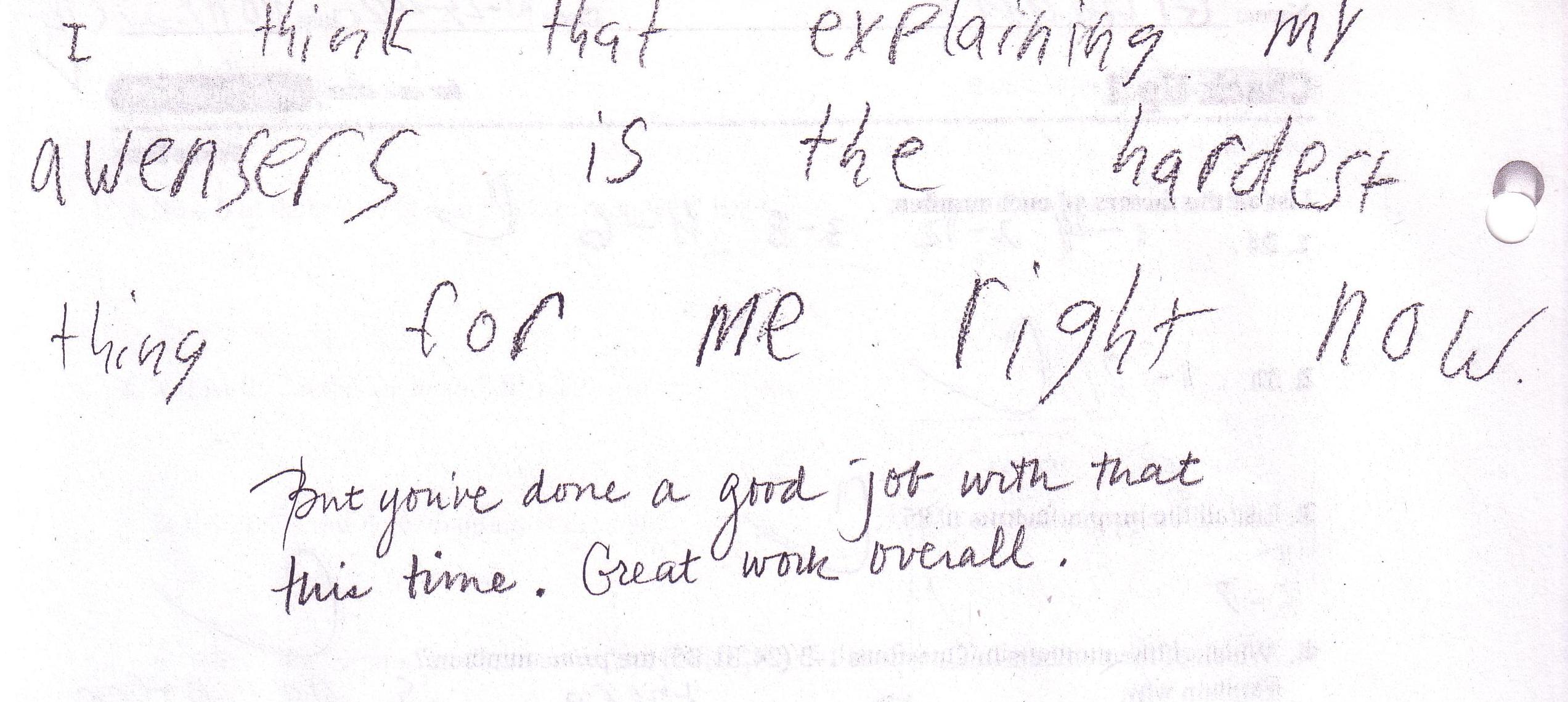
math self-assess and my response croppedWritten quickly on the back of a math quiz, this is part of a student’s routine reflection on test-taking strategies and skills, with reading self-assessment croppedmy response.

Here are some of the sentence starters for a reading journal self-assessment, leading up to a portfolio conference.

  • My students and I weren’t in the more-or-less adversarial relationship that grading so easily encourages. Kids treading line-up cropped with Colin and Samended to be fully invested in the goals we had set together. So I got to hear them say things like this: “Something in me just rushes right through instructions, because I want to get started on the answers. So I’m trying to build the habit of stopping myself and reading the instructions again.” Or: “Now I can really understand what I’m reading, I get involved in what’s happening, and hate it when you say that reading time is over.” These are kids realizing what they need–habits of rechecking, reachable books–and figuring out that they can provide that for themselves.
  • Freed from grading that would imply class standing, we didn’t have to worry about an “even playing field.” I could help kids make individual choices of topics and materials comfortable enough to encourage confidence, interesting enough to inspire excitement, and challenging enough to nurture flexibility and pride. Like our physical education teacher, I aimed for “challenge by choice”–and I found that well-supported students motivated by genuine interest almost always aimed high.

nate with tube and vortex croppedThere had been a rage for home-made marble chutes, in a run of rainy-day recesses. This student worked on his own to explore a new idea, incorporating a toy vortex.

At a professional conference, another teacher asked me, “But why do kids work, if there’s no grade as a reward?” I didn’t actually burst into tears, but I felt some despair. We are in real trouble when teachers themselves have been conditioned to forget the intrinsic rewards of learning, the joy of feeling powerful as a learner, the genuine appetite kids bring to talhambra mattheir mutual effort to understand the world.

What about my own reward? Immeasurable. My students grew like weeds, not just physically but intellectually. They bloomed! That was the real delight, for me, in teaching at a school that disavowed grades: I got to watch kids learning like mad, bright-eyed and working tirelessly, full of the meanings in their learning and full of themselves, taking off and flying for their own reasons.

I wouldn’t trade that for nothin’. (Nada. Zip.)

I could not fit this topic into anything resembling my 1000 word target. So I’ve saved some aspects for another post: the relationship between grading (or not) and group work; ditto the development of class community. Also: in the absence of grading, kinds of feedback students could come to expect–and my continuing fascination with learning that happened in odd little corners (like rainy-day recess) where feedback wasn’t a factor.

Afterthoughts, Afterlinks, Resolutions, and Thanks

My most recent post, about math mentors and math fun, was the 25th on this blog. The calendar year is about to turn; I’m a little less than halfway through my year to think it over. Time for a mixed salad of quick thoughts, including some resolutions.

More math fun

First, it turns out that 2013 is not prime. All year I’ve wondered. Finally, this morning, I started scratching calculations on the back of an envelope. Then I went to the web to double-check, and found a prime factor calculator. That confirmed it, just in time:

goofygraphics2013I also checked 2014. That, too, is a product of three primes, but I’m not telling. (You know right off the bat what one of those primes has to be.)

After reading the previous post, Kate Keller said some really nice things, including, “Wait! You left out the birthday ritual!”

Kate’s remembering something we did whenever a birthday happened in my class. I started by writing the child’s new age on the big whiteboard: 11, or 12, or occasionally 13. Then I’d ask, “What can we say about the number —?”

Students responded in a variety of ways:

  • with cultural uses of the number. (“It’s a dozen!”) (“Some people think it’s unlucky, but they’re crazy…”)
  • with expressions that equaled the number: 3 x 4 = 12, or 14 plus -3 = 11, or much more complicated expressions coming out of our experience with Lloyd’s Game (described in the previous post.)
  • with a magic number sequence that started with the number and returned to the number.
  • with words that describe other properties of the number: it’s odd (or even); it’s prime (or composite); it’s a palindrome; it’s deficient or abundant or perfect.

These various statements, written on the whiteboard, both documented learning and provoked it. Although we focused on the same numbers again and again, the activity was repetitive only in the way ritual has to be repetitive: a pattern similar in every iteration, but never actually identical; a shared dance in which roles can change and change again; a bowl or basket or web for both familiarity and innovation.

If I forgot to include the number ritual in our celebration of someone’s birthday, or if we ran out of time before dismissal, the kids insisted that it be carried over to the next day. Remembering my students’ affection for the ritual, and remembering the way every student participated, I feel like I’m holding some important key to who they were, and are; something hard to put into words; a treasure.

For still more math fun, check out the YouTube channel of Vi Hart. Here’s a link to one of my favorites, the first in a sequence of three about plants and the Fibonacci sequence. “Ow!” one of my younger students said. “My head hurts! Play it again!”

vihartfib

More My Place

I’ve been tickled to have the posts about My Place get a steady trickle of hits from Australia, so I did some behind-the-scenes backtracking. In the process, I found a wonderful collection of material relating to Nadia Wheatley, with an author interview, curriculum plans, and reviews of some of her other books–and a link to my own post about My Place, down towards the bottom. Great stuff!

If I were teaching right now…

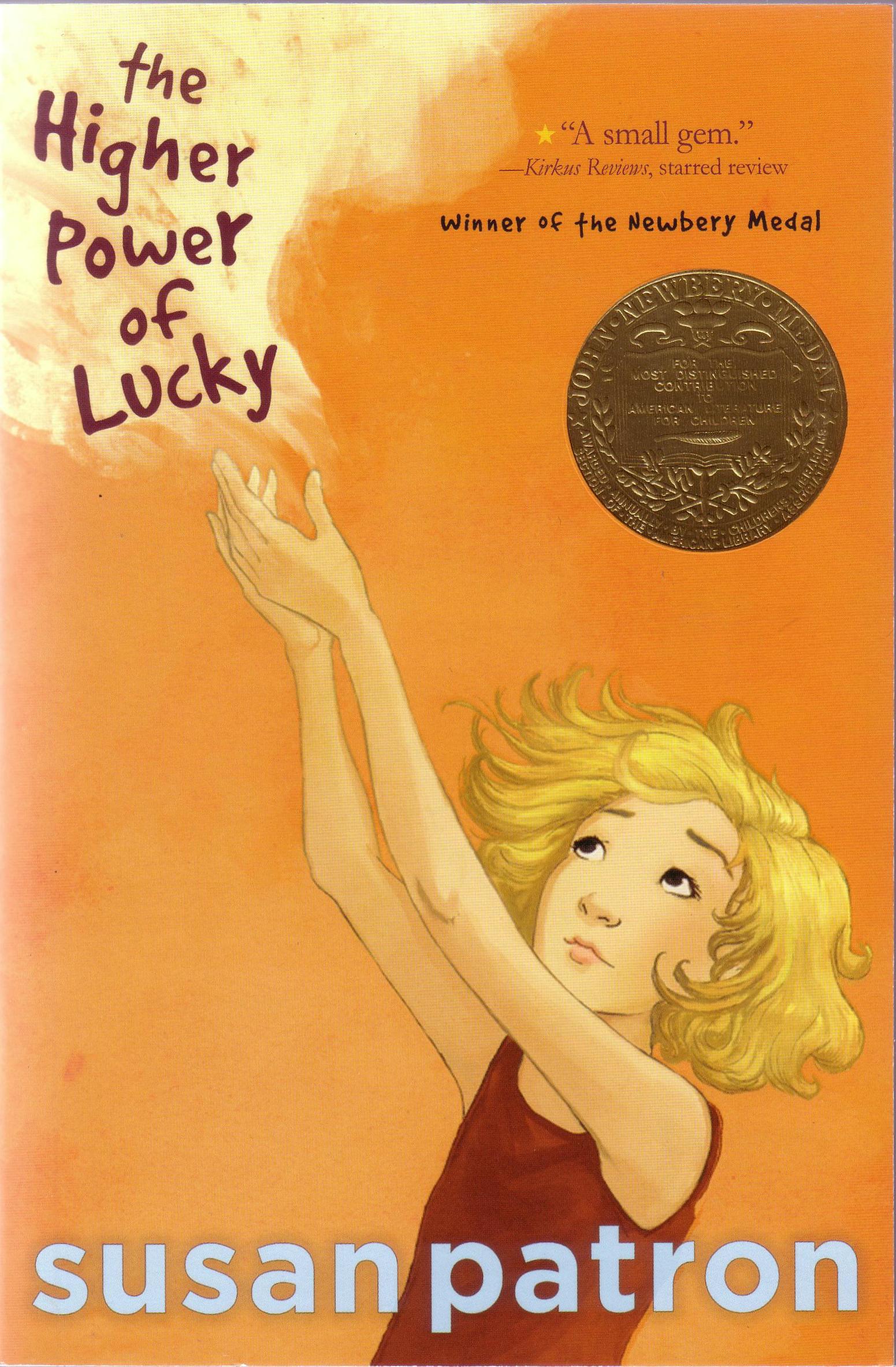
I would read aloud The Higher Power of Lucky, the first in a series of three novels about a girl named Lucky in a town named Hard Pan, in the Mojave Desert.

higherpowerofluckyb

Living in a very small town, Lucky has memorable friendships with both kids and grown-ups. She eavesdrops on twelve-step anonymous meetings, hoping to hear the advice she needs. She hopes seriously for an afterlife, because there are some questions she would like to ask Charles Darwin. (She has a dog named HMS Beagle.) She’s cranky and impulsive and imperfect and worth a million dollars, and she’s part of a new sub-sub-genre of realistic contemporary fiction for young adults, in which characters think about biological evolution and what it means, and interact sympathetically with adults who can’t or won’t.

“If” thought # 2: I would figure out how a class could use the latest book by Alice Roberts, the charismatic anthropologist and medical doctor who narrates a BBC video series (which we did use in class) called The Incredible Human Journey.

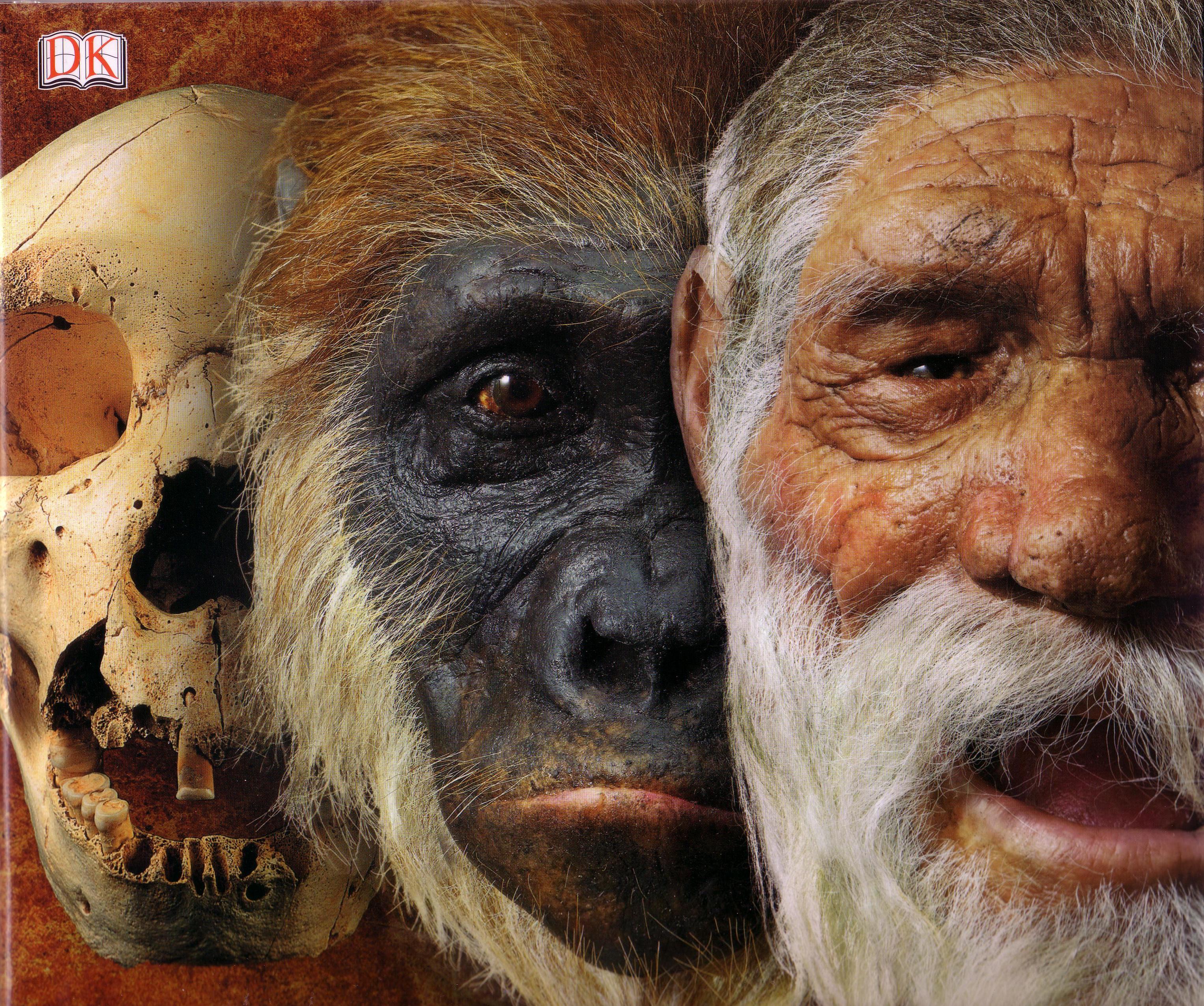
alicerobertsevolutionbAlice’s new book (we pretend to be on a first-name basis with her, in my household), published by Dorling Kindersley, is called Evolution: The Human Story.  It uses narrative, model reconstructions, photographs, illustrations and charts, to take the print medium’s slower-paced (but thrilling) look at the history of our species, starting with the Big Bang. Such a rich resource for a class to use!

A third “if” thought: I would explore the idea of privacy, which matters a lot to 11- and 12-year-old people, and keeps coming up in the news.

Resolutions

One of my most faithful readers wants to know why I haven’t yet written about some teaching and learning that was central to my teaching life:

  • about the evolution of life in general, and about human evolution more particularly;
  • about animal behavior and archaeology and the history of technology;
  • about immigration, both chosen and involuntary, in the history of our country and our communities and families;
  • about Islam and the Arab world and the history of Arab Spain;
  • about The Voyage of the Mimi, both the first and the second;
  • and about the making of Voyage to the Sea.

Instead of writing about evolution, I guess, I’ve been evolving. (I know; I’m using the word in two of its different senses.) Somehow I’ve had to work up to those topics, and also work down with them. They’re all so huge for me, giant human artifacts around which I’ve spent all these years crawling, like an ant in the jungle, climbing up and looking around whenever I felt brave, or whenever a student was nudging me onward.

However, I’ve just made that list. I’ve included some of it sideways, in this mixed salad post. I’m pledging myself to figure out ways of exploring those giant thoughts in 1000 word packets, before my year to think it over is over.

I welcome, and probably need, suggestions from readers who shared those themes with me as student or parent or colleague or cheerleader. If you were writing this blog, how would you tackle all that big stuff? Just askin’.

In an activity so solitary (except for the joyful throng of co-conspirators in my memory), tiny encouragements from the rest of the world mean so much! A quick note in an email, a side comment in the aisles at Colella’s, a post on a website generated on the other side of the planet, devoted to a much-admired author–each of these remind me that I’m really doing this, and parts of it matter to other people. Some of you have recommended the blog, or a particular post, to friends and relatives and colleagues, or on Facebook; some of you have written comments on the blog itself, invariably thought-provoking, nudging me and lifting me forward. For all that…

goofygraphicsthanksRecently, my daughter has been sharing a website or movement called Lean In, which encourages women to lean into their ambitions, to overcome fears and take risks, with each others’ support. I take a big breath and “lean in” every time I publish one of these posts, and I’m inviting you to lean in with me, women and men (and girls and boys)–whatever that may mean for you.

Math Mentors and Math Games

Early in my graduate education, I took a Lesley University summer school course about teaching mathematics, with a genuine, fresh-from-the-trenches middle school math teacher, Lloyd Beckett. Authentically–and contagiously–he had come to believe in the power of math conversation, and in the rich gifts students with different approaches could offer each other.

Lloyd’s course woke me up as a math teacher and as a mathematician. For years I had assumed that my relatively decent math grades rested completely on my ability to memorize. As it stood, that was largely true. When I did particularly well on one of the New York State Regents exams, my teacher, Augustus Askin, whom I adored, looked at me and said, “How did you do that?” Although I don’t think he suspected me of cheating, he had seen the puzzled look I often wore in math class.

Memorizing was okay for the test, but the effects never lasted very long. Real understanding, for me, required experiences that math class rarely offered–that I couldn’t even imagine math class offering.

On the other hand, in secret, generating that puzzled look, I’d spent years figuring out my own approaches. I could hold onto math concepts, and work with them comfortably, if I experienced them pictorially or concretely, or told stories about them. This was in a time, though, before math manipulatives, at least in my country schools, and before the wonderful math videos I was able to use with my own students, decades later.

There were exceptions. A little girl for whom I babysat had one of those balance toys with numbers weighted to add or subtract properly. If you hung a 5 and a 2 on one side, and a 7 on the other, the balance came to rest with the pointer in the right place to mean yes.

Here’s a sample of a similar balance still on sale.

math Plastic-Bear-Shaped-Digital-Balance

Other, purer versions make more sense for older kids, but I spent a lot of time playing with that balance, savoring it. It was what I needed.

I’m also stubborn, and I hated subtracting. All on my own, with no support from the rote-memory approach in school, I had figured out a way of subtracting by adding, doing a sort of mental algebra: what plus 5 will equal 7? Or what plus 9 will equal 17?

In my earnest little heart, though, I suspected that I was cheating. I thought I was making up for not being good at math.

Years later, when I spoke with parents at math curriculum nights, I sometimes called myself a “born-again mathematician.” Teaching math with new math tools and toys and approaches, and with new respect for many kinds of math minds, I found that I loved math, respected my own math learning style, and got a huge kick out of helping all sorts of kids come to understand new math ideas and feel new math power.

That marked me for life, evidently. In my current pause from teaching, any time a math idea sails into my day, I grin and go with it. So, for any of you who feel math deprived, just through the holiday, or in your everyday life, I offer a few math games.

The first two aren’t really games, just reflexes.

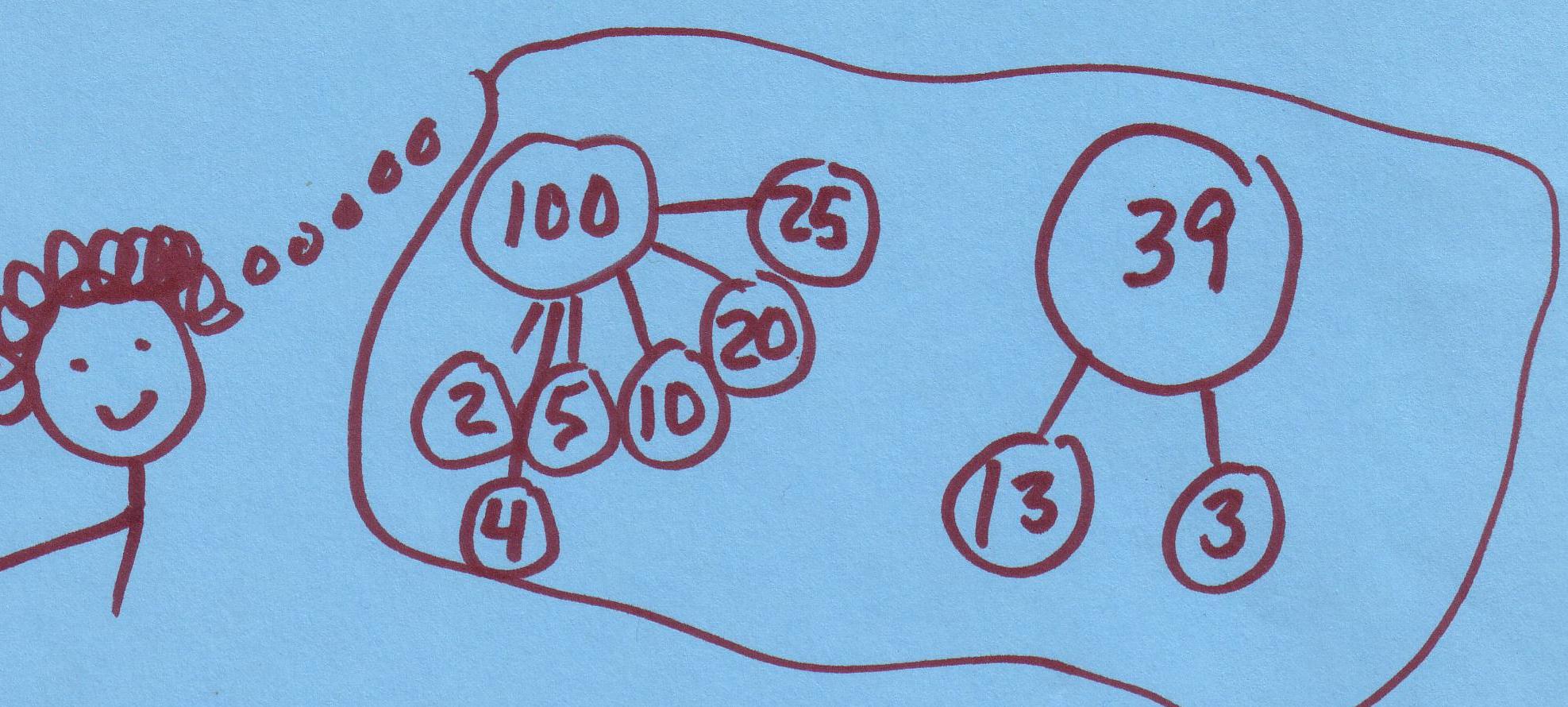
When I tear myself out of whatever book I’m reading, I play with the page number as I walk away. 139. Hmmmm: is that prime? It might be, since none of the proper factors of 100 overlap with the factors of 39…

thinkingabout139 cropped

When someone in our family has a birthday, I figure out the prime factorization of the new age. My father recently turned 92. Let’s see: 2 x 46, or 2 x 2 x 23. Suddenly I feel, inside the 92, an 80 (4×20) and a 12 (4×3). Oooh, cool.

Last year, my daughter’s children were both prime, 3 and 7. As of a few days ago, they are both powers of 2, having turned 4 and 8 (or 2×2, and 2x2x2.) Abe is now twice as old as Julia, and that will never happen again.

What official-sounding thing can we call this? A mathematical storytelling impulse? It works for me.

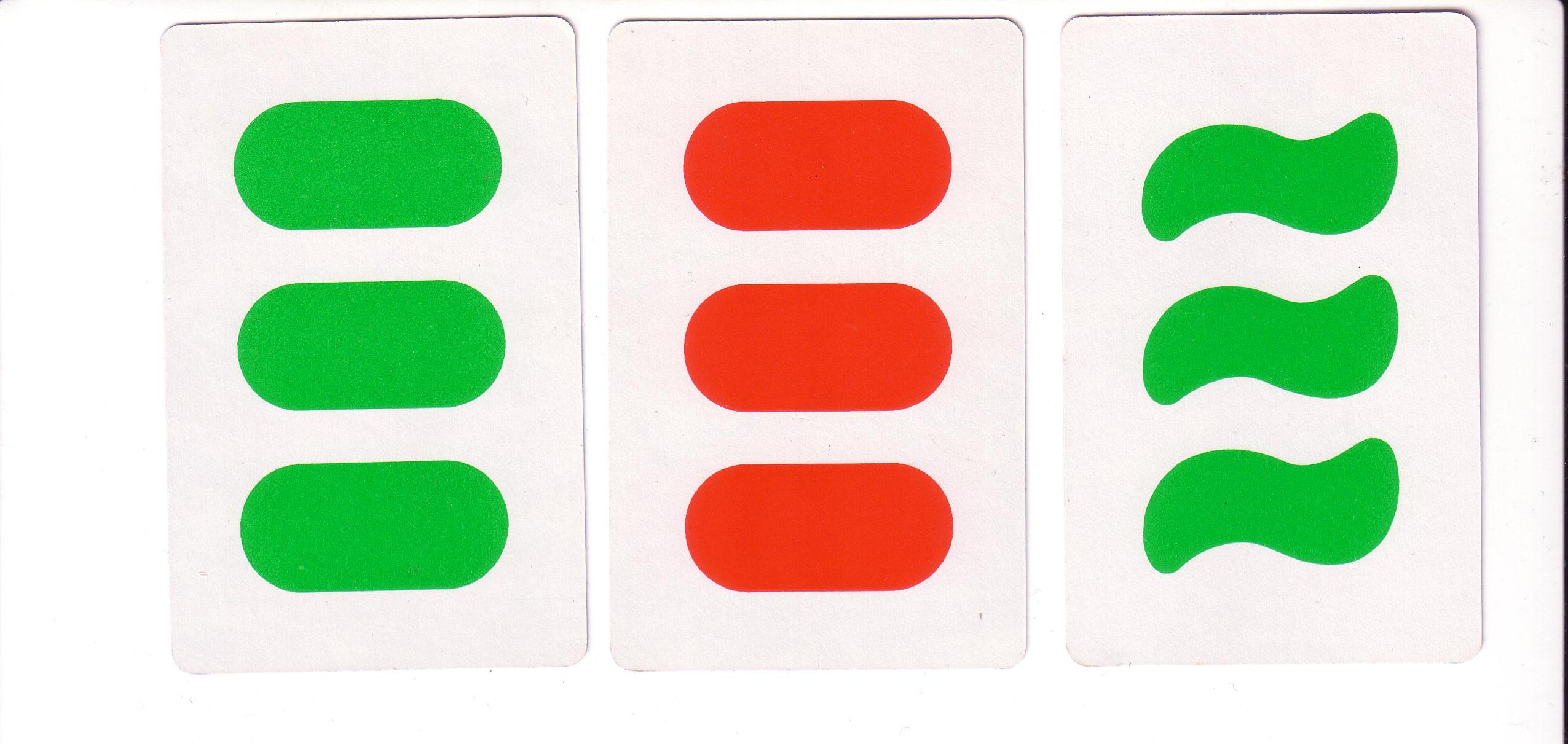
But other things can work, too. I’ll never forget the day my kids and I stopped by Kate Keller’s house for a quick visit, and learned now to play Set, from watching her play it–because she refused to tell us the rules. Obsessed, we came home and made our own version out of file cards. Later on, watching my students play Set was like giving them a diagnostic test. Some kids were quicksilver zippy at Set, and slow at everything else that happened in class. Some kids were slow, as I am, but warmed up as they went along. Clues, clues. And hilarious fun: in math choice times, I had to limit the number of kids who could play Set together, because that corner would get so loud.

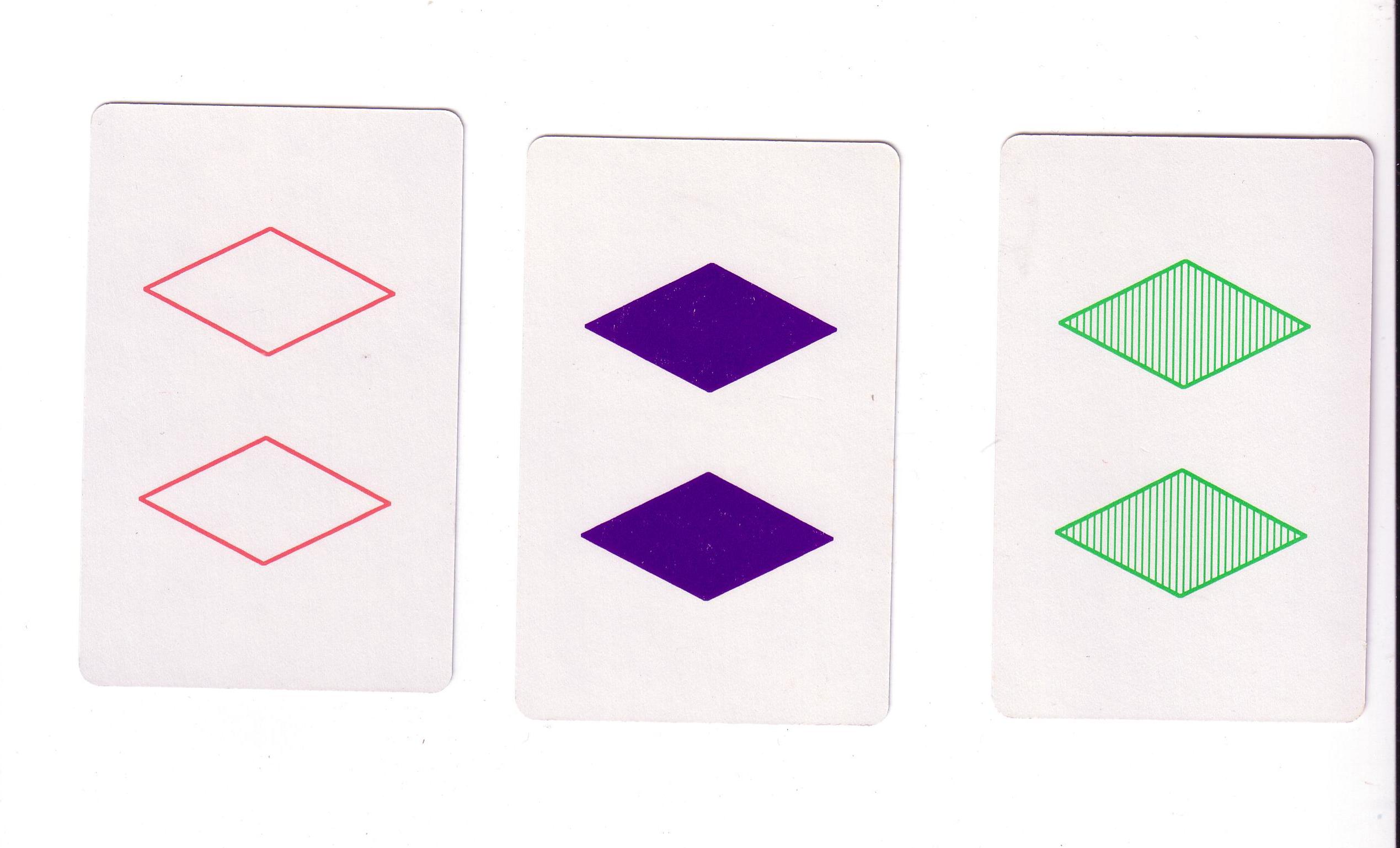
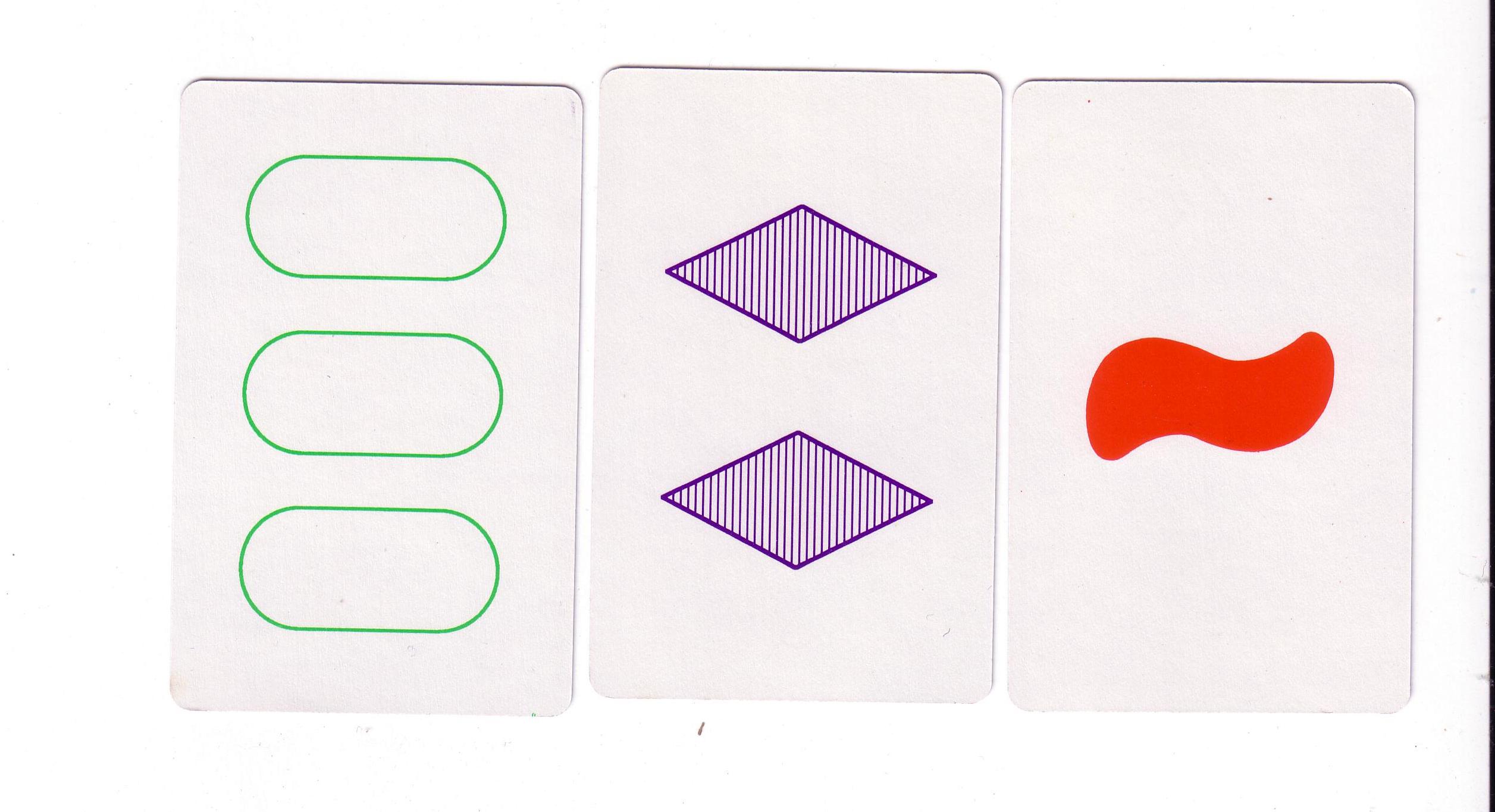
This is not a Set:

not set aNeither is this:

not set b

But this is:

set c croppedand this is:

set a…and this is a particularly delicious Set:

set bTo learn more, you could track down Kate Keller, my all-time-most-important math mentor, who has more fun with math than anyone else I know. She also perceives and nurtures students’ math individuality with something I can only call math compassion, a power almost magical.

Or follow this link to the Set Wikipedia entry; it’s fascinating! There are ways to play Set online now, too–a discovery that could sharply curtail my future productivity.

Finally, Lloyd’s Game. Of course, he probably called it something else. I’ve sometimes imagined Lloyd just up and quitting when one of his best whole class math games no longer worked. 1999 was a great year for this game, but the very next year, 2000, was hopeless.

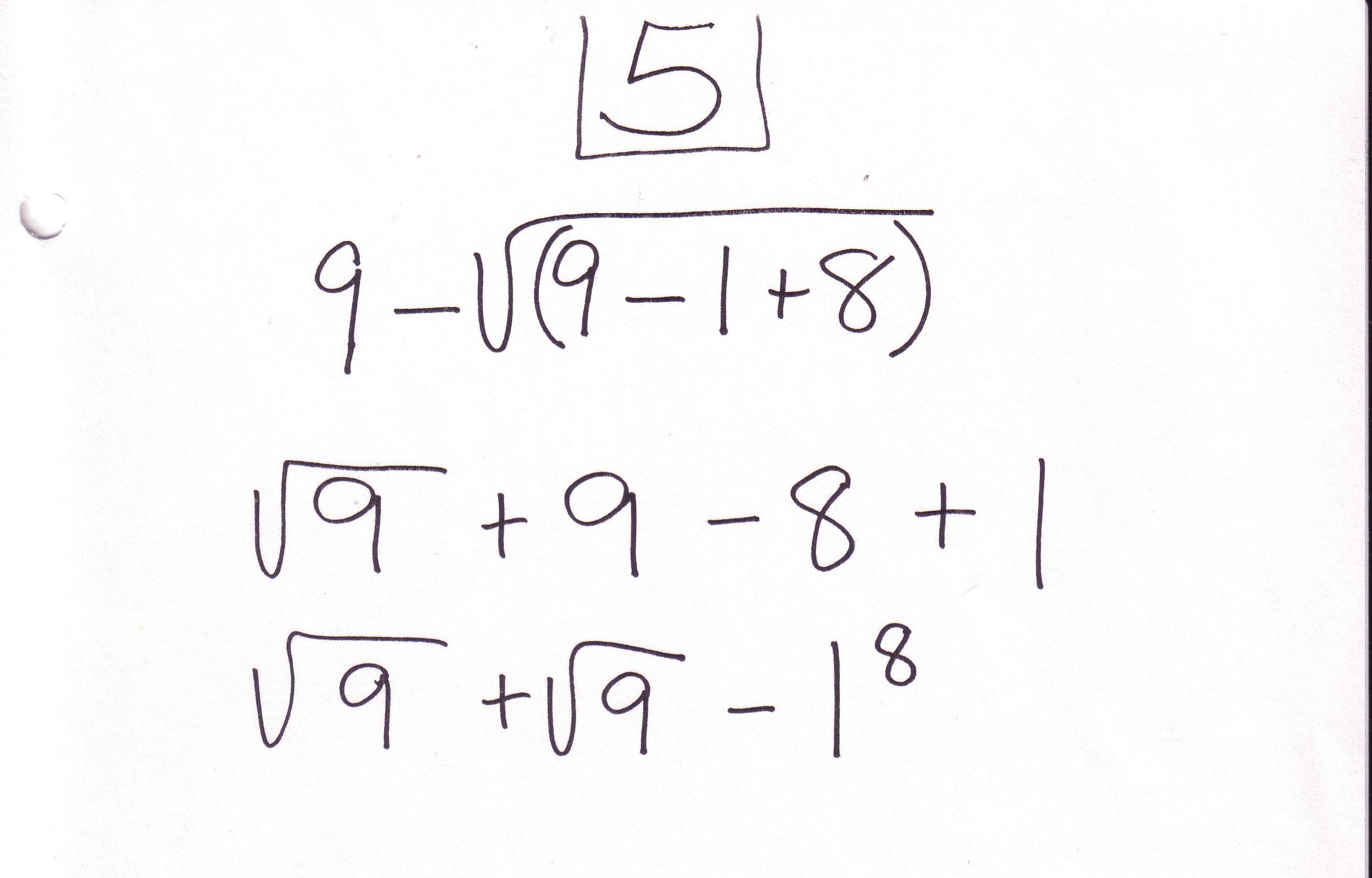
In Lloyd’s Game, you have access only to the digits in the Gregorian calendar’s count for a given year. You combine those with math symbols (no quota on those) to create expressions equaling the numbers from 1 to 100. You must use all four digits in each expression, and you may not use two-digit numbers made from combinations of digits (although I remember resorting to that a few times when nothing else worked.)

Generally, in class, we used the new year’s digits to create the numbers of the days in January, catching up with a burst of activity when we came back from the holiday break or weekends, but mostly targeting each number as it came up, day by day. We used the basic operation symbols, + — × and ÷, along with parentheses, the fraction bar, the square root symbol, and the exclamation point meaning factorial. We were allowed to use a number as an exponent, so 1 to the 9th power was an excellent way to dispose of a superfluous 9.

Here are two examples, using 1989:

Lloydgame27and2 cropped

The best fun came in class, as we compared multiple ways of arriving at the same target number. Gradually, as January progressed, we watched and cheered breakthroughs for kids who had initially feared the game’s challenge.

Here are three ways of making 5, from one of the posters we hung up around the room, again from working with 1989:

LloydGame cropped

After 2000, a flop for obvious reasons, we sometimes used the year in which the largest number of kids in the class had been born. Sometimes I chose numbers relating to our themes: the year Charles Darwin was born, the year the Blackstone Canal was first opened, etc.

Try it out, alone or with some pals. You can use the birth year of your favorite politician—they’re all still creations of that wonderful (for this purpose) century past.

In any case, life is short. Go ahead and feel human. Play with math while you can!

Word Ladders, Snowball Poems, and Dictionary Pickle

Just before Thanksgiving, I wrote about the pleasures of playing with words. Apparently, getting-together times put me in mind of folks with whom I’ve savored our fabulously mongrel language.

I don’t want to slander all those other languages I’ve tried to learn but can’t speak worth beans. Still, I’m here to testify: I love English, with its many origins all braiding together into a zillion ways of saying almost anything, and its individual words revealing themselves as artifacts of long grassroots change never legislated and rarely neatened. It’s a mess, our language. Hooray!

The syllable game I described in that post can be a way of peering into a word’s history. It’s like sending off a sample of your blood to find out which long ago human voyages came together to be you. A look into the dictionary, to check on syllabication, can reveal aspects of a word’s genetic code. What other words are related? What parts does the word share with other words? If you’re using the kind of dictionary that gives information about a word’s origin, you can really trace your word’s genealogy.

The Syllable Game is particularly good at getting kids to see a word simultaneously as a whole and as its parts. That’s a crucial skill for future reading about history, geography, politics, sociology, or any sort of science. If you can’t break a word apart for help pronouncing and understanding it, you won’t be able to connect the word on the page or screen with the word you’ve heard in class, or the related words you already know.

Many word games help the player notice the ways our language is modular, like Lego, composed of small units that get combined–and that’s part of its genius. English is a good language for describing the world, because a word can be prefixed or supplemented to become more accurate. Like the mental flexibility that let early modern humans solve problems all over the planet, English is an open-minded toolkit, with an ability to morph that lets us all speak more clearly, whatever we want to say.

Deborah Melone, a fellow member of Every Other Thursday Poets, introduced us to Harry Matthews, who taught us a number of word games designed to get folks started writing. Teaching them, in turn, to my students, I discovered that these games work well for kids.

Word Ladders

You can use a word ladder to change a cat to a dog:   cat / cot / dot / dog. The rules are simple:

  • You may change only one letter at a time.
  • The changed letter has to remain in the same position within the word.
  • All the steps on the ladder have to be real words.

A Scrabble dictionary can be a great help here.

It’s fun to reconcile opposites, but they both have to have the same number of letters. (There’s no way of changing night to day in this game.) Wet to dry seems like it’s going to be hard, but here’s one way: wet, set, sat, say, day, dry.

The words don’t have to be opposites, though. Going from crow to hawk is tricky, because vowels and consonants change position in the words. When I tried this one, my ladder list was fun to write from, embedding each step in the ladder in a new line of a poem–a poem that lured me into territory I wouldn’t otherwise have explored. That was Harry’s point.

It’s also fun just to play open-endedly, and see where you arrive. Watch for the words that are dead-ends, and think why. You can always backtrack and keep going.

Or experiment to see: what’s the limit on word-length that can work within these rules? Can you do a ladder of six-letter words?  Ladder / sadder / sander / sender…  There must be some way to get away from that er.

Snowball poems

Deborah became a brilliant practitioner of another Harry Matthews word game: the snowball poem. Here’s one of hers, from our anthology Something Understood, published by Every Other Thursday Press:

sad
lost
angry
always
needful
something
completely
unavailable
inaccessible
inappropriate
nevertheless
obstinately
determined
insistent
stubborn
growing
wildly
happy
some
way

I just noticed a place where this breaks the rule, which is to add or subtract just one letter per line. (It’s always lovely to have proof that rules are meant to be bent.)

One of my former adult students, Chuck Jackson, started a snowball poem like this:

I
go
out
from
these
places
seeking
Paradise


I’d give anything to find the piece of paper with the rest of that.

Dictionary Pickle

Here’s another game I invented myself, which can be played solitaire or with a partner. You need a dictionary that really works for the kid playing, that isn’t too fancy.

The first player just starts with a word that is likely to have an interesting definition.

The second player looks up the word. Let’s say my partner just gave me the word solstice. I’m using the student dictionary at Merriam-Webster’s wordcentral.com, and I find this definition:

Function: noun
1 : the point in the apparent path of the sun at which the sun is farthest north or south of the equator
2 : the time of the sun’s passing a solstice which occurs on June 22nd and on December 22nd

As the second player, I get to choose a word from that definition, and I’m going to choose equator.

My partner looks this up, and he and I go on a little detour over the idea of the celestial equator, but he decides to stick with the definition of equator, from which he chooses the word imaginary. 

When I look that up I choose unicorns. And so on…

When students play this together in class, or with an older person at home for homework, I ask them to list the words, with just brief versions of the definitions from which the word for the next turn was taken. It’s important to ask kids to do some recording, I think, and equally important that that not be so onerous as to eliminate the fun.

Debriefing, I’d have each student tell us about one word on the list new to him, or a word that she’d like to use in her writing.

White-board Fun

Actually I’m not really going to write about this now– I’m going to stick with my self-imposed word count target, for once. But here’s a photographic preview. (This is like Jeopardy: What was the direction?)

white board lesson


My Place and Our Places

Last week, I focused on the book My Place, by Nadia Wheatley and Donna Rawlins, in which a series of child narrators describe the place where they live–always the same place, on the same hillside, changing as the book moves backward through Australian history. Each of the child narrators has his or her own sense of that same place.

What builds a sense of place, for any of us? What do we even mean by that? What can adults do to give kids a sense of place–or to stay out of the way of their process of developing one?

The book My Place inspired Our Places, a book created by one of my classes in the spring of 2010, when the kids with whom I had worked that year decided that they wanted to make their own maps of their own places, and put them together into a book.

We had discussed other final group projects, but this was the one they chose. “Only it can’t be different years, like My Place, because we’re all living in this year.”

“Just our different places.”

“And we’ll tell about the same kinds of things.”

Here’s a detail from Anwyn’s pages: Our Places Anwyn 1 detail

Pets

By “the same things”, the kids meant the motifs we had noticed in My Place, and then listed, common threads from child narrator to child narrator. For example, in both books, My Place and Our Places, almost every child’s place includes a pet.

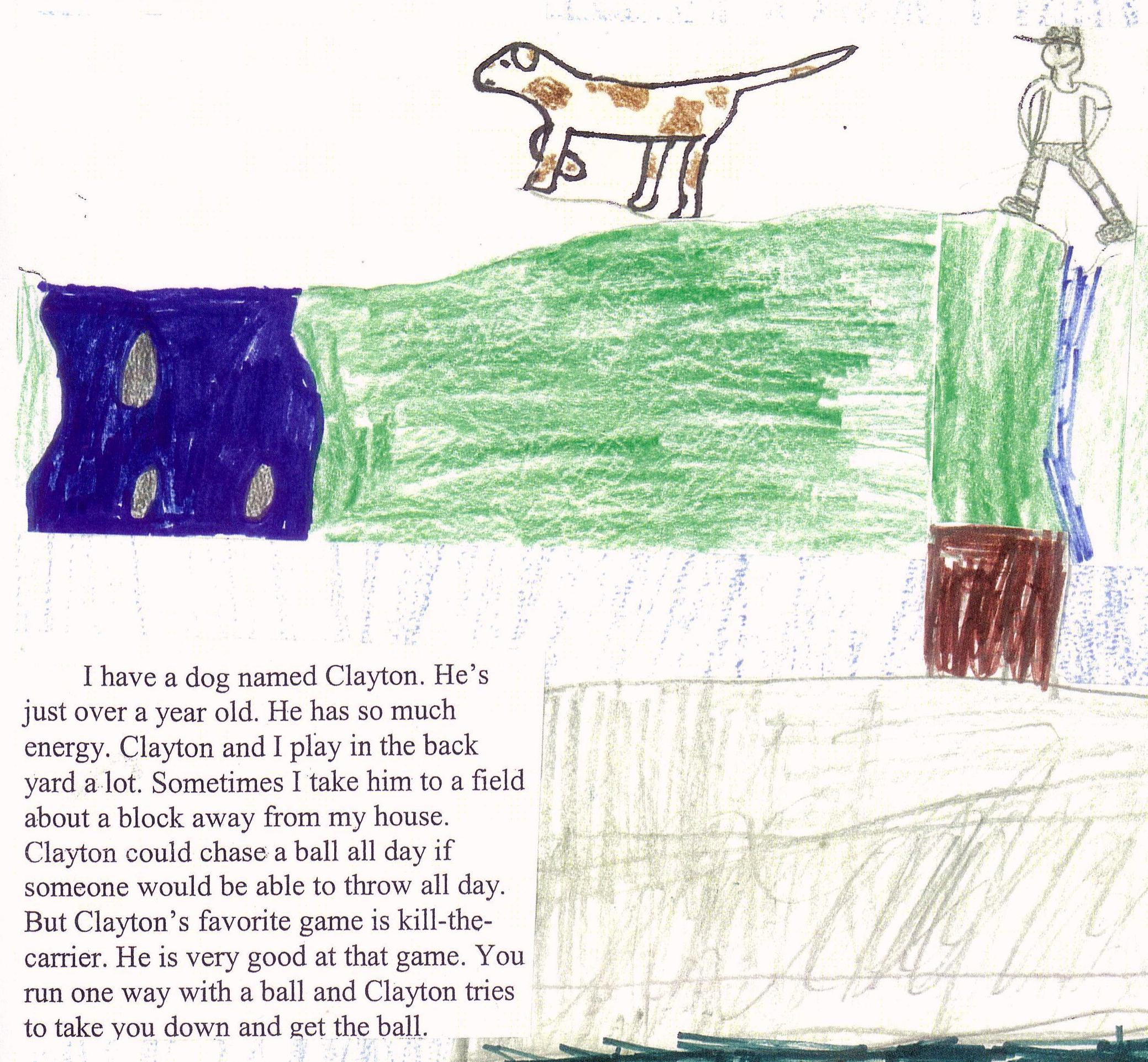
Jose wrote about his dog, Clayton. Our Places Jose 1b detail

Other kids wrote about cats named Oliver, or Shelly, or Scout. One described a parakeet named Tweety. Our Place Isy 1b detail with Penny

Another wrote about her hen, Penny, who is “smarter than the other chickens and always bosses the other chickens around, even though she is the smallest.”

Parties

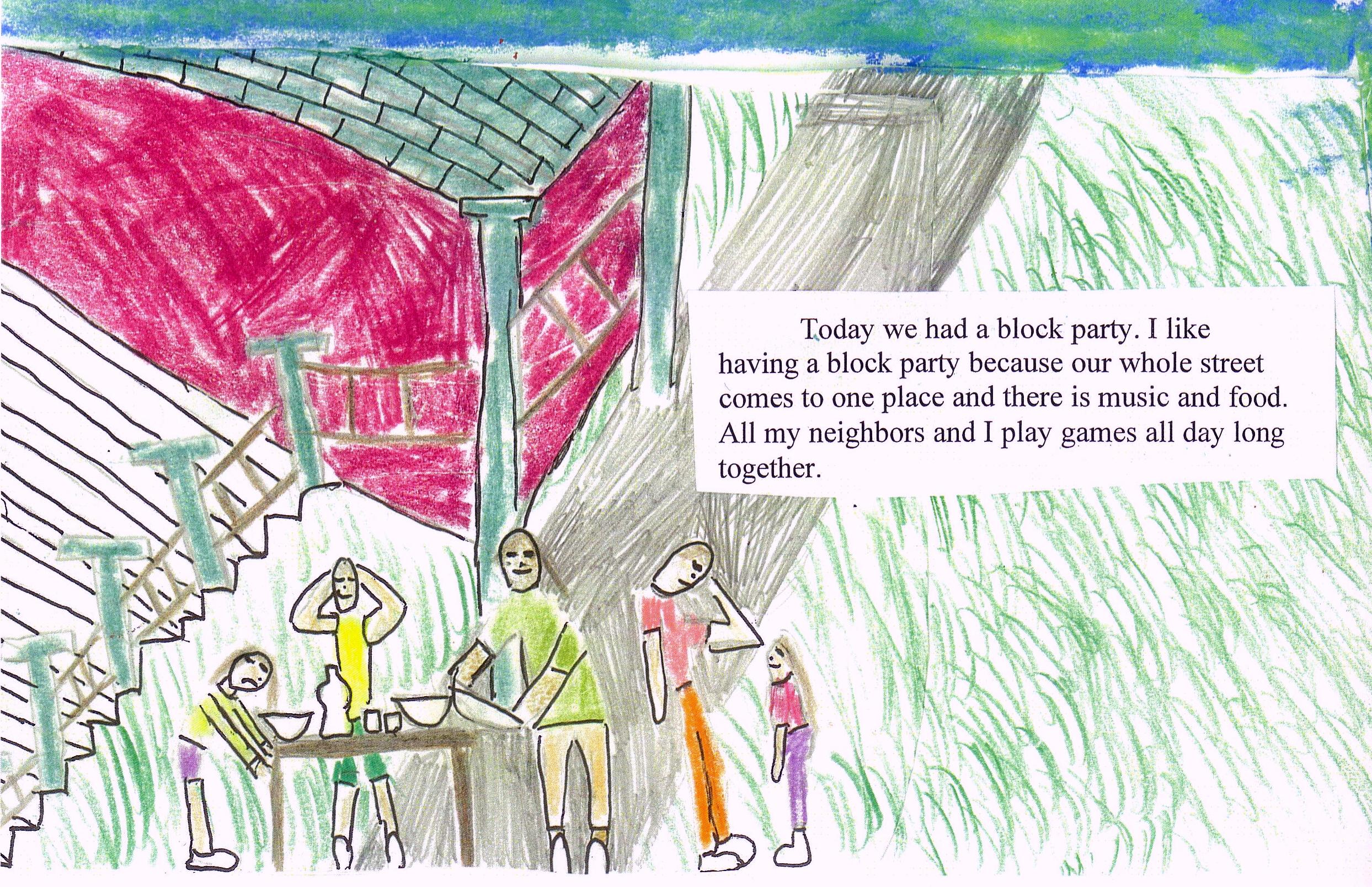
In both books, there’s always some kind of party. Luke lives in two separate houses with the two sides of his family. He decided to write about the place where he lives part of the week with his dad, in a section of Boston. Our Places Luke 1 block party

The detail below is from Caroline, who had already explained that her next-door neighbors were “almost like grandparents.” Our Places Caroline 2b party detail We didn’t coordinate which kinds of parties which kids would write about, but we wound up with an interesting variety: birthday parties, generic summer parties, a Halloween party, a Super-Bowl-watching party, a Fourth of July party with lots of fireworks, a Christmas party, and the gathering to send a big sister off to her prom.

“Some of the parties in My Place are for sad occasions, not happy ones.”

“Like Michaelis going away to Vietnam.”

“Or Thommo’s family getting thrown out of their apartment.” 

“Or there’s the time when the war is over, and some people cry because they’re glad the war is over, but sad that their boys aren’t coming home.”

“But that year’s kid walks on stilts and gets everyone to stop crying.”

Connections to the past

We talked about what the students could include that would be like the giant fig tree at the top of the hill in My Place, a landmark experienced and valued by every child narrator across a 200 year span.
Should the students each focus on some natural feature? They settled on just something old: an old tavern, the stone walls along which chipmunks and squirrels run, an old car, cemeteries, a big rock.
Our Places Dean 1 rock detail

 Freedom

Growing up in a time when some kids are asked to check in with their parents by cell phone as often as every half hour, my students had been interested in the way the My Place kids roamed all over their neighborhood or hillside, with and without permission. Although we hadn’t chosen it as a common thread, several students wrote about their range of freedom, and how that had changed as they’d gotten older.

For example, Abby described being allowed to bicycle further: Our Places Abby bicycling detail

Another girl marked in green the streets on her map where she was allowed to walk by herself.

Maps

These were sketch maps, like the ones in My Place, made to scale as well as kids could manage, but not based on detailed measurements. (That would be another project.) Here’s Abby’s map of her newly enlarged territory: Our Places Abby 2 map Some kids made their maps more accurate with the help of published maps, by tracing or just looking at an existing map or aerial photo to get a sense of relationships. Our Places Nate 2 map detail Like the maps in My Place, the student maps told parts of each child’s story. Our Places Max 2b

So what builds a sense of place?

A sense of place can’t require staying put. In My Place, the final narrator, an aboriginal child, says, “I belong to this place,” instead of “This is my place.” But the place shown is just one of several places where that extended family stays for different parts of the year.

What would it be like to stay in one place? Barangaroo’s grandmother says nobody would do that; it would be boring. For sure, though, Barangaroo has detailed knowledge and a strong emotional connection with that place.

When I moved to the house and neighborhood I think of as “where I grew up”, I had already lived in seven previous places.

Our Places Polly map detailMany of my students spoke in discussion about special summer places, or even, for one, a place she’d been only once, but memorably. I too had been strongly influenced by places where I’d never actually lived, including my Maine grandparents’ dairy farm, and my other grandmother’s urban lot in Brockton, Massachusetts, where I met the kids who lived on the street, and established hide-outs in the bushes.

Who knows? The sense of contrast between a variety of places may focus a child’s attention on the uniqueness of each place. Our Places Matt treehouse detailIn any case, here’s what seems to be more important than duration: a child’s active experience of the place. To bond with a place, a child needs experience of that place within some kind of freedom to explore, to take risks, to know a range of emotions, to act on a sense of possession. To grow her own garden and decide what to plant in it; to build a treehouse with his uncle, or a dam across the creek, or to follow the path across the brook; to create a little secret get-away under a wisteria bush.

Each experience becomes a tag, a label on the mental map the child is constantly creating, partly unconsciously. Each tag gets reviewed with revisits either physical or mental. Few kinds of learning more clearly deserve characterization as constructive learning, learning fitted together and made coherent by the learner; learning that constructs meaning instead of receiving it–in this case, meaning that is especially deep and nourishing.

I’m struck by the importance of peers in this process of place-bonding: siblings, or neighborhood pals, or cousins, or even rambunctious dogs–fellow explorers, with their own impulses and their own hesitations, often useful.

Time on one’s own matters also, and this is demonstrated in all my students’ equivalents of the hide-out in the My Place giant fig tree: their solitary bike rides, walks over to Dean Park, and charitable activities for ants.

On the other hand, for anyone who thinks that young adolescents don’t care about grownups: notice the importance of both parents and other adults, the next door sort-of-grandparents, the almost adult who babysits, the neighbor who takes all the kids for a ride in his old car, while everyone squeals going around the corners.

I loved how much I learned about each of these students, in the process of learning about their connections with their places. Teachers have to live with various kinds of grief, and one of them is this: it’s not possible to do every wonderful thing with every class. But I can’t help wishing I could have, and sometimes, in a group of adults, I have an almost irrepressible impulse to give them this assignment.

(Maybe some readers will comment with labels you would write on your own map, if you made one.) (Or with your own map.)

When we agreed to make the book, I said I would figure out how to send a copy to Nadia Wheatley. It took several steps of contact, and involved some suspense. Eventually, that summer, a package came back from Wheatley with thanks warmly expressed, and with a wonderful surprise: a DVD of episodes from the video series made for Australian television in the year of the book’s twentieth anniversary, with extra episodes to carry the story to 2008, exploring new dimensions of belonging or not belonging.

The video is wonderful, and does special justice to the book’s theme of transcending differences. Still, I feel as I often do about film adaptations of books I love: the book means more to me. It’s less about excitement, television style, and more purely about the role of place in our lives, the responsibilities a place can grow in us, and the ways sharing a place can connect us.

My Place

We’re sitting in the meeting area–not in the circle we use for meetings in which we all talk with each other, but in the arc facing my corner, that works better for read-aloud books with illustrations. For a larger class I would need to make a Power Point. The intimacy of leaning forward, leaning together into the world of the book, can work here.

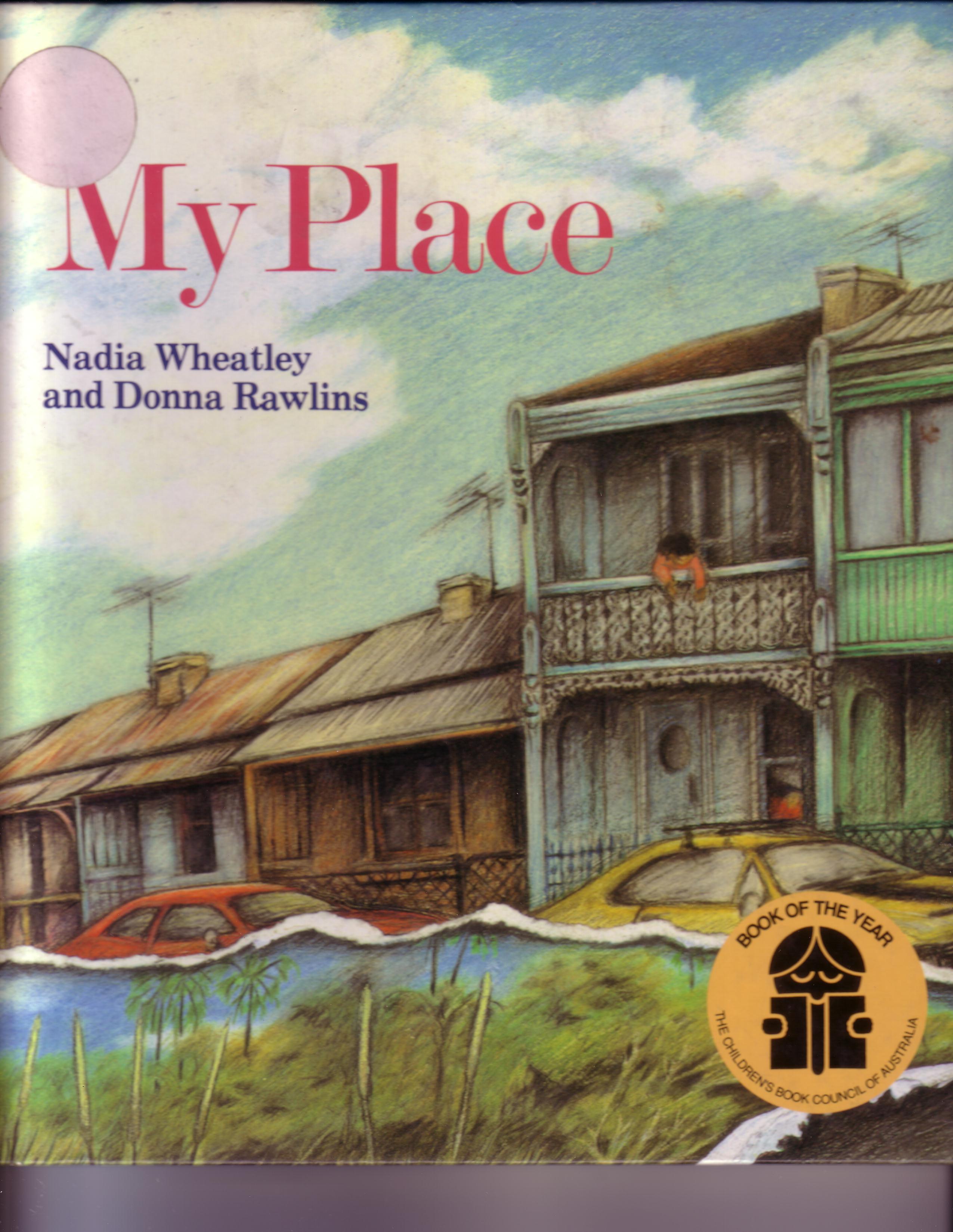
In this memory, I’My Place Nadia Wheatleym reading My Place, a book created by Nadia Wheatley and Donna Rawlins, originally published in Australia in time for the bicentennial of their European settlement. One of my early class parents discovered the first U.S. edition, and donated a copy. (Most of the copies I’ve bought over the years have been from the later U.S. edition, from Kane Miller, who bring books from other countries to the States.)

After that first reading, one crop of kids have linked to the next, and students spending a second year in my mixed-age class have said almost every year, “You should read My Place again.”

As I begin to read aloud, puzzled faces remind me that the book can be confusing. Each year, reading My Place refreshes my appreciation for the full, rich range of interests and attention styles represented among my students. I’ve learned to trust them: they’ll get it, together.

My Place 1968 editThere’s the kid who always notices numbers of any kind, including dates. She figures out, already on the second two-page spread, that we’re going backwards in time. “Before it was 1988, now 1978. The next one will be 1968.” It is, and that year’s child narrator, Sofia, has posters of the Beatles on her bedroom wall. She writes about an older brother who’s a soldier in Vietnam.

That step to the side–to a history both different from our own country’s, and similar to it–lets us notice things we may have been programmed not to notice. Kids say, “So they were involved in the Vietnam War, too?” “Both countries were settled by waves of immigrants?” Eventually, “This stuff about how the Aborigines were treated–it makes me think about our own Indians.”

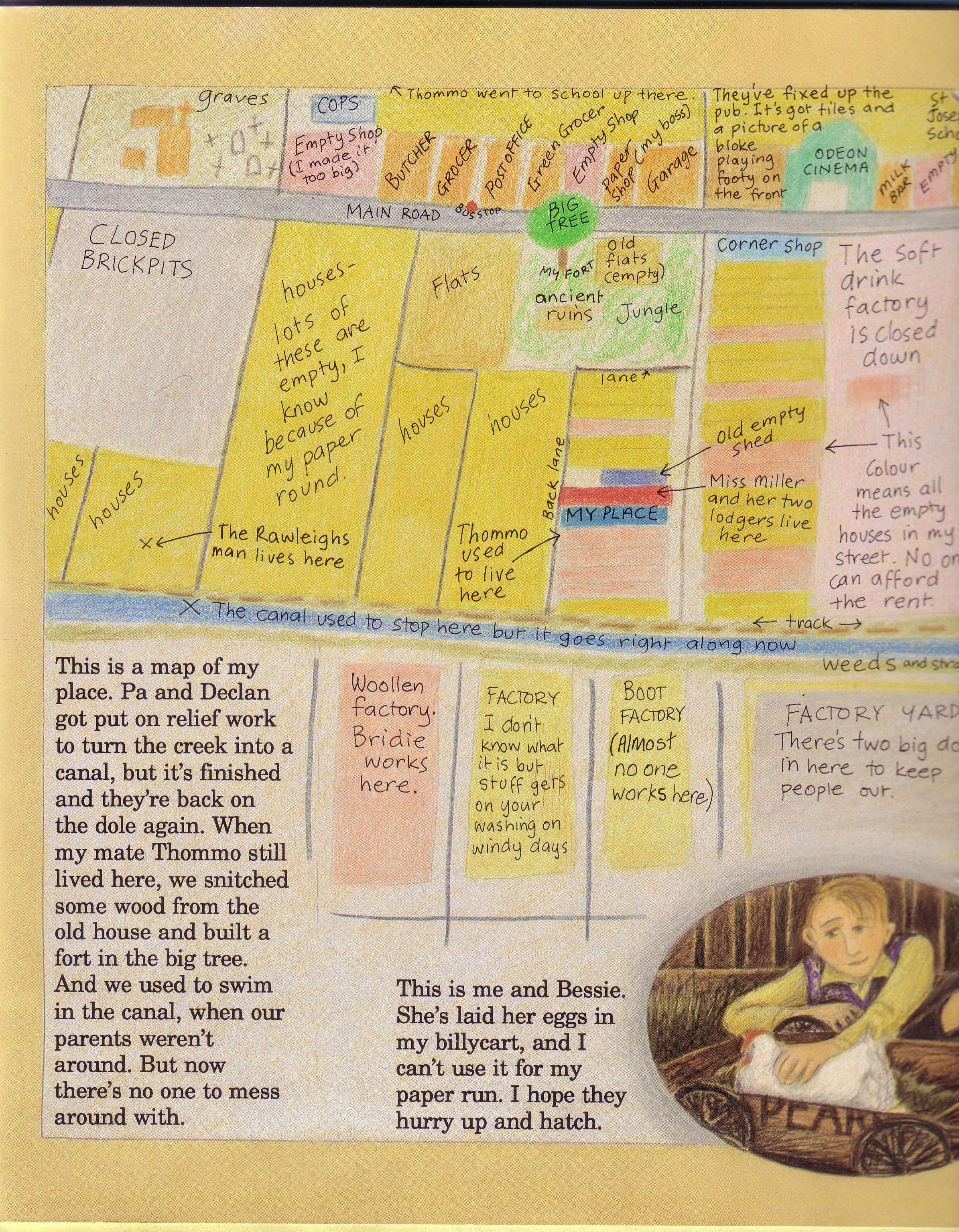
Always, at least one kid is especially interested in maps–visual records of things that stay in one place. He looks at the progression of child narrators’ maps, a new (older) one for each jump back in time, and he begins to imagine a similar map of his own neighborhood: how far from his house he would include in each direction; what scale he would use; what he would put in and what he’d leave out; what he would label, and what colors he would use for different kinds of buildings–all the decisions we’re meant to imagine the book’s child narrators making. (The map below is from 1938, which was a hard time in Australia, too.)

My Place map 1938 edit

Other kids make sure I read all the labeling on each map–partly because they’ve figured out that important clues are often embedded there.

Another kid is crazy about geography as lists and facts. She quickly picks up on the clues that we’re in Australia, something I try not to give away. Some years, we take this further: we use the detailed clues to convince ourselves that we’ve found the bay and canal near Sidney. (The map below is from 1838.)

My Place map 1838 edited

My Place 1898 railings and Miss Miller detail

Some kids are particularly able to pick up on detail in illustrations, and they’re the ones who say, “Wait! This is all the same house! Look at those railings!” Then we go back and compare, page by page: yes, yes, yes, yes.

My Place 1988 railings detail

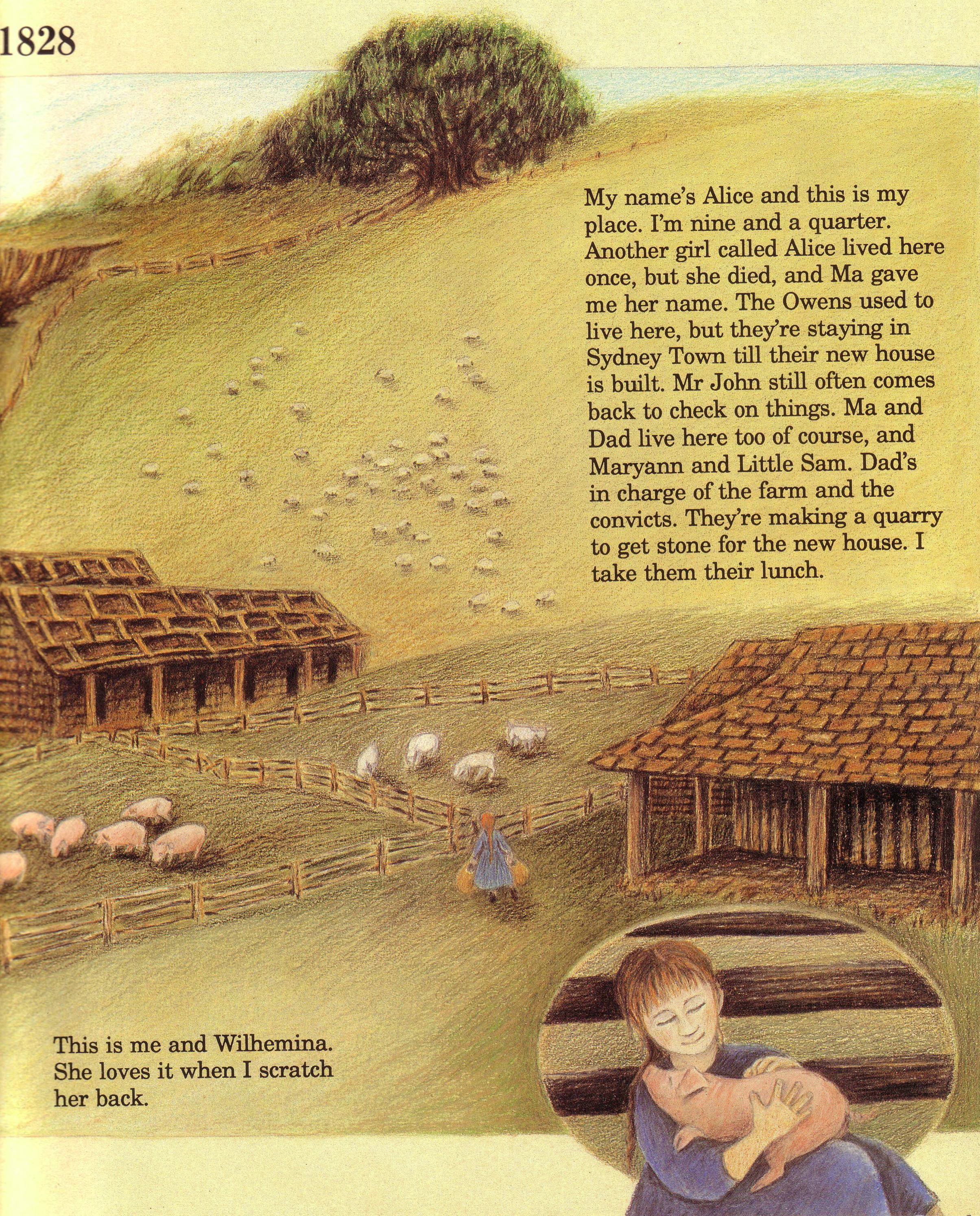
My Place 1828 hillside cropped And for much of the book it is the same house–each child narrator is the right-aged child living in that place–until the house hasn’t been built yet, and we’re with the sheep and pigs, on that hillside, below the big tree, above the bay and creek.

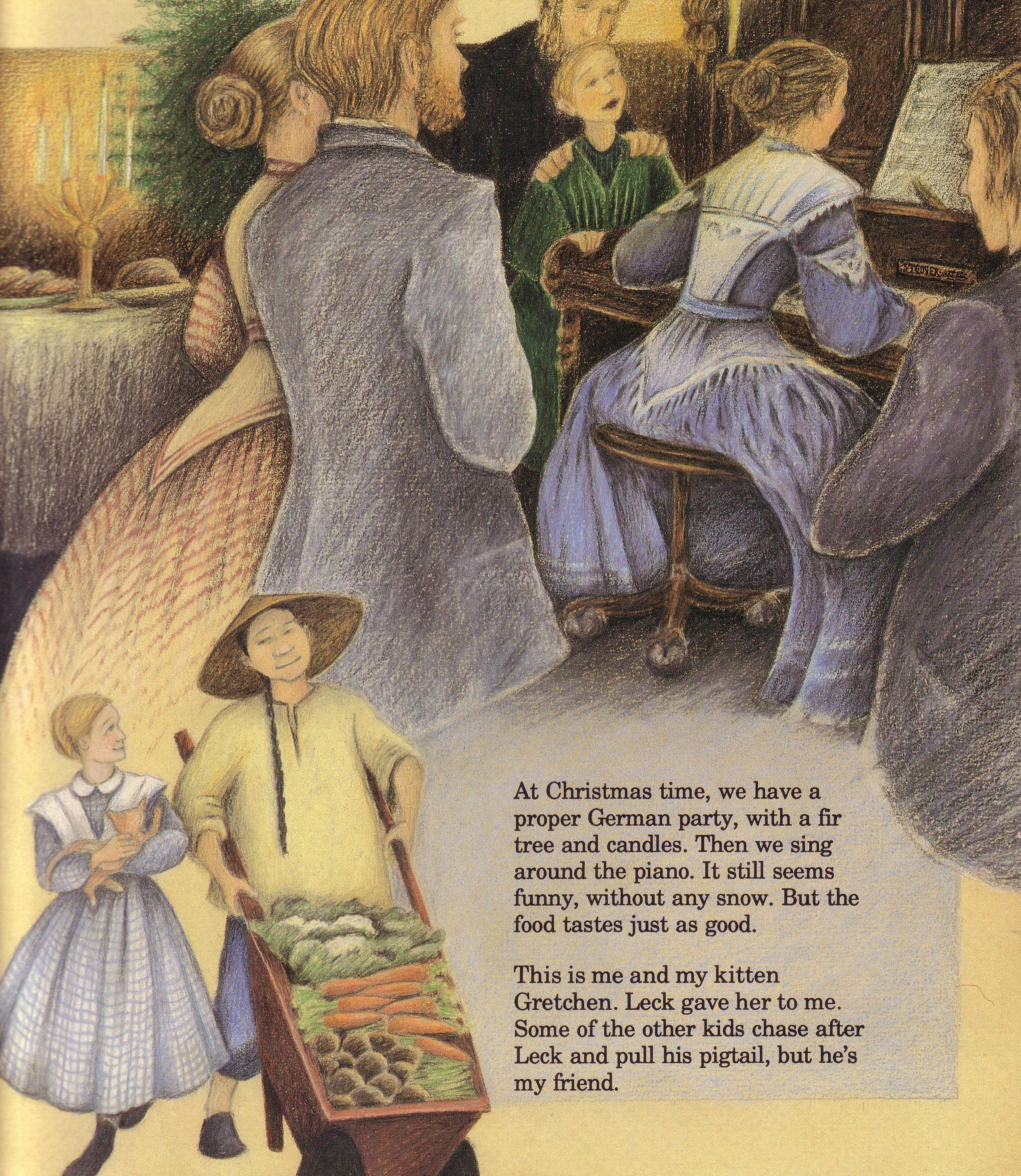
In every class, some kids will have unerring radar for family relationships, They’re the ones who first point out that Sofia in 1968 is the unwelcome baby sister in 1958; or that the Miss Miller who is almost 90 in 1948 is the zippy aunt with the bicycle in 1898, and also the nine-year-old Minna who makes friends with a Chinese immigrant vegetable farmer in 1868.

My Place Minna and Leck recroppedBy 1798, almost the end of the book, everyone has learned to follow these connections through the book’s strangely inverted time. When 11-year-old Sam, indentured convict laborer, climbs up into the big tree and pretends that he can see all the way to Shoreditch and his mother and sisters and brother, the class grows even quieter. They know that he will become the Sam remembered in 1838 by one of his children, the father who has fallen off the rich landowner’s roof, and died.My Place last map detail

I don’t want to tell about the actual ending of the book; I want you to go find it and read it, and join all of us in the complicated feelings it generates.

My Place and Place Based Education

There’s a new name for something I’ve always tried to do as a teacher: place based education, arising out of the resources of a place, helping students develop a sense of place, helping students feel responsibility to their place and empowered to make a difference there. (If this sounds good to you, you should go find the wonderful books David Sobel has written to explore place based education and document its effectiveness.)

Nadia Wheatley and Donna Rawlins were also doing place-based education before it was named that. Clearly, they created My Place to help Australian kids know more about their country, and to encourage those kids to know their own local and particular places, their personal equivalents of the big tree that is a landmark for every one of the child narrators, or the canal that was once a creek, or the ridge where the main street was once a footpath. Because there are so many narrators, the place itself assumes unusual importance.

I’ve always been fascinated that their book’s strategy works for American kids, too. Immersion in this other place encourages kids to notice their own places, and I’ll write more about that in a future post.

It seems to me that Wheatley and Rawlins must have wanted something else, too: they wanted to show their narrators experiencing the local versions of big picture history: the pros and cons of the immigration experience; the hurt of economic injustice and waves of joblessness; the recurrent mercilessness of war, and the injuries and losses and dislocations left in wars’ wake; the environmental impacts of economic development, as we travel back to a time when it was actually safe to swim in the creek. But also kids’ perennial delight at new technologies: streetlights! personal automobiles! television!

Within all that big picture stuff glimpsed small and made real, Wheatley and Rawlins have shown us each child narrator’s way of assembling and creating his or her own experience out of what is available. We see all the different reasons for perching or hiding in the big tree. We see the comfort children find in animals, and the things that can be learned about each child’s adults from the parties they throw.

Always, in each new older time opened out for us, something has been lost; always, something has been gained. Each child narrator exists within the river of time, which gives and takes away. The book itself, its spirit, becomes that river, revealed to us in a special way by the authors’ device of making it flow backwards.

For just a minute, I want to address directly all those years’ worth of kids sitting in a series of meeting areas together, taking up the book’s back-cover challenge: THIS BOOK IS A TIME MACHINE! Again and again, you showed me details and connections I would have missed by myself. But also, in the deep and brave way you experienced the book and its place and world, you helped me feel what it all meant, and for that especially I thank you.

My Place Sam in the tree detailThere’s more to this story: the book’s wonderful success in Australia, and its transformation into a video series, brilliantly updated to the present; one class’s decision to make a spin-off book called Our Places. For various reasons, I’m saving those things for another time.

Heels-over-teakettle, and Other Festivities

Today I’m thankful for all my fellow word-lovers, past and present.

I’m thankful for my grandmother, who chatted with everyone she met, and picked up other people’s conversational expressions the way a dog picks up burrs. She kept and passed on treats like enough blue sky for a Dutchman’s britches and one pickle short of a quart. Listening to my mother and my grandmother talk together–with a what in thunder is he celebrating? here, and a heels-over-teakettle there–marked me for life, in the best possible way.

Once again, I’m thankful for George Batchelder, brilliant junior high English teacher, the one who gave us whole class periods for the Times crossword puzzle. He also asked us to list, on a page in our notebooks, plausible but nonexistent words: words with English prefixes and suffixes and blends, that were nonetheless fake, of our own manufacture: beautaceous, recrunk, preventicate, loombipuddle.

I’m thankful for a host of word-crazy students, including Andrew Cozzens, who often leaned over at dismissal to confide his word of the day. Even after he had left my school, he wrote emails telling me wonderful words he had recently discovered, such as loquacious.

I’m grateful for the poets of Every Other Thursday, whose recent poems have included the words moonbeamedcantedphlegmatic, and loris, and the phrase crammed and nuzzling.

I’m everlastingly thankful for Alex Brown, and his children (who are also my children), and for our tendency, when together, to lapse into the synonym game without warning. Why stop with playful, when you can keep right on with lively, exuberanthigh-spirited, festive and frolicsome?

That leads me (inexorably, but also gleefully) to word games. Today I offer just a few, in honor of long car trips to and fro, and in tenderness toward family relationships more amenable to word games than to talk about affairs either local or international.

Warning: there may be a sequel, down the road. In my family, word games were not scarce as hen’s teeth; we were two-thirds wealthy with them. (What?) And then I went on to invent some.

First, my grandmother’s (and mother’s) special rules for Scrabble.

  • You may let a word edge over the boundary of the playing grid, by just one letter, any time you need to, in order to play a particularly satisfying word.
  • If you have the right letter to replace a blank, you may do so, and take possession of the blank, at any time; this doesn’t count as a turn. (My cousin’s wife Terry, during one particularly hilarious game, replaced a blank with a blank, but I can’t remember why, only the way we were reduced to mirthful tears.)
  • At the end of the game, everyone collaborates in an effort to place every last orphan letter on the board, in genuine legal words.

My mother, at 86, still won’t play Scrabble scored, because she wins so reliably that her opponents become discouraged (down-at-the-mouth, or even mad as a wet hen.) Once in a while, we’ll calculate the point value of a word just because it’s so delicious.

All my successive families have played the geography game in the car. My class used to play it when lining up for gym or dismissal.

  • The first player names a place: a town, a country, a street, a river, a mountain–anything that could be on an ordinary map. Let’s say Merrimack River.
  • The second player ignores parts of the name like River, focuses on the last letter, and comes up with a place name that begins with that letter. Given a K, the average person will say Kansas, but you can be playful–that’s the point, right?–and say Kalamazoo. I always try to, unless someone else has used it already in that game.
  • Small children may name a place somebody else has already used, if they need to, and anyone may have help with the spelling of tricky place names with ph making the f sound, like Phoenix, or endings that sound like ee but are actually spelled with a y. Etc. Our language, including our geographic language, is full of these opportunities, but adults should go easy on the pedanticism. (No, you won’t find it. It’s in the category of plausible but manufactured.)
  • You’ll want a good supply of place names that start with y, such as Ypsilanti.
  • Do not be alarmed if your game drifts into the dreaded A-swamp: America / Australia / Andalusia / Africa…  My class once made it through the entire line (becoming slightly late for dismissal in the process) using place names that begin and end with A. Like many hardships, the A-swamp arose there in our geography to test your indomitable spirit.
  • In the days of smart phones, it’s easy to resolve arguments about spelling. In my family of origin, I was definitely not the final authority, having the spelling memory of a flea, or maybe a rock.

Speaking of spell-checkers, you can play a solitaire word game by typing in the names of your friends and seeing what the spell-checker makes of them. Or follow the eight-year-old Colby Brown’s example: randomly type a paragraph entirely in gibberish; then let the spell-checker do its best; then write an actual paragraph around whatever words the spell-checker has found.

Last, for now, here’s a game that requires either a dictionary or, if there are no dictionaries available, a referee. It’s called the Syllable Game, and this one I invented.

  • We played this game many times beginning with the word Touchstone, the name of our school. Compound words generally work well, but the rules just require words of at least two syllables to start, and for every turn. In fact, you’re better off beginning with a word of three or four syllables. In class, this was often a word central to our current study. So, for example, transportation, or, for the purposes of the game, trans / por / ta / tion.
  • The second player comes up with a word that preserves one of the syllables of the first word. This is where you need the dictionary, to check the official syllabication of the word, which will often contradict your first impression. (On the other hand, there is nothing like a car full of people carefully enunciating the word metamorphosis to judge its syllabication. Just designate a syllabication referee as well as a driver, and you’ll be fine.)
  • In class, students were absolutely required to use a dictionary, which gave them great practice, exposed them to related words, and could lead to all sorts of pleasant detours.
  • The pronunciation doesn’t have to be preserved, but the spelling has to be preserved exactly. So trans / late or por / tion or im / por / tant could all work as second turns, but port / man / teau or tran / scribe could not, because the por has been changed to port, and the trans has been changed to tran.
  • Let’s say that the second player decides on trans / at / lan / tic. In a two-player game, the first player now jumps forward from that word, with all sorts of lovely possibilities: lan / guage or fan / tas / tic or at / ten / tion. Etc.
  • The syllable you’re preserving can show up anywhere in the new word, jumping from second syllable to first, or third to first–so long as it’s the exact same syllable spelled the same way.

Assigning this as homework, I asked students to play with a parent or older sibling, and to record the whole ladder of turns, showing syllable breaks. Parents notoriously resisted using a dictionary, but came up with wonderful words.

syllable gameFinally, for whole class play, to help the game move faster, I invented a variation called The Syllable Web Game, which we played on the spare white board at the front of the room. Any syllable on the board was available to  any player, even if it had already been re-used. (In the illustration, you can see how the ce from cement was reused in celesta, and then in celestial and cerulean and something I can’t read in the photograph.)

Usually we played this game during morning sketching time; sometimes also writing time and silent reading time. Players showed the syllabication and initialed their words, and then explained their meanings in the class debrief.

So now I bow, gratefully, to all the sources and innovators and playful practitioners of the language we share. It’s a very full room, and you’re all in it!

syllable Touchstone

Using Picture Books with Big Kids

Lately I’ve been trying to imagine my sixth-grade teacher, Mrs. Tuthill, reading a picture book in class, or letting any of us read one. Within the school day, I can’t remember being encouraged to read anything but textbooks. (I was lucky, though; I had a much younger sister to read to at home, and my mother was well on her way to becoming a children’s librarian.)

The people who taught my daughter and son in middle school, good and competent teachers, never used picture books, to my knowledge.

Right now, this minute, most teachers face intense pressure to demonstrate rigor and grade-level competence. I would be thrilled to hear about a sixth-grade teacher in my town, using picture books or urging students to include them in their own reading. I know it’s improbable.

On the other hand, the teachers who taught me how to teach, and the colleagues who challenged and nurtured my teaching spirit, all used picture books in inspired ways. I can’t imagine the life of each class community in which I was honored to work and breathe, without picture books.

It’s amazing what is controversial in this world.

Time of Wonder crop aSusan Doty and I were setting up our classrooms, chatting now and then. She said, “I think I’ll start the year with Time of Wonder,” a Robert McCloskey book I didn’t know yet. It seemed like a sweeter book than I would usually choose for my cool and savvy 11 and 12-year-olds.

Still, I liked it, and tried it out on them.  As I read aloud, the room grew quieter and quieter. I could gauge the attention of many of my listeners by their faces; could tell others were with me when they grinned at the book’s very subtle humor.

Like all the best picture books, Time of Wonder is powerful and efficient. Reading Time of Wonder together, my class and I shared summer, and summer adventures, and the inevitable ending of summer. We shared what it’s like to listen to adults talking about possible trouble, a hurricane coming. We shared what it’s like to sit with your grown-ups and sing through the storm, and wake up the next day to explore the branches and roots of a fallen tree.

A good picture book, like a poem, and like so much of our everyday storytelling for each other, means more than one thing by everything it means.

We talked about students’ experiences of a recent hurricane. The book had given us permission to admit to having been frightened–if we were–along with a model of opportunities for discovery everywhere–and we had had those, too.

Recently I appealed to past students on Facebook. What picture books stood out for them? Taylor Davis responded almost immediately, “The one about the red canoe… something about a boy and his aunt…I remember falling in love with it!”

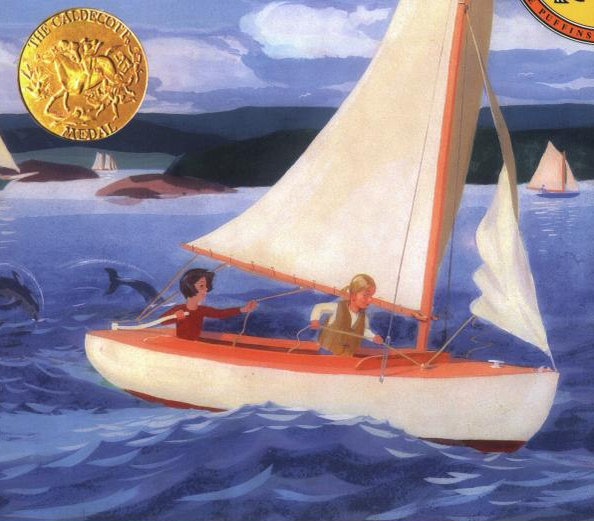
Three DaysTwo kids, two women who are sisters, a wonderful adventure with danger and glory, and a cat named Sixtoes waiting back at home for an offering of fish.

Some years I used “the red canoe book” as read-aloud to start the year, especially if we were going to be studying watersheds (or map reading, since they use maps to plan their trip.)

Some years, though, the canoe book waited with others to be chosen by individual students, out of a crate full of books brought from home, from my family’s picture book collection. That crate supplemented the classroom’s shelf of picture books, and another bin of books borrowed from the school library, and another from the public library. All together, kids could choose from an enriched and enlarged collection, in the two or three weeks at the start of the year when everyone read picture books during silent reading time.

That happened by my decree, a rare state of affairs which always met with some initial resistance. At home, for their official homework reading time (and, of course, in any additional time they spent curled in a tree or a favorite chair, or walking around a safe path in an open room) they could read the big thick fantasy novels in which they were immersed. In school, though, for those first few weeks, I needed to watch them choose, begin, read, finish, and pass along book after book after book.

go dog go p d eastmanIt’s true that I felt grave concern about a real and present danger: without my intervention, students might get to adulthood never having read highlights of English literature such as Go, Dog. Go! by P. D. Eastman–or never having read them with their new-found, big-kid powers of observation, and sense of irony.

We needed picture books to help us take ourselves less seriously. We also needed picture books to help us take ourselves more seriously, to take us on an express trip into important questions about life and the world.

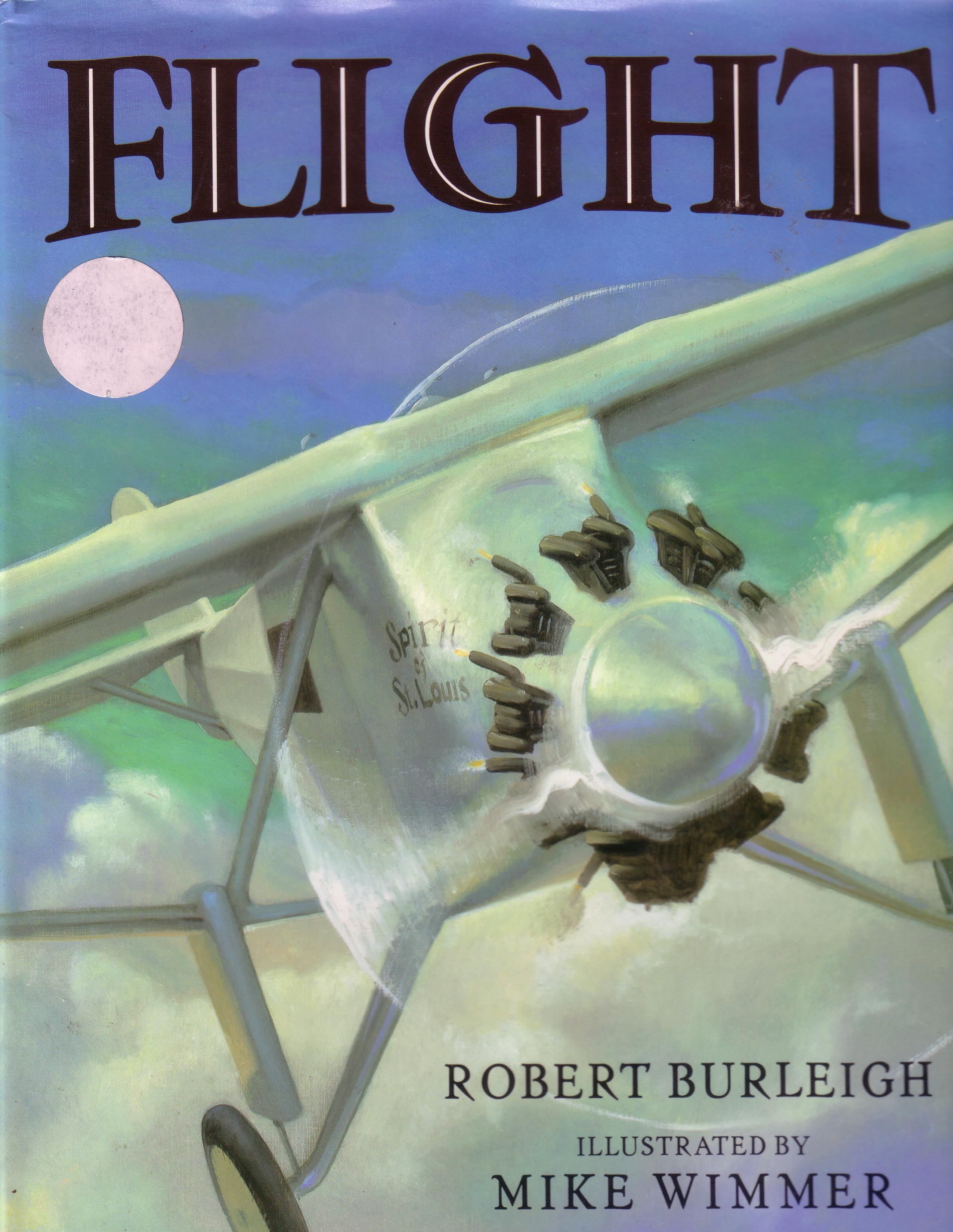
Jessica Unger, responding to my Facebook invitation, remembered Flight, in which the young Charles Lindbergh struggles to stay awake on his trans-Atlantic voyage. (In other words, in which the perils of lost focus or failing attention could be lethal.)

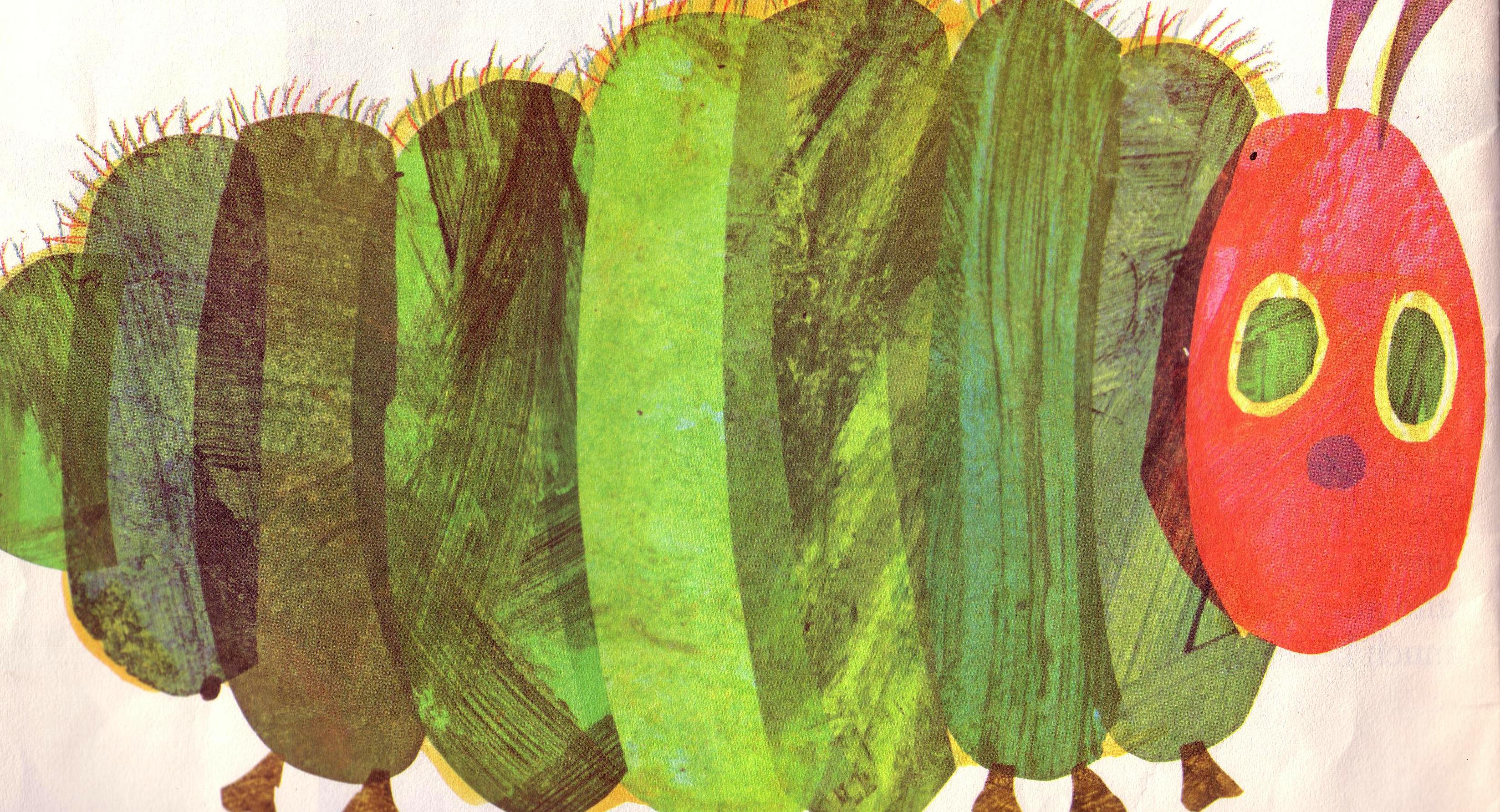
Flightt Robert BurleighSeveral past students remembered Eric Carle’s Very Hungry Caterpillar, in which eating and eating, and growing and growing, result in transformation.

Very Hungry Caterpillar Eric Carle cropped

galileo croppedUltimately, picture book season in September worked out well for everyone in the class, partly because many of the books I had gathered were what is known in the trade as “sophisticated picture books”, books definitely intended for somewhat older audiences.

Here’s one of many wonderful picture book biographies. This one, by Peter Sis, doesn’t dodge the horror of Galileo’s being put on trial for his life, for saying what he could see.

Non-fiction picture books could work well later in the year, too. If a group of students were exploring a topic together, reporting to each other on separate individual readings, the right picture book could enable a strong contribution even from a reader still overwhelmed by long blocks of text.

After the first couple weeks, for their individual reading, and for the read-aloud books we shared, the students and I mostly chose novels. I might suggest time with picture books for a student who had left her book at home, or a kid marking time until the next book in his series came out on Wednesday.

Frog Band and Owlnapper Jim SmitSometimes this detour back into picture books would become extended, as a student tracked down all the available picture books by a particular author, or discovered a wacky series that satisfied a taste for British humor, juvenile grade, like this one. (This is a page from The Frog Band and the Owlnapper, by Jim Smith.)

Often, also, a picture book or two could launch a new thematic study–launch in the sense of full throttle forward.

Henry Hikes to Fitchburg D.B. JoFor example, Henry the bear (Henry David Thoreau just barely in disguise) makes a case for his preferred mode of transportation–and a bet with a friend–to prove that hiking to Fitchburg takes no longer than working to pay for train fare.

rows and piles of coins

Henry’s argument with his friend opened a thematic study called Transportation Choices. Other picture books helped us think about people with limited access to choice: people in our own world unable to drive due to disabilities or aging–or youth; people in places where a bicycle can change a family’s possibilities. In My Rows and Piles of Coins, by Tololwa M. Mollel, a young boy wants a bicycle not just to ride, but to serve as a mechanical pack animal, getting farm products to market.

The right picture book could widen–powerfully, effectively, almost magically–our sense of “us.”

Miss Bridie straightenedBefore my school opened an older student program, all my 12-year-olds graduated from our school and became immigrants into the cultures of other schools. Immigration made a particularly strong thematic study topic then, and picture books helped focus on the choices made by immigrants, including what they chose to bring–which could mean how they chose to be prepared. Miss Bridie Chose a Shovel follows Miss Bridie across the sea, and then through her life in her new land, where she uses her shovel to plant, to clean up after a fire, to dig a grave. Here she is, walking away without looking back, setting out into her new life with her shovel in hand.

There are so many other wonderful picture books I’m sad to leave out. My Place, an amazing book from Australia, which I read aloud almost every year, I’m saving for its own special post. The picture books we used to explore ideas about evolution, ditto.

sailor dogFor now, just one more. Almost always, on the last day of school, I read aloud this book. If you were ever in my class, you may remember how we created instant background music for certain pages. Singing the final song, to the tune of Popeye the Sailor Man, was a great antidote for any tendency to get weepy, especially my own.

According to my daughter, I’ve given at least three copies of Sailor Dog to her children, Abe and Julia. “That’s okay,” she says. “It’s good to have one on every floor of the house.”

Some notes:

The round shapes visible on many of the books shown aren’t part of the illustrations. They’re just stickers that marked the books belonging to the classroom collection, or my family collection.

I want to give you publisher information here, in gratitude to the people who keep these books in print. Some are in fact out of print, and harder to find, but I’ve discovered that I can often locate used copies of old favorites through web sellers. So here’s the list:

Time of Wonder, written and illustrated by Robert McCloskey. Puffin.

Three Days on a River with a Red Canoe,  written and illustrated by Vera B. Williams. Greenwillow.

Go, Dog. Go! written and illustrated by P. D. Eastman. Random House.

Flight, by Robert Burleigh, illustrated by Mike Wimmer. Puffin.

A Very Hungry Caterpillar, written and illustrated by Eric Carle. Philomel.

Starry Messenger: Galileo Galilei, created and illustrated by Peter Sis. Square Fish.

The Frog Band and the Owlnapper, written and illustrated by Jim Smith. Little Brown.

Henry Hikes to Fitchburg, written and illustrated by D. B. Johnson. Houghton Mifflin Harcourt.

My Rows and PIles of Coins, by Tololwa M. Mollel, illustrated by E. B. Lewis. Clarion.

Miss Bridie Chose a Shovel, by Leslie Connor, illustrated by Mary Azarian. Houghton Mifflin Harcourt.

Sailor Dog, by Margaret Wise Brown, illustrated by Garth Williams. Golden Books.