Ancestor Pies

A few weeks ago, Chrissy Danko and I met for lunch. Every time I’ve thought about it since then I’ve started grinning. She is the oldest of four siblings, and I taught them all, sad to say goodbye to the last of them and to their parents. (‟Wouldn’t you like to have more?” I asked Joe and Joan, impertinent as ever.) It was a huge treat to sit and talk with Chrissy, and hear about them all, and hear about who she’s becoming as an adult.

When she came to me, Chrissy was so shy she barely spoke in front of the class. My fierce protection of turn-taking, especially for the turns of the quiet, didn’t work for everyone, but it helped Chrissy. She opened up; she began to appreciate herself more. Now she is writing her dissertation, for a PhD in philosophy, about Hume and Kierkegaard–and about what it means to be an individual, to have a self.

Here’s a photograph of Chrissy, when she was in my class:

Chrissy projects timeChrissy with two heads

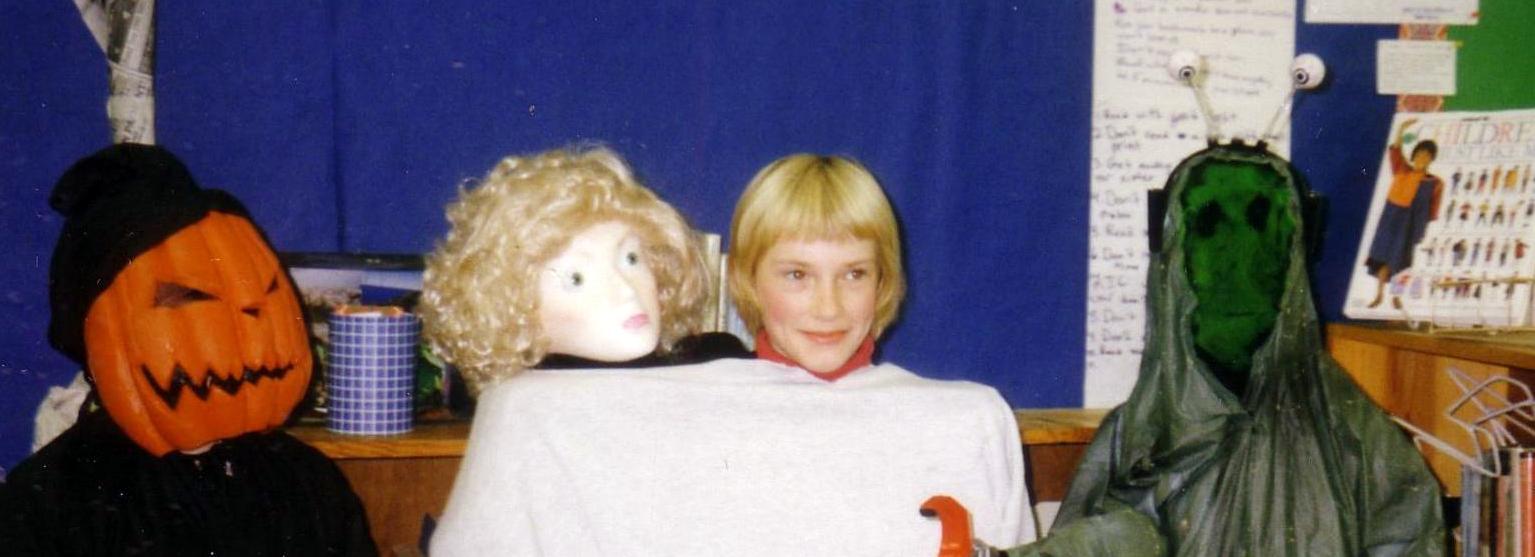
Here’s another, at Halloween. I have no idea who’s the alien, and who’s the pumpkinhead, and would love to know. (At a place that really values creativity, Halloween can be pretty amazing.)

I don’t know how it is in your life, oh patient reader, but in mine, right now, there are many mysteries, treasures that lie somewhere unknown in still-pretty-tall stacks of boxes. Some absences I can live with cheerfully for a while more, but some feel like serious deprivations. For example, although I saw it some time in the last year, I can’t find Chrissy’s ancestor pie. Hers was one of the most unique of the circle graphs of background and heritage that I assigned in the early years of the immigration theme.

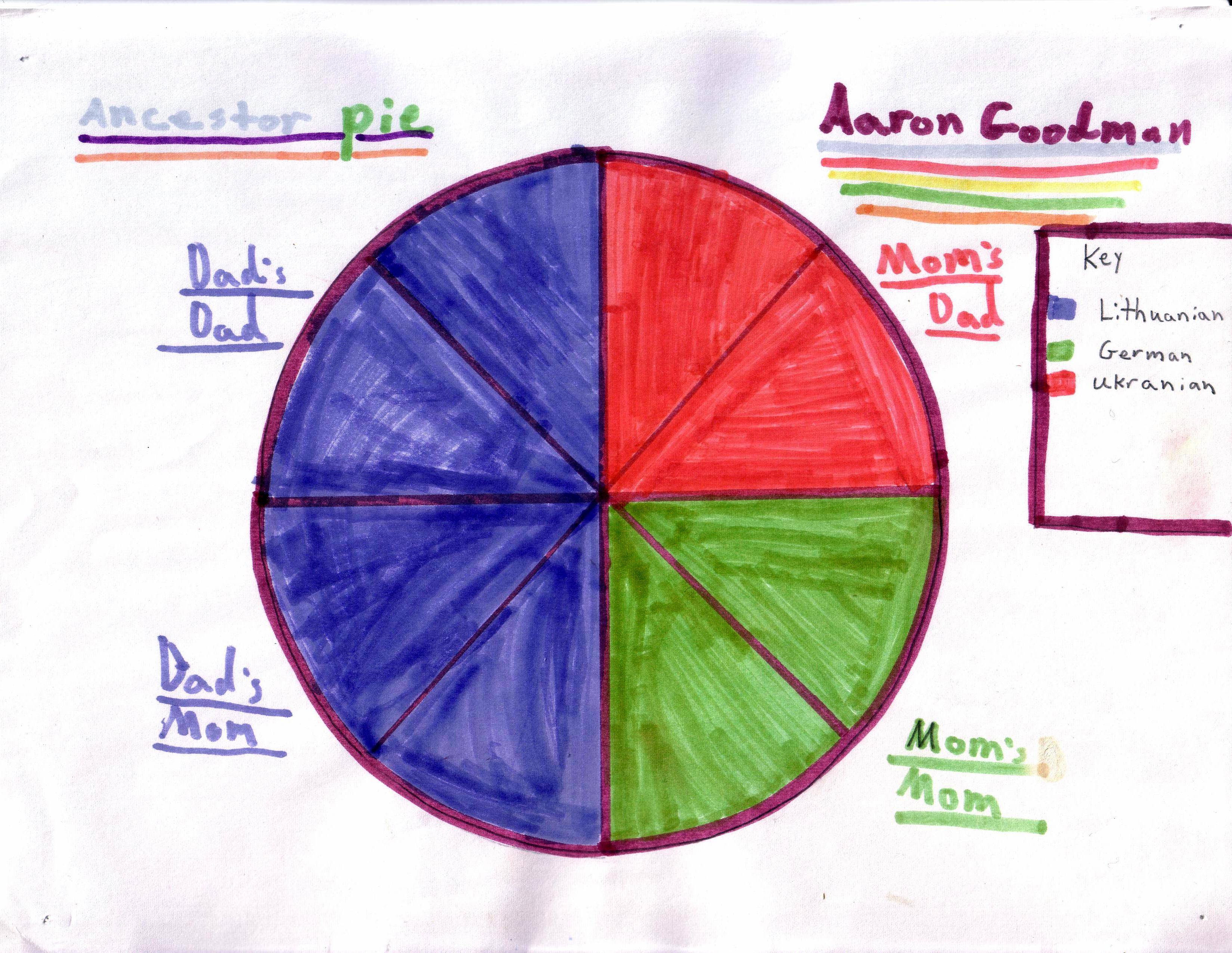
Here’s Aaron Goodman’s ancestor pie, made that same year, also quite wonderful:
immigration ancestor pie Aaron

Pretty soon in the evolution of the immigration theme, I stopped assigning ancestor pies, realizing that they could be problematic for some kids. While it was an assignment, thoughand later, when it was a choicewe considered fractions as small as sixteenths, one sixteenth for each of a child’s sixteen great-great-grandparents. Two parents; four grandparents; eight great-grandparents; sixteen great-great-grandparents.

(When I heard that a cousin in my father’s Maine hometown had said that his great-grandmother had been two-thirds Indian, I knew that couldn’t be quite the case. Ancestry denominators come in powers of two.)

Aaron didn’t need sixteenths; fourths did it for him. Ben Redden needed eighths, and managed to line up the eighths from two different grandparents, to show that he added up to a fourth English.immigration ancestor pie Ben

For Chrissy’s ancestor pie, unique and memorable, she made one big pink circle, on which she wrote, ‟I’m all Polish.”

On one of those trips back from Ellis Island described in the previous post, Chrissy’s dad’s stories intrigued me. More accurately, I was struck by his lack of stories. ‟They won’t talk about it,” he said. ‟None of them will, or ever would.” The memories of life in Poland too dark? Or still too much sense of rupture from that other life? Maybe both—since those feelings seem able to coexist, in all of us.

Another parent had spent years coming to understand that her mother’s grimness could be traced to her own mother’s very difficult immigration experience. She’d been left behind as a baby, then finally came over to join her family, and was ridiculed for being slow to catch on to America; her bitterness affected her daughter. ‟I’m where it stops,” my student’s mother said. ‟I’m not going to keep living out that hurt, and I won’t pass it on to my daughter.” (I may not have the family history details quite right, but I will never forget the mother’s resolve.)

Even the stories we would definitely call successes seemed often to have a shadow.

Beyond those individual stories, looking at the community story, I began to see the melting pot project as very much unfinished, at least in our area. A friend of mine in Marlborough went to have her children baptized. ‟Wrong church,” they told her. ‟You’re Irish. This is the Italian church.” Several Worcester parents in my class described lingering enmity between Irish Catholic and French-Canadian Catholic colleges.

These and other stories convinced me that we can all be tribal, insular, distrustful. We seem to be nowhere near being able to handle racial differences; we can’t even handle ethnic ones.

(All of these, of course, being cultural constructs, not biological. Inside that designation of Polish there could be many variations, given Poland’s history. And we are all Africans, in very recent time. But that’s for another post, somewhere down the road.)

The ancestor pies told yet another story. Sarah Tonry’s, one of those mysteries hidden in the boxes, had nine colors, as I remember, for nine different flavors of European heritage. Most of the kids in our central Massachusetts population colored in at least three or four different cultural origins, and when we located all our collective countries of origin on maps, the class list ran to nearly twenty, easily.

Willy nilly, we were the melting pot, and the ancestor pies showed us that.

I myself have to go to fractions smaller than sixteenths to show anything other than one big circle. Growing up, surrounded by people with ‟interesting fractions,” I felt the lack severely. At some point, our mother helped my sister and me calculate that we were 1/2048th French. An exhilarating notion. We spent a whole crossing of Long Island Sound gloating.

Family legend in my father’s family said that we were 1/16th Native American, and recent research by family genealogists indicates that my generation probably really is 1/32nd Abenaki. I’ve learned since that brutal treatment of Native American Indians in southern New England led survivors to flee north. So Judith, my great-great-grandmother, could have been any combination of tribes, along with whatever portion she had of what we call white.

I’ve thought about Judith a lot, remembering this again and again: inside our historical selves, the selves we bear through the changes and patterns and stories of history, there are wars. There are hurts unassuaged, that convey hurt forward without ever being named. For all of us, one way or another, things got thrown overboard; loved people were left behind.

Publicly, we may celebrate our emigree identities, whatever they may be, and the melting pot project, the meetings of differences. Privately we still seem to carry a lot of grief, more than we usually let ourselves know.

That’s one of the things the community of a class can do together: we can honor each others’ historical selves, whatever we know and share of them. Honor them with knowledge and wide understanding of the historical context; celebrate them with respect and joy. We can be gentle with the unnamed mysteries inside the tall stacks of unsorted boxes that are each of our identities.

One year, Kate Keller (wearing her aide hat) suggested that all of us take our just-finished immigrant mini-posters outside. (Each mini-poster gave the basic information about one immigrant, relative or friend, for each member of the class; Kate and I each made one, too.) Outside, we all stood together on the wide steps below the classroom windows, holding our posters and making a human timeline, century by century. A fairly boisterous crew, we stood there quietly for a minute or so, honoring all those reasons to have left and reasons to have arrived, all those ways of persisting afterwards. We called all those people, a few still living, most gone, to be present. Neither of the adults had dry eyes.

Living with each other, hearing each other’s stories, we might have looked pretty homogeneous to an outsider, but we were honoring difference, discovering commonality, keeping an old project alive. Nothing else we did mattered more.

Ellis Island Stories

 On one of my first trips to Ellis Island, with my family, we were part of the annual surge of people into the national parks, on the day after Thanksgiving. (‟Highest attendance, nationwide,” the rangers told us.)

ellis island hallMoving from exhibit to exhibit in that throng, I overheard an older woman telling her companions about her own father’s journey to America, alone, at the age of 12. As she stood above the Great Hall, where people were sorted–allowed in or refused and sent away–stories she had heard all her life took on new shape.

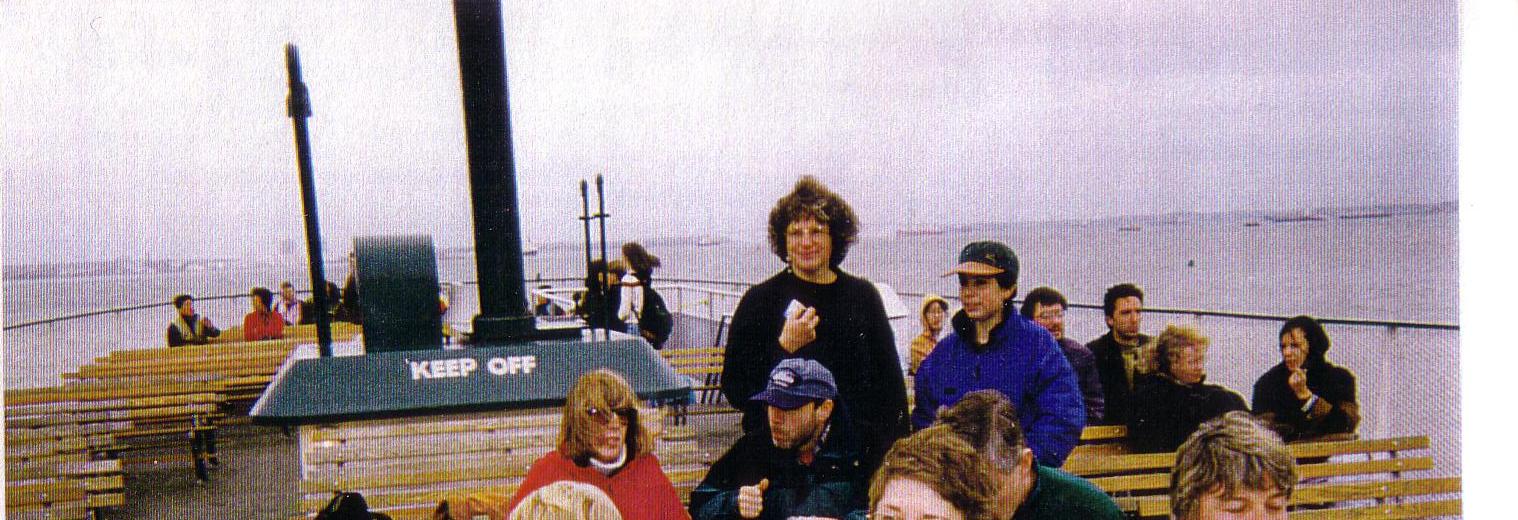
On the ferry back to New Jersey, listening to all the languages around us, I leaned over to my husband and asked, ‟How many?” and he listened for a few minutes and said, ‟Maybe twenty?” We were surrounded by another pilgrimage, a pilgrimage of new immigrants, come to honor that shrine of the old immigration.

None of our own close relatives came through Ellis Island—his mother came after the island was closed; my ancestors, like the rest of his, came centuries ago, when nobody was counting or checking or manning the gate in any way; when people just came.

Still, the story we felt around us is universal—all those people, in all their languages, were saying so—and we were deeply moved.

The parents of my students helped me figure out how to get us there, from our distance in Massachusetts. The first time, Gail Epstein and David Tapscott arranged for us to stay with relatives near New York City, taking over their rooms in a giant sleepover. (Thus the comment–in the recording below, that shows part of our debriefing session once we got back–about not stepping on anyone.)

ellis island debrief higher contrast

Another year, Carol Bedrosian, now the editor of Spirit of Change, arranged a bus for a day trip, and helped the class throw a car-wash to defray some of the costs. It was a very long day. We left from Grafton at 5:30 am, and returned about midnight. Still, it worked, and we used that way of getting to Ellis Island many more times.The trip book–a combined guide and workbook, the sort of thing teachers can create and use in the wonderful age of photocopying–included games to play on the bus. We chose a video to watch on the way home, and the few kids who didn’t pass out cold in extremely odd positions watched along with the adults.

The bus had more room than we needed, and cost a fortune, so we invited parents and grandparents to join us and help cover the cost. Making this a multi-generational field trip had all sorts of benefits. Kids got to know each others’ parents; parents got to know their children’s friends. Especially on the way home, as children slept, parents told each other (and me) their own families’ stories, deeply moving, often full of sorrow and darkness along with hopes fulfilled. With all those generations bearing witness, we settled more deeply into some truths of our history.

When I decided to post here that debrief of the very first class trip, I knew I would have to tell the story of the guy reaching over the railing.

We were exploring in our small groups. My group was in the room with what I called immigration math, huge colorful 3D graphs and interactive maps, showing immigration trends across time. I had designed a day that would echo our day at school: math time in the math room; reading and writing time in the galleries full of photographs; sketching time in a gallery full of the actual objects immigrants had brought with them, candlesticks and prayer books, christening dresses and lockets. Recess time we spent outside, looking for our own relatives on the wall of names, watching the seagulls. All of this was meant to help us feel ourselves mid-harbor, mid-history, mid-melting pot.

Lucy Candib, medical doctor and mother of Addie, was with me there in the math room with our group of four or five kids. Suddenly, we heard the terrible sound of someone’s head hitting the stone floor in the entrance room behind us. A young man from another school had leaned out over the stair railing too far, reaching to a friend, and had tumbled down to the floor below. Lucy was the first person at his side. I saw him on a stretcher, apparently unconscious, as rangers waited for a helicopter to fly him off the island.

All of us, every single one, including me, had to tell that story first, before anything else, when we got home late that night. I had to get past the ghost of that story in order to go back to Ellis Island with kids again. That incident made me tighten my organization for the trip, and recruit kids to be mindful of everyone’s safety. It forced me to think through (again) all the risks teachers take when we leave the classroom with kids, and all the reasons why we should, anyway—because the story of the young man who reached too far was not the only story we all had to tell when we got home, just the first.

Inspired by that woman on the balcony of the Great Hall, imagining her father, I had designed the immigration unit around true immigration stories of family members and friends, people still alive and people known only by the stories still told about them. Kids called uncles in California who knew that stuff; they interviewed their babysitters; they often found family artifacts and brought them in to share. In our work at school, students gathered these stories, distilled them into file card versions to put on a huge timeline stretching around the room, and chose one to write in full and revise for publication.
Always, in any particular class, a good portion of the kids, as many as half, had family stories that linked to Ellis Island–but the assignment didn’t specify that.

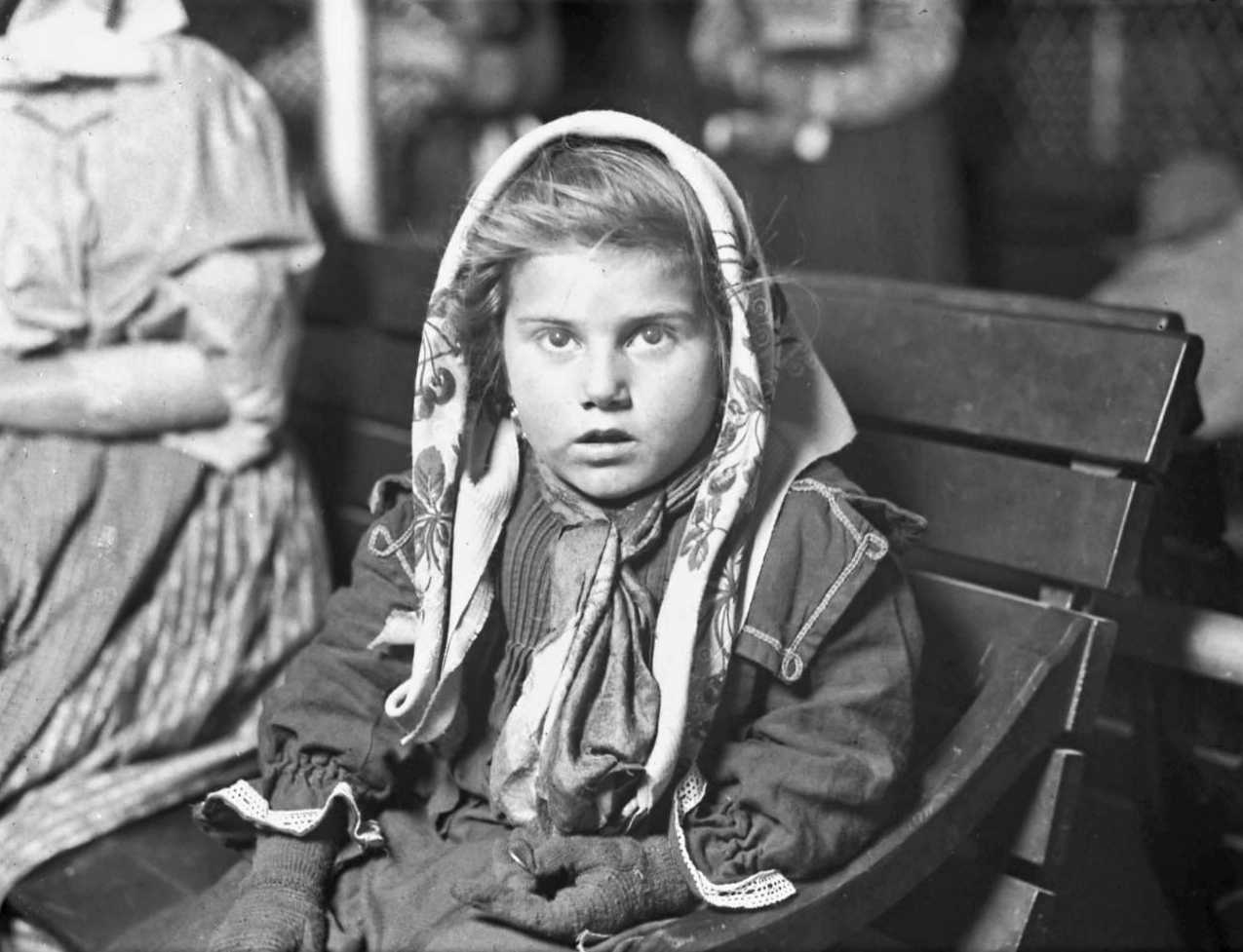
At Ellis Island Lewis Hine - Italian child gets her first penny, 1926Ellis Island, I asked the kids to make up a fictional story, also. In a room full of giant portraits of immigrants, near the entrance to the Peopling of the Americas exhibit, each student chose a person from one of the photos: boys and girls, women and men, from several continents.

ellis island photos writing croppedThen, as students moved from section to section in the exhibit, the trip book led them through the corresponding stages of the immigrant experience: a section about saying goodbye, when they left their old homes; a section about finding work; a section about communities of immigrants giving each other comfort and reassurance. After reading some of the text on the walls, looking at the photographs, and listening to recorded accounts on phones placed around the exhibit, each student wrote a journal entry in the voice of his or her chosen person, bearing them through the experience, stage by stage. To the right, Ian Wills and IanTapscott have found a comfortable piece of floor. Below, Mike Costa reads what he’s already written.
ellis island mike costa croppedSometimes a kid chose a photograph that could be a stand-in for a great-great-grandmother or grandfather. Sometimes they chose photographs that could be stand-ins for themselves. Stefan Cunha chose a newsboy yelling out across a street–and for all these years since I have remembered the clarity and power of his writing in that situation.

By the time we got back onto the ferry to leave Ellis Island, each of us was like a set of Russian dolls, with other lives nested inside us: the boy who discovered that the immigrants had come to earn their way into this country with unbelievably hard work; the girl who was let through Ellis Island but had to say goodbye to her father; the aunt who could never fully emerge from the trauma, the shadow, of the pogroms; the teenager who became the family’s translator exactly at the age when he wanted independence; the mother with her children held close all around her, hollow-eyed, all of them hungry and hoping to be better fed.

Ellis Island was hard hit by Hurricane Sandy; it’s only gradually being reopened, and I’ve worried that exhibits I treasured, as a teacher, may have been lost. Even before that, security arrangements put in place after the World Trade Center bombings had so lengthened the process of getting onto the island that it no longer worked for us as a day trip. Meanwhile, I had been learning about Blackstone Valley immigration stories, and had discovered the Museum of Work and Culture in Pawtucket, Rhode Island–not at all the same, but fascinating in its own way. The focus of our work in the fall gradually shifted.

It’s fair to say, though, that all my curriculum work afterward was affected by the Ellis Island field trip experiences, and by the thematic study that grew around them. Looking back I can see shifts: in my sense of what is at stake in curriculum choices; in my sense of the huge and complicated realities young adolescent students can stretch to embrace; and in my sense of the importance of combining, carefully and respectfully, both research and imagination.

Below, Adam Curley and I are too excited to sit down, while various parents huddle and talk in the October wind across the harbor.

ellis island photos ferry cropped

You’d have a hard time tracking people down with these photographs, from several of the earliest trips–so I decided to just go with them. Thanks so much, to everyone who helped these wonderful field trips happen!


Supporting Deeper Understanding with a Skimathon Process

Why did I decide to help students find the books they would use as seeds, or starters, for their research reports? Why did the right starter book matter so much?

Here’s why: with rare exceptions, each student would read the whole of the starter book for her chosen-and-received topic. In fact, most students read the whole book through twice, taking thorough notes in the style the student chose, from those I demonstrated. All that happened before a student went on to use other print or video or online sources more selectively.

The Common Core Standards now recommend much more reading of non-fiction books for younger students, and I’m hoping that they intend this same thing, as often as possible: not browsing, but actual reading, beginning to end. A good non-fiction book has its own shape and strategy, its own way to model the truth of the world. Sampling little bits won’t give you that.

I would rather have a student read the whole of a book written and designed for a child or young adult audience, even if it’s pitched a little below the student’s reading level, than see that same student read little bits of a book written for adults.

Instead of just harvesting specific details here and there, my students (average age, 11) could observe and absorb the way the author / illustrator / editor / publisher of the starter book framed the fundamental concepts and ideas. They could connect with their topics not as collections of facts but as ideas supported by facts. From what the Iceman was carrying when he died, we can learn a lot about the skills of his people. Or: Snakes don’t need legs, because different species have evolved very effective ways of moving for their different environments.

It’s an ambitious goal, to perceive a topic in terms of its big ideas. Still, I found that students could do this, given carefully selected books. I found that whole classes of very diverse students could do this, every single one of them, given the right range of books to start from, and enough support.

books Elephants Calling page croppedThe page above is from Elephants Calling, by Katharine Payne (Crown, 1993.) Following a particular elephant family, this book worked well for students who especially liked non-fiction with a story.

In effect, I enlisted all those authors (and illustrators and editors and publishers) as co-teachers–for free, or almost free–and I got to learn from them, too.

After years of beginning a research report writing process using a skimathon, what would I give as advice, to a teacher reading this and wanting to try it? Maybe, instead, you’re a home-schooling parent, or a home-schooled student setting up your own process–or even an adult with a new interest, figuring out how to learn all about it. Aspects of this process could work in any of these situations, but I’m going to address teachers, because I’m so glad to have been one–and I know that the job is gigantic.

First, I’d suggest that you wait until the students know you and each other. You want students to feel confident asking you for suggestions. “So far, I’ve only found two starter books that feel right to me–can you help me find possibilities for another?”  You want them to give recommendations to each other. “Mike, you have got to look at this book; it’s so gross.”

One way or another, you want to give yourself extra time to work with the book collection in the light of what you know about the particular class.

I’ll admit that I did a lot of summer work to get started with each of my various skimathon lists–but it was some of my favorite work, apart from actually being with kids. We didn’t teach from textbooks and teacher manuals, so preparing a new skimathon book collection played an important role in helping me get ready to explore a body of material with students.

Teaching a multi-aged class in which I almost always worked with some kids a second year, I almost never used the same theme two years in a row. Whenever I came back to the theme, though, our January start for this process gave me time, during the holiday break, to reassess.

You’ll probably want to do the same thing. Every time you return to a given theme, you’ll want to search for better books on any topic for which the book at hand has seemed inadequate or out-of-date. You’ll want to find books that appeal to students’ evolving interests, and books that work with your own evolving sense of the theme–which will change, of course, every time you teach it.

Either making the first collection for a Skimathon, or reassessing and revising our list, I spent time online, searching various topics. A local public library’s collection supplemented what we had at my school, and I got help from the children’s librarian there, Lucy Loveridge, an old friend. She understood the kind of teaching I was doing, and could suggest books not just according to their topics but according to their other qualities. Mary Brochu, at Touchstone, had worked with me as an aide, and could take a new topic and run with it, bringing me the results. (It takes a village to teach a theme.)

Beyond what I could get from the libraries, I used part of my supply budget every year to buy new or used books to support the Skimathon and the report writing process. Even if a book was available from a public library, it often made sense to buy a used copy for our classroom library, so a student could keep it over a span of several months.

For one version of this process, for a theme asking who we are, as humans, about half the students would eventually write reports about archaeological investigations, such as Pompeii or Skara Brae or Stonehenge. The other half wrote about the history of technology, defined very broadly to include things like early human use of fire, or the history of money.

books Taming Fire croppedThe book to the left, from Scholastic, challenged many of the readers most attracted to it, but it repaid their attention fully, and helped produce some really thought-provoking reports.

Through the time when I was teaching, children’s publishers were producing a fabulous explosion of new books on these topics. New didn’t always mean better–but sometimes I could see vast improvement. For example, when I started teaching about animal behavior, very few books emphasized behavior as opposed to physiology (the way the animal’s body works), and even fewer viewed all of this from an evolutionary perspective. I found it exhilarating to watch that change, and harness it in the form of better books for my gang.

At the same time, online sources for used books made it easier to find older books that were still the best of their kind.

books Early InventionsLike all the books I’m featuring this time, this one (Chelsea, 1995) is officially out-of-print, but can still be found–and it’s an extraordinary book, truly focused on ideas supported by details. We used it not as a starter book but as a secondary resource for a number of topics: fire, shelter, agriculture, time-keeping.

One way or another, every time I worked with these topics, I could find better books for the skimathon. In addition, if I knew about special interests of particular kids, I stood a good chance of finding the right starter book: a book about the history of musical instruments, for example, or about the Phoenicians.

Surprisingly often, the child I’d targeted for a particular book would fall in love with something else, and the book would go to another student who had never before heard of the Chinese buried warriors, say, but became instantly spellbound. Overall, the kids’ collective interests, intersecting with our topics, constantly lured me in new directions, enriching the whole enterprise.

Whenever you can, choose books that will support hands-on work. For another version of this process, within a thematic study asking what we can learn from animal behavior, students would observe live animals at zoos and aquariums, connecting both formal and informal observations with what they had read in their books. So I tried to find books that would really support that process of connection-making, books with detailed descriptions and illustrations of behaviors kids would be likely to see when they went watching, behaviors such as locomotion, use of senses, feeding, territorial behavior, or dominance behavior.

I also spent time calling our region’s zoos and aquariums to make sure they still had the animals in question, and removed the books for animals kids wouldn’t be able to find anywhere nearby. With a heavy heart I set aside an excellent book about the colony behaviors of naked mole rats, when the zoo in Providence closed their naked mole rat exhibit.

In these same phone calls, I’d ask the curator, “What animal species do you think are especially rewarding for kids to watch?” Then I’d scour the book sources for books that could work for my students.

In any situation in which you’re counting on a combination of print research and direct experience, you want to check both halves of the deal before you offer it on a list.

Students could use the beautiful, information-rich illustrations in the book below, Homemade Houses: Traditional Homes from Many Lands, by John Nicholson (Allen & Unwin, 1993), to help them build models of many types of indigenous architecture.

books Homemade Houses Dogon

Looking at the book collection as a whole, make sure that you have a good range of reading levels and type sizes, and a good variety of styles of nonfiction presentation. Depending on the age level of your students, you may want some of the starter books to be nonfiction picture books, with much more illustration than text, and limited text volume on each page. All the books should have plenty of illustrations. Every student, no matter what her skills or interests might be, needs plenty of room for choice–especially since you’ll be asking all the students to make multiple choices.

In my groups, I knew that some students could handle the Dorling Kindersley Eyewitness books, or the Usborne books, which have excellent information, well-organized conceptually, but very dense text and illustration layouts on every page. Still, I tried to save those for back-up resources, not starter books.

One last piece of advice:

Once you’ve worked with the kids’ choices to assign the topics–I could write a whole post just about that, of course–have the kids help you decide which topic you’ll use, from the ones that wind up not being assigned to any student.

You won’t really write a full report on your topic. You’ll be busy helping them. Still, you’ll do just enough to serve as a model: take some notes and share them; make your own table-top book show when it’s time for them to do theirs; make a web to begin thinking about the structure of your report; write and revise a couple of passages; draw some illustrations,

Collectively, your students will know all the books, at that point, and they’ll get a huge kick out of suggesting topics for you. If you have an aide, he or she should get a topic too.

It could change your lives, after all. I’ve never thought of elephants the same way, after reading about them, watching them at the Roger Williams Zoo in Providence, and taking detailed notes on one elephant’s every move for half an hour. I still follow the work of Katharine Payne’s Elephant Listening Project.

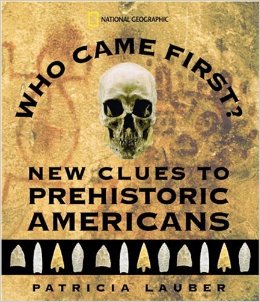
books who came firstI also seem to be permanently hooked on the earliest settlement of the Americas, a topic full of controversy and even invective between the various experts–with a great book for kids that gives them a sample of competing sources of evidence.

Whatever way you might incorporate some of these ideas, good luck! If you’d like some cheering on, get in touch with me by leaving a comment.

The Seasonal Feast of the Skimathon

It was a moment of high suspense: the moment somewhere in mid-January when I announced the results of the Skimathon.

The Skimathon, lasting from one to two weeks, staged a grand meet-up between all the students in the class, usually about 15, and a collection of books, usually at least 30, all related to our theme for the next several months. These were called starter books, because they would eventually serve as the seeds, the starters, of the students’ individual research reports connected with our theme.

Early in my teaching life, when I first asked 11 and 12-year-old students to write extended research reports, they found their own books–or tried to. Unfortunately, things like this happened: a child who wanted to observe, read and write about the behavior of chickens found only a technical manual written by someone at Tufts Veterinary School. Maybe a good book, but not very effective for that kid.

I invented the Skimathon as a way to give students support and a head start, while still honoring and working with their individual preferences. Over time, as it evolved, the Skimathon became a structure for combining our energies toward their success.

Although the Skimathon temporarily interrupted well-loved ordinary reading activities, it felt like a feast. During the Skimathon, students spent each silent reading time skimming and assessing several books, and then took home several more to look through that night.

Students weren’t required to skim all the books, but I usually set a minimum to ensure that an open-minded student wouldn’t be smitten with the first three books and quit. Within each class, always, a couple of kids tried to read (not just skim) all the books that interested them–or even every single book in the bins! Some parents acknowledged that they had read quite a few of the books that came home.

The students recorded their reactions to the books using codes of their own invention, in a special Skimathon packet. Here’s a sample page:

skimathon mimi2 sample

The next day the skimmed books came back to be swapped for new ones. I heard a lot of “Did you know?” as kids wowed each other with amazing new information. Did you know that the Iceman was found by random hikers? Did you know that some bats really do suck blood? Etc.

The goals of the Skimathon evolved along with the process. At first, I just wanted kids to experience less frustration finding books. Gradually I realized how much this activity could do for us.

Partly it was about getting good at skimming–sampling the informational content and the presentation style of each of many books, fairly quickly, in order to make choices. I supported this with mini-lessons about particular techniques for skimming non-fiction books, and about the use of specialized book parts, like the glossary or table of contents.

(In all work of this sort, I’ve thought often of Karen Kuelthau Allan, my content area reading professor at Lesley University. She modeled, so beautifully, a collection of effective strategies for getting the most from nonfiction reading, and I’ve wished again and again that I had encountered her much earlier in my own student years.)

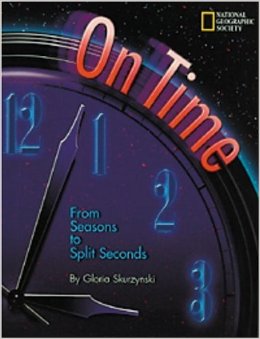
On Time by Gloria SkurzynskiThe Skimathon process also helped students begin or continue to notice a wide variety of non-fiction approaches–the different ways authors, illustrators, designers and publishers have found to organize information and ideas into the form of a book. (To the left, a fascinating book by Gloria Skurzynski, about the history of time keeping, organized by the length of time being measured or designated.)

At the end of a Skimathon reading time, we showed sample pages, sharing different reactions to the same book, or different books about similar topics. Many kids issued recommendations to the full group, sometimes based on content, sometimes based on book style: especially gripping photographs, or helpful maps, or funny little cartoon characters reappearing, like Waldo, in the illustrations.

Ultimately each student would be matched up with one of those starter books as the seed for individual research, report writing, and display making. So the Skimathon was an exercise, for each student, in learning to judge what would work, what would sustain his or her own engagement.

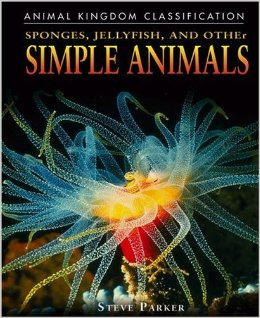
jellyfish steve parkerThe process of skimming this many books also gave students a really wide-angle overview of our theme.

(Here, to the right, one of a set of books about animal behavior. This one helped students think beyond vertebrates.)

For some students, the overview helped them be more receptive to their classmates’ teaching about individual topics, later on. For some especially omnivorous students, casting such a wide net at the beginning helped them accept the necessity of narrowing down later.

For the opposite kind of kid, the one who started out thinking that she would die if she couldn’t do her report about x, the Skimathon could stretch horizons, build flexibility, open up new connections. The last seven or eight years of this process, I asked students to come up with at least three good strong personally-appropriate choices, no longer ranked in any way visible to me. (No, I explained, it wasn’t fair to write PLEASE PLEASE PLEASE next to a particular topic, or to offer bribes designed to appeal to their teacher’s weakness for chocolate.) Each student had an important job: to come up with multiple choices that could all work. Not just one favorite path, but several highly promising paths.

Every year, at least one or two students found it impossible to choose, and listed the maximum number of choices–five, or six, or whatever I’d set as a max. That was sort of wonderful, of course, but I always felt that I should think particularly carefully about those kids. I know that condition of almost pathological over-enthusiasm. Those of us who are prone to it need help being more discriminating, making distinctions, thinking through our own needs more carefully.

Meanwhile, I had the important job of making sure that every student wound up with one of his or her choices, a really engaging and effective topic for that person, without any overlap within the group as a whole. That way, the full collection of individual topics would offer rich opportunities for peer education. Each student would have unique responsibility for some part of our big picture–a responsibility to which every student could rise, regardless of reading or writing levels or rates.

I knew, though, that the peer teaching would be lively and whole-hearted only if each student got a combination of the right topic and the right style of starter book. I looked at their choices for themselves through my own perspective about their capacities. Would a person who read thoroughly (but slowly) be swamped by too much reading material in this first resource? Would a person who thrived on narrative excitement, even within nonfiction learning, find enough of that? Would the structure of his book help a person who needed lots of help connecting details with larger concepts?

The Skimathon worked remarkably well as a way to launch a research report process. The world is fascinating; kids have an inborn desire to understand it; publishers for children have been producing increasingly engaging, thoughtful, and well-illustrated nonfiction books. Finally, the Skimathon worked because it gave me some room to provide support, but honored the vision and choice of each individual child–thereby strengthening their capacity for both vision and choice.

And here’s how I knew it worked: students in my mixed-age class for a second year asked immediately and impatiently, at the beginning of January, “When are we going to do the Skimathon?” With any luck, the bins were full and nearby, the lists were ready, and I could answer, “Soon!” or even better, “Today!”

In the next post, I’m going to answer the question, “What would I give as advice to a teacher starting out with a skimathon process?”

Absence and presence

In the end, it’s not really the topic of grades that’s so huge for me— It’s the topic of no grades: what can happen, what I’ve seen happen, in their absence.

graduation JuliaThis is Julia Miller, who graduated from Touchstone long enough ago that she’s about to graduate again, from high school. Behind her, draped on the greenhouse, you can see the flag her Older Student Program group made the previous fall, just before going on their fall hiking trip. If you look closely, behind Julia’s right elbow, you can see the word CREATIVITY and the beginning of the word RESPONSIBILITYtwo of the values that group chose as their watchwords for the year. She’s about to dance–

graduation julia dance cropped–mostly as a joke, but I love the way this photograph shows her blooming along with the petunias, and reaching for the literal and figurative skies.

As they go through their experience, students in an ungraded situation aren’t thinking, “no grades no grades no grades.” They’re making connections from topic to topic and theme to theme and school to home (and vice versa); they’re trying out different voices and different genres and new strategies for understanding the world; they’re thinking a lot about the community of each other.

Teachers who aren’t giving grades aren’t thinking “no grades no grades no grades.” They’re making connections themselves, learning about their topics, watching and planning for ways to include other adults and experiences outside the classroom; imagining the world of each student from inside that student’s perspective; nourishing the community that can do more for each individual than any teacher’s plans.

As we went along, the missing grades barely figured in what I said about the teaching and learning I shared with each year’s class. At parent meetings, I never said, “First, I want you to know that I’m not giving grades.” It was taken for granted, invisible.

Still, that absence of grades was constantly at work in the presence of other energies and outcomes.

I saw the benefits: for kids whose learning experience had never been assessed with grades; but also for kids who had come to my school after experience with grades elsewhere.

Now and then, a transplant–or his parents–couldn’t make that transition. Most were like people woken from a long and troubled sleep. They stretched; they looked around; slowly, or quickly, they became active, in a new way, in the scene of their lives.

Still, I don’t have available the experimental control, in which the same teachers worked with similar kids and gave grades. I don’t know how that would have worked for any of us.

Close friends have said that I would probably have blown all my fuses and quit; that I would have left teaching very early in the game, if I’d been forced to translate my students’ growth and learning into graded assessments.

I wonder: how many teachers have been driven out of teaching by the necessity of an activity ultimately so alien to their original hopes and intentions? How many others, not questioning grades, have nonetheless abandoned teaching out of disappointment with the state of mind grading has induced in their students? What have we lost with this attrition, these departures?

My own history meant that I didn’t take the absence of grades for granted. I first started questioning the effectiveness of grading long before I was a teacher, long before my husband and I went looking for schools for our children. I became skeptical of grades at a time when I was being graded myself, and getting good grades. Not always, but sometimes, I could feel how addictive that was; I could glimpse how few risks I was taking; I felt, often, the price of that labeling.

Beyond that, I remember watching the effects of grades on some of my friends. I knew their talents and strengths, and wondered why their grades didn’t represent them more accurately. In fact, there didn’t seem to be any way for some of my friends to live in their strengths, in the classrooms we were encountering. Looking back I can see how the learning was often shaped to be easily measurable, easily graded.

If you’ve read previous posts, you know that I had some wonderful teachers. I don’t blame them individually. I was in the first wave of the post-war baby boom, and our classes were large. To some degree, increased testing and grading pressure attempted to manage that suddenly increased demand.

Like them, still, many teachers don’t have a choice of not assigning grades. Some give the grades they have to give, but play down the importance of those grades in any way they can, putting their energy into those other products and outcomes I tried to describe in the previous post:

  • Teacher support, and student goal-setting, guided by targeted, individualized, meaningful assessments
  • Learners who know and understand and respect themselves as learners
  • Authentic and rewarding group learning
  • Deep meanings held in community
  • Powerful connections with significant content

One of those “teachers without a choice” lives under the same roof with me, and his frustrations were part of what finally goaded me into writing about not giving grades. So I want to end this series of posts, at least for the time being, with a nod to him and to all those teachers past and present, saddled with the obstacle of grades and making the best of it, for their students’ sake.

I think I’ve said this before, and I never forget it for a minute: I was lucky.

But that’s enough (finally, or at least for now) about no grades. Next time, I want to start thinking about structures to help teachers and students meet each other halfway, beginning, I think, with the seasonal feast of the Skimathon!

Five More Thoughts About Grading

The story so far: If the product of a learning experience takes the form of a grade, other possible products and outcomes have less reality and less power for the learner.

Voices speaking out against grades want to shift the focus of learners and teachers, to give priority to those other products and outcomes. I’m going to focus on just a few.

# 1  Teacher support, and student goal-setting, guided by targeted, individualized, meaningful assessments

Focused effort matters, and thoughtful assessment can support that. Very briefly, here are some of the kinds of feedback individual kids could come to expect in my classroom, in place of grades:

  • one-on-one working conferences to look at pieces of writing, reading comprehension progress, math quiz outcomes, etc.;
  • group mini-lessons based on common confusions or not-quite-there efforts or emerging possibilities or spontaneous break-throughs, acknowledging and moving forward from all those;
  • quick skills checks in the form of miniboard warm-ups;
  • written responses to specific assignments;
  • long narrative progress reports twice a year;
  • conversations in preparation for portfolio sharing, and the portfolio conferences themselves;
  • feedback from classmates, students in the wider school community, parents, and other adult audiences.

The previous post has examples of some of these. The feedback for students in younger classes varied from this in developmentally appropriate ways, but always with the same goals: not judgment, but celebration and support.

Each of these activities provided an opportunity for student and teacher to observe patterns in comprehension and skill, or difficulty, and to set goals both short-term and long-term. At the same time, each of these assessment activities was an opportunity to revisit, share, and reconsider the important questions inherent in our content.

#2  Learners who belong to themselves

I remember a conversation with the high-school-aged daughter of a friend. She told me about her classes for that year by telling me her grades. She couldn’t tell me what was interesting to her; couldn’t say what she wanted to learn next; couldn’t describe anything about her learning process. Her grades were high overall, and she assumed that the subject in which she was getting the highest grades should be her major in college.

This young woman didn’t belong to herself as a learner; she belonged to her grades, and to the people who were giving her those grades–even the people who were celebrating those grades.

Especially once we were able to keep students until they were ready for high school, people observing the graduates of my school have been struck by the way graduating 14-year-old kids belong to themselves–how clearly they know and understand and respect themselves as learners.

fall projects NateInstead of pinning their student identities on their GPA, students in ungraded situations learn how to work with their real identities as learners. They learn how to choose meaningful and sustainable challenges for themselves. They know how to manage their own attention, and what to do to sharpen their memories. There may be passages through which they struggle, but a lot of the time they’re having a blast. Above all, they know, for themselves, why it matters. To the left, checking and graphing temperatures.

#3  Authentic and rewarding group learning

Teamwork flourishes best when grades are out of the picture. When I’ve talked about the amount of group work happening in my class, people have often asked, “Don’t kids get distracted by working together? How can you tell who did what?”

I’d have to be crazy to deny that distraction happens sometimes, or that timid students can become dependent on others. Still, young adolescents are ready and eager to learn how to be teams.

as Tsongas 3At Tsongas Industrial History Center, these girls are constructing a working canal system model. As usual, museum educators  commented on how well students worked together–incorporating everyone’s ideas, sharing the dirty work on the floor.

At any age, effective group work doesn’t happen automatically. In order to get the huge benefits of several minds focused on the same task, complementing and helping and challenging each other, kids have to learn how to be task-focused and team-focused both at once; how to do the social work, the intellectual work, the creative work, and the procedural work all woven together.

Kids exposed to plenty of group projects in an ungraded situation get a terrific head start. Without grading to tell them they’re competing instead of collaborating, they learn how to stay balanced within the group process, and how to help the group stay balanced so it keeps on working for everyone.

If you want an argument against grades, focused on future success, you could start with that.

tracing watershed pathway croppedAbove: Working with a parent volunteer, students help each other figure out which direction the rivers are flowing on topographic maps.

Meanwhile, freed from generating grades, I could put time into helping groups design and choose tasks that would engage them, with topics and audiences that mattered to them. The resulting energy helped their bicycle built for two (or three or four) keep momentum.

Often, when sharing work in a portfolio conference, students mentioned their partners and teammates, and told about what each of them had contributed, as I set off quiet internal fireworks of celebration. Yes!

# 4  Deep meanings held in community

As humans, we seem to have evolved to construct meaning, and experience meaning, collectively.

Stonehenge.arp.croppedMany groups of students have been inspired by the collective power of the communities that built Stonehenge, and archaeologists’ ideas about the community events held there.

Archaeologists and paleo-anthropologists have found evidence of the power and importance of community life and community understanding, deep in the past history of our species–and even for the other hominin species before us.

Young adolescents work hard to begin to understand huge things: life and death, economic reality as they observe it, the concept of scale, the notion of one image symbolizing whole realms of experience. Whenever I asked groups of students what they’d like to understand better about the world, I was astonished anew at the ambition of their questions, knowing this at the same time: the really heavy lifting they can’t do alone, any more than adults can.

Lizzie Bright croppedIn my own most emblematic image of this, a group of learners listens to a challenging novel read aloud. As I write, I realize that I’m thinking particularly of Lizzie Bright and the Buckminster Boy, a novel about racial prejudice in early 20th century New England, beautifully written by Gary Schmidt. Sharing a novel like this, the students build understanding together through their various comments and questions. Sometimes I sense their collective bravery in their silence for a tricky passage, or just after.

If somebody out there knows a way to assign grades to the quality of a shared group silence, let me know.

Now hold that in contrast to this: When individual achievement is the only test of an experience; when shared learning is considered cheating; when it’s constrained by the “level-playing-field” concept that requires teachers to do exactly the same things for every student; when teachers face such large classes that they have no way of knowing who’s doing what without completely isolated graded assessment–the deepest and truest parts of learning are hobbled, compromised, or outright lost.

It’s not impossible to nurture community, and the deep meanings community can hold, in the presence of a grading system–just harder. In fact, in my experience, over-emphasis on individual outcomes in any form–either grades or some supposedly benign substitute–works against the development of community, and the construction of shared meaning.

#5 Powerful connections with content

When grades aren’t the focus, content itself–the world!–gets more attention. The world is alarming to young adolescents–and to all of us–but also fascinating. Grades wind up being a smokescreen in the way of that fascination.

That’s what broke my heart about my friend’s daughter, mentioned earlier. She was experiencing very little actual engagement with the world and how it works and what we make of it. Her grades were like junk food, no fit substitute for actual encounters with the depth of time, or the mysteries of prime numbers, or the relationship between surface area and heat loss, or the way human history offers such contradictory evidence of both altruism and cruelty.

I think of a student long ago who wanted to read novels about the Holocaust. She had no assignment. She just kept coming back to me for more books, and talking about them to her classmates and parents. She was choosing her own path to a deeper understanding of the world.

Or I think of a student, now grown to a man, who used his sketchbook, during morning sketching time (which was completely open, unassigned), to make a very long narrative map, which continued from one two-page spread to the next, and the next, for months. The map as a whole incorporated everything that kid was noticing about the world through which he traveled: about geography, transportation, and the designs of buildings and other systems; about humor; about continuity and discontinuity.

Looking back, I remember now that this student’s family had just gone through an unusually messy divorce. His rehearsal of continuity in the built and natural worlds, page by turned-over page, feels tremendously poignant to me now. At the time, I was focused on his thinking and processing and creativity. But it seems likely, now, that the mapping was working for him on levels I couldn’t even guess. He gave himself the assignment that let him live in his intellectual strengths, and use those strengths to help him live through his family’s troubles.

Although he made me copies of some of the pages, I have no idea where they are. Hooray for memory so vivid and dear that it doesn’t need props. Hooray for learning so rich that no grade could encompass it. Hooray for the safe haven, also a highly effective launching pad, in which such work could happen.

I have a feeling I’m still not done with this topic…

Afterthoughts, Afterlinks, Resolutions, and Thanks

My most recent post, about math mentors and math fun, was the 25th on this blog. The calendar year is about to turn; I’m a little less than halfway through my year to think it over. Time for a mixed salad of quick thoughts, including some resolutions.

More math fun

First, it turns out that 2013 is not prime. All year I’ve wondered. Finally, this morning, I started scratching calculations on the back of an envelope. Then I went to the web to double-check, and found a prime factor calculator. That confirmed it, just in time:

goofygraphics2013I also checked 2014. That, too, is a product of three primes, but I’m not telling. (You know right off the bat what one of those primes has to be.)

After reading the previous post, Kate Keller said some really nice things, including, “Wait! You left out the birthday ritual!”

Kate’s remembering something we did whenever a birthday happened in my class. I started by writing the child’s new age on the big whiteboard: 11, or 12, or occasionally 13. Then I’d ask, “What can we say about the number —?”

Students responded in a variety of ways:

  • with cultural uses of the number. (“It’s a dozen!”) (“Some people think it’s unlucky, but they’re crazy…”)
  • with expressions that equaled the number: 3 x 4 = 12, or 14 plus -3 = 11, or much more complicated expressions coming out of our experience with Lloyd’s Game (described in the previous post.)
  • with a magic number sequence that started with the number and returned to the number.
  • with words that describe other properties of the number: it’s odd (or even); it’s prime (or composite); it’s a palindrome; it’s deficient or abundant or perfect.

These various statements, written on the whiteboard, both documented learning and provoked it. Although we focused on the same numbers again and again, the activity was repetitive only in the way ritual has to be repetitive: a pattern similar in every iteration, but never actually identical; a shared dance in which roles can change and change again; a bowl or basket or web for both familiarity and innovation.

If I forgot to include the number ritual in our celebration of someone’s birthday, or if we ran out of time before dismissal, the kids insisted that it be carried over to the next day. Remembering my students’ affection for the ritual, and remembering the way every student participated, I feel like I’m holding some important key to who they were, and are; something hard to put into words; a treasure.

For still more math fun, check out the YouTube channel of Vi Hart. Here’s a link to one of my favorites, the first in a sequence of three about plants and the Fibonacci sequence. “Ow!” one of my younger students said. “My head hurts! Play it again!”

vihartfib

More My Place

I’ve been tickled to have the posts about My Place get a steady trickle of hits from Australia, so I did some behind-the-scenes backtracking. In the process, I found a wonderful collection of material relating to Nadia Wheatley, with an author interview, curriculum plans, and reviews of some of her other books–and a link to my own post about My Place, down towards the bottom. Great stuff!

If I were teaching right now…

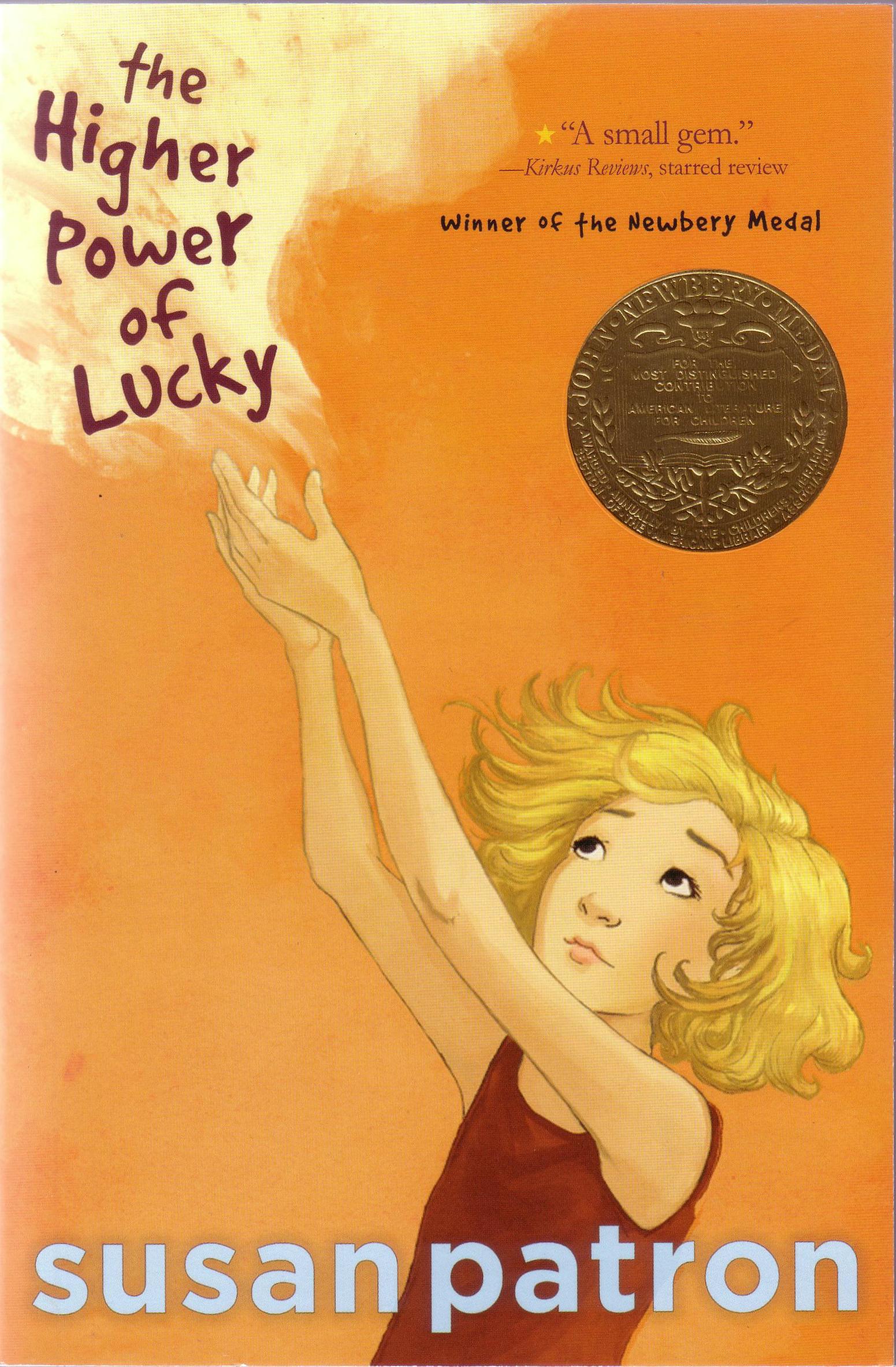
I would read aloud The Higher Power of Lucky, the first in a series of three novels about a girl named Lucky in a town named Hard Pan, in the Mojave Desert.

higherpowerofluckyb

Living in a very small town, Lucky has memorable friendships with both kids and grown-ups. She eavesdrops on twelve-step anonymous meetings, hoping to hear the advice she needs. She hopes seriously for an afterlife, because there are some questions she would like to ask Charles Darwin. (She has a dog named HMS Beagle.) She’s cranky and impulsive and imperfect and worth a million dollars, and she’s part of a new sub-sub-genre of realistic contemporary fiction for young adults, in which characters think about biological evolution and what it means, and interact sympathetically with adults who can’t or won’t.

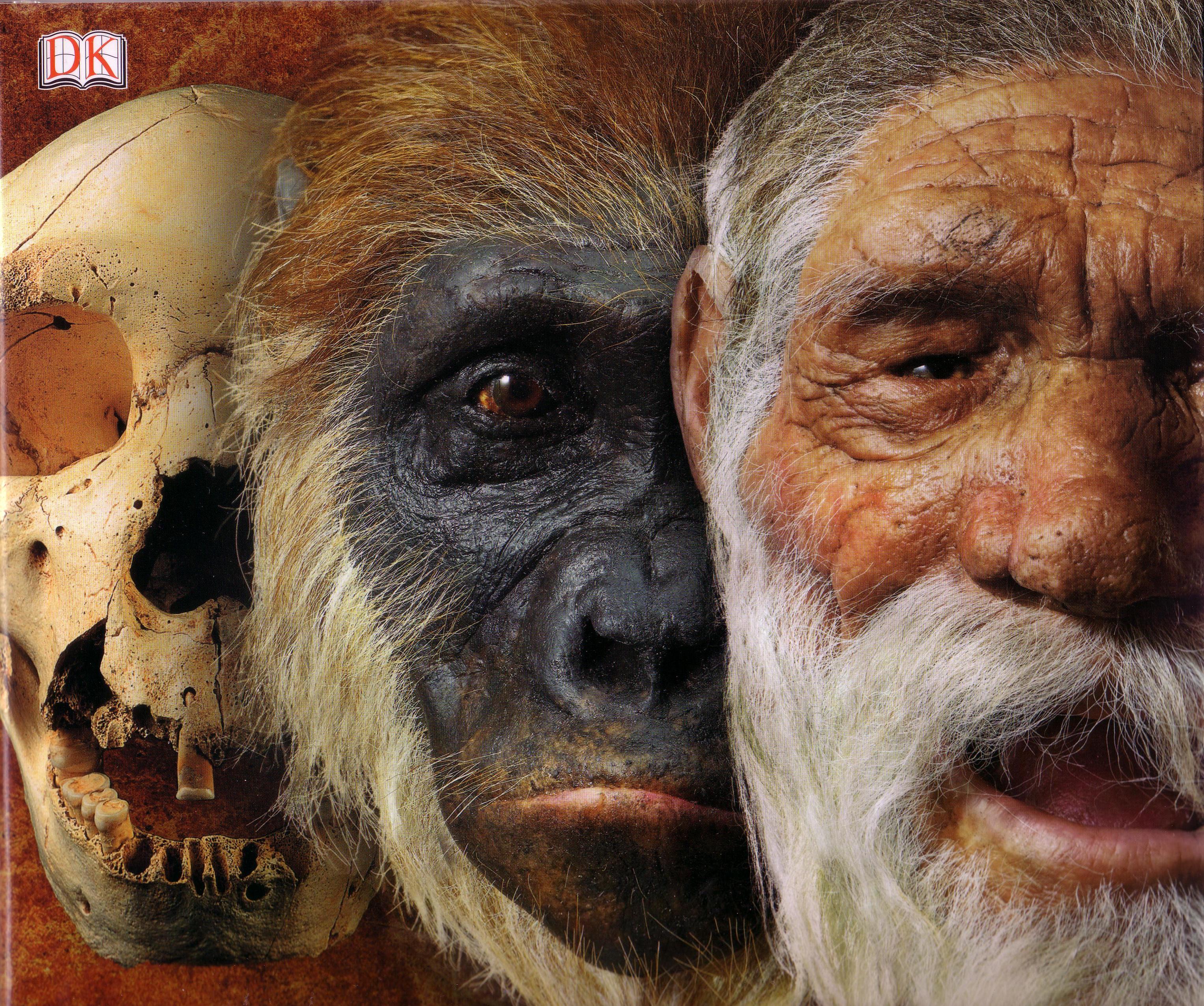
“If” thought # 2: I would figure out how a class could use the latest book by Alice Roberts, the charismatic anthropologist and medical doctor who narrates a BBC video series (which we did use in class) called The Incredible Human Journey.

alicerobertsevolutionbAlice’s new book (we pretend to be on a first-name basis with her, in my household), published by Dorling Kindersley, is called Evolution: The Human Story.  It uses narrative, model reconstructions, photographs, illustrations and charts, to take the print medium’s slower-paced (but thrilling) look at the history of our species, starting with the Big Bang. Such a rich resource for a class to use!

A third “if” thought: I would explore the idea of privacy, which matters a lot to 11- and 12-year-old people, and keeps coming up in the news.

Resolutions

One of my most faithful readers wants to know why I haven’t yet written about some teaching and learning that was central to my teaching life:

  • about the evolution of life in general, and about human evolution more particularly;
  • about animal behavior and archaeology and the history of technology;
  • about immigration, both chosen and involuntary, in the history of our country and our communities and families;
  • about Islam and the Arab world and the history of Arab Spain;
  • about The Voyage of the Mimi, both the first and the second;
  • and about the making of Voyage to the Sea.

Instead of writing about evolution, I guess, I’ve been evolving. (I know; I’m using the word in two of its different senses.) Somehow I’ve had to work up to those topics, and also work down with them. They’re all so huge for me, giant human artifacts around which I’ve spent all these years crawling, like an ant in the jungle, climbing up and looking around whenever I felt brave, or whenever a student was nudging me onward.

However, I’ve just made that list. I’ve included some of it sideways, in this mixed salad post. I’m pledging myself to figure out ways of exploring those giant thoughts in 1000 word packets, before my year to think it over is over.

I welcome, and probably need, suggestions from readers who shared those themes with me as student or parent or colleague or cheerleader. If you were writing this blog, how would you tackle all that big stuff? Just askin’.

In an activity so solitary (except for the joyful throng of co-conspirators in my memory), tiny encouragements from the rest of the world mean so much! A quick note in an email, a side comment in the aisles at Colella’s, a post on a website generated on the other side of the planet, devoted to a much-admired author–each of these remind me that I’m really doing this, and parts of it matter to other people. Some of you have recommended the blog, or a particular post, to friends and relatives and colleagues, or on Facebook; some of you have written comments on the blog itself, invariably thought-provoking, nudging me and lifting me forward. For all that…

goofygraphicsthanksRecently, my daughter has been sharing a website or movement called Lean In, which encourages women to lean into their ambitions, to overcome fears and take risks, with each others’ support. I take a big breath and “lean in” every time I publish one of these posts, and I’m inviting you to lean in with me, women and men (and girls and boys)–whatever that may mean for you.

Math Mentors and Math Games

Early in my graduate education, I took a Lesley University summer school course about teaching mathematics, with a genuine, fresh-from-the-trenches middle school math teacher, Lloyd Beckett. Authentically–and contagiously–he had come to believe in the power of math conversation, and in the rich gifts students with different approaches could offer each other.

Lloyd’s course woke me up as a math teacher and as a mathematician. For years I had assumed that my relatively decent math grades rested completely on my ability to memorize. As it stood, that was largely true. When I did particularly well on one of the New York State Regents exams, my teacher, Augustus Askin, whom I adored, looked at me and said, “How did you do that?” Although I don’t think he suspected me of cheating, he had seen the puzzled look I often wore in math class.

Memorizing was okay for the test, but the effects never lasted very long. Real understanding, for me, required experiences that math class rarely offered–that I couldn’t even imagine math class offering.

On the other hand, in secret, generating that puzzled look, I’d spent years figuring out my own approaches. I could hold onto math concepts, and work with them comfortably, if I experienced them pictorially or concretely, or told stories about them. This was in a time, though, before math manipulatives, at least in my country schools, and before the wonderful math videos I was able to use with my own students, decades later.

There were exceptions. A little girl for whom I babysat had one of those balance toys with numbers weighted to add or subtract properly. If you hung a 5 and a 2 on one side, and a 7 on the other, the balance came to rest with the pointer in the right place to mean yes.

Here’s a sample of a similar balance still on sale.

math Plastic-Bear-Shaped-Digital-Balance

Other, purer versions make more sense for older kids, but I spent a lot of time playing with that balance, savoring it. It was what I needed.

I’m also stubborn, and I hated subtracting. All on my own, with no support from the rote-memory approach in school, I had figured out a way of subtracting by adding, doing a sort of mental algebra: what plus 5 will equal 7? Or what plus 9 will equal 17?

In my earnest little heart, though, I suspected that I was cheating. I thought I was making up for not being good at math.

Years later, when I spoke with parents at math curriculum nights, I sometimes called myself a “born-again mathematician.” Teaching math with new math tools and toys and approaches, and with new respect for many kinds of math minds, I found that I loved math, respected my own math learning style, and got a huge kick out of helping all sorts of kids come to understand new math ideas and feel new math power.

That marked me for life, evidently. In my current pause from teaching, any time a math idea sails into my day, I grin and go with it. So, for any of you who feel math deprived, just through the holiday, or in your everyday life, I offer a few math games.

The first two aren’t really games, just reflexes.

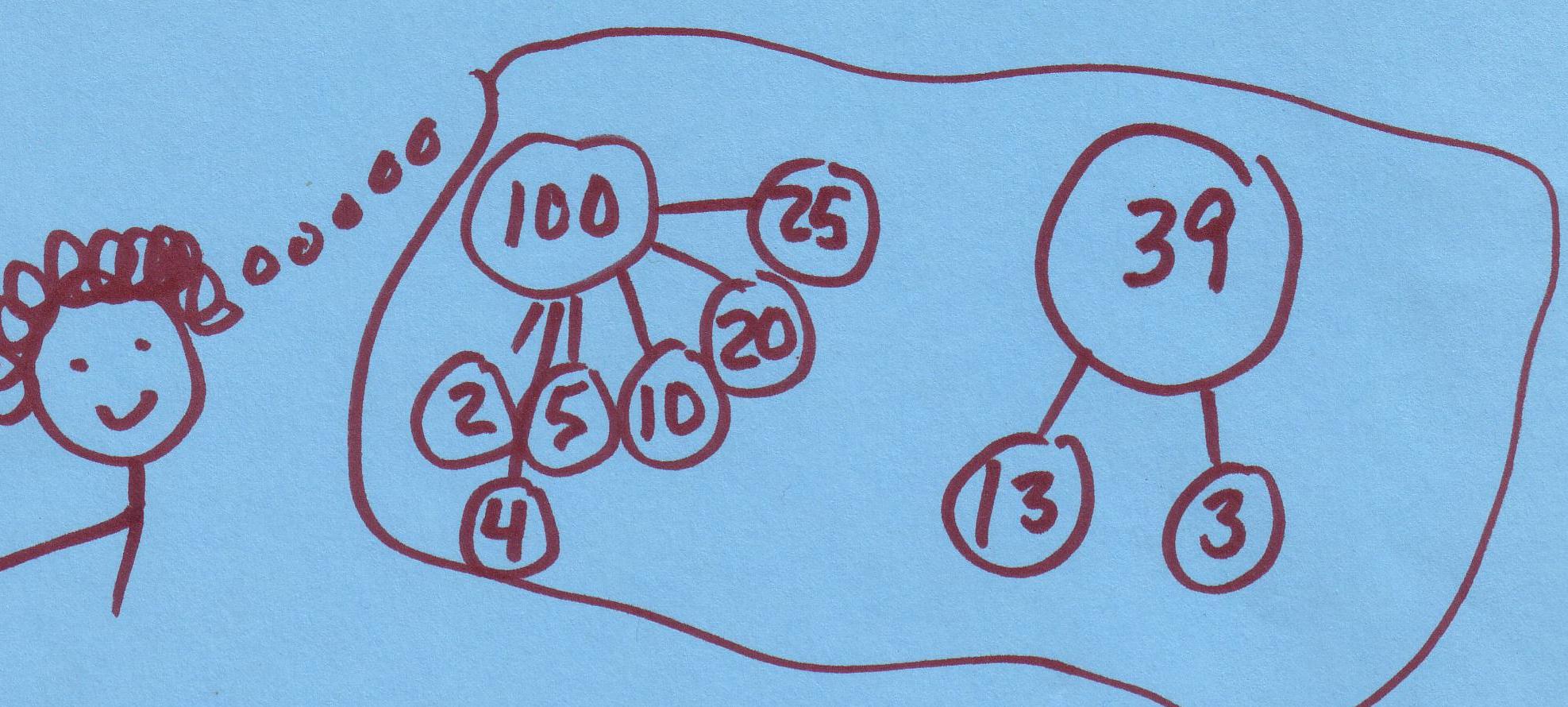
When I tear myself out of whatever book I’m reading, I play with the page number as I walk away. 139. Hmmmm: is that prime? It might be, since none of the proper factors of 100 overlap with the factors of 39…

thinkingabout139 cropped

When someone in our family has a birthday, I figure out the prime factorization of the new age. My father recently turned 92. Let’s see: 2 x 46, or 2 x 2 x 23. Suddenly I feel, inside the 92, an 80 (4×20) and a 12 (4×3). Oooh, cool.

Last year, my daughter’s children were both prime, 3 and 7. As of a few days ago, they are both powers of 2, having turned 4 and 8 (or 2×2, and 2x2x2.) Abe is now twice as old as Julia, and that will never happen again.

What official-sounding thing can we call this? A mathematical storytelling impulse? It works for me.

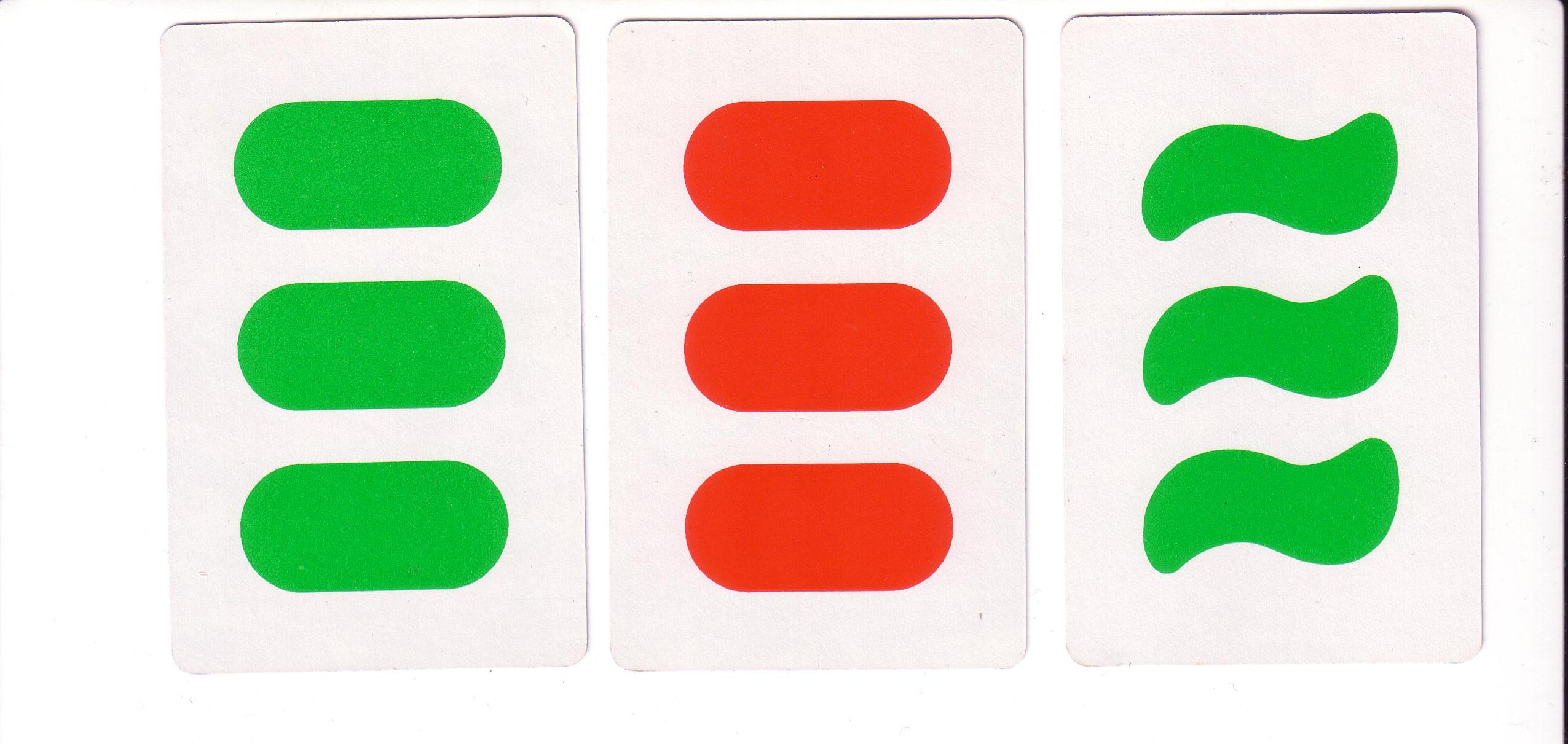
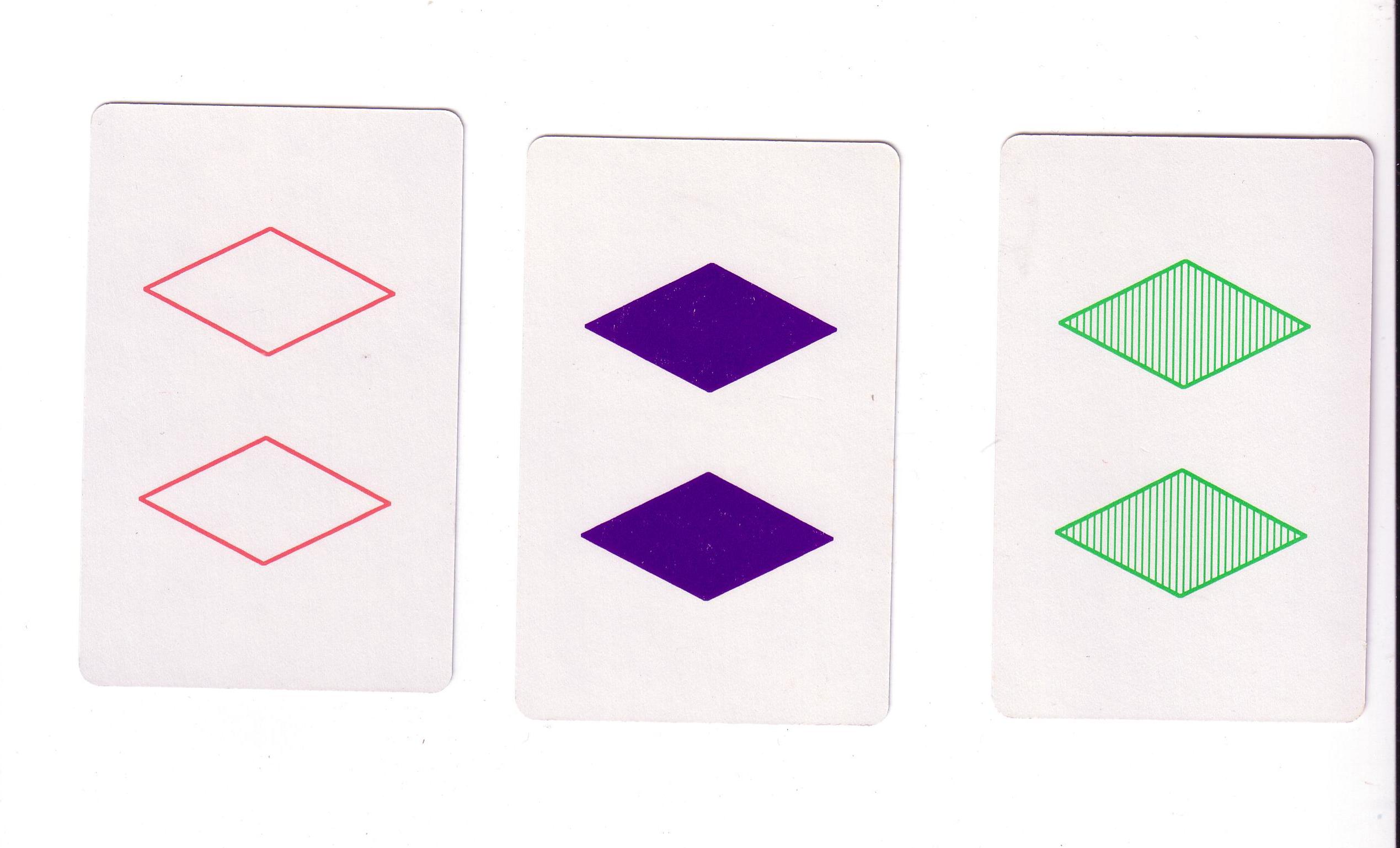
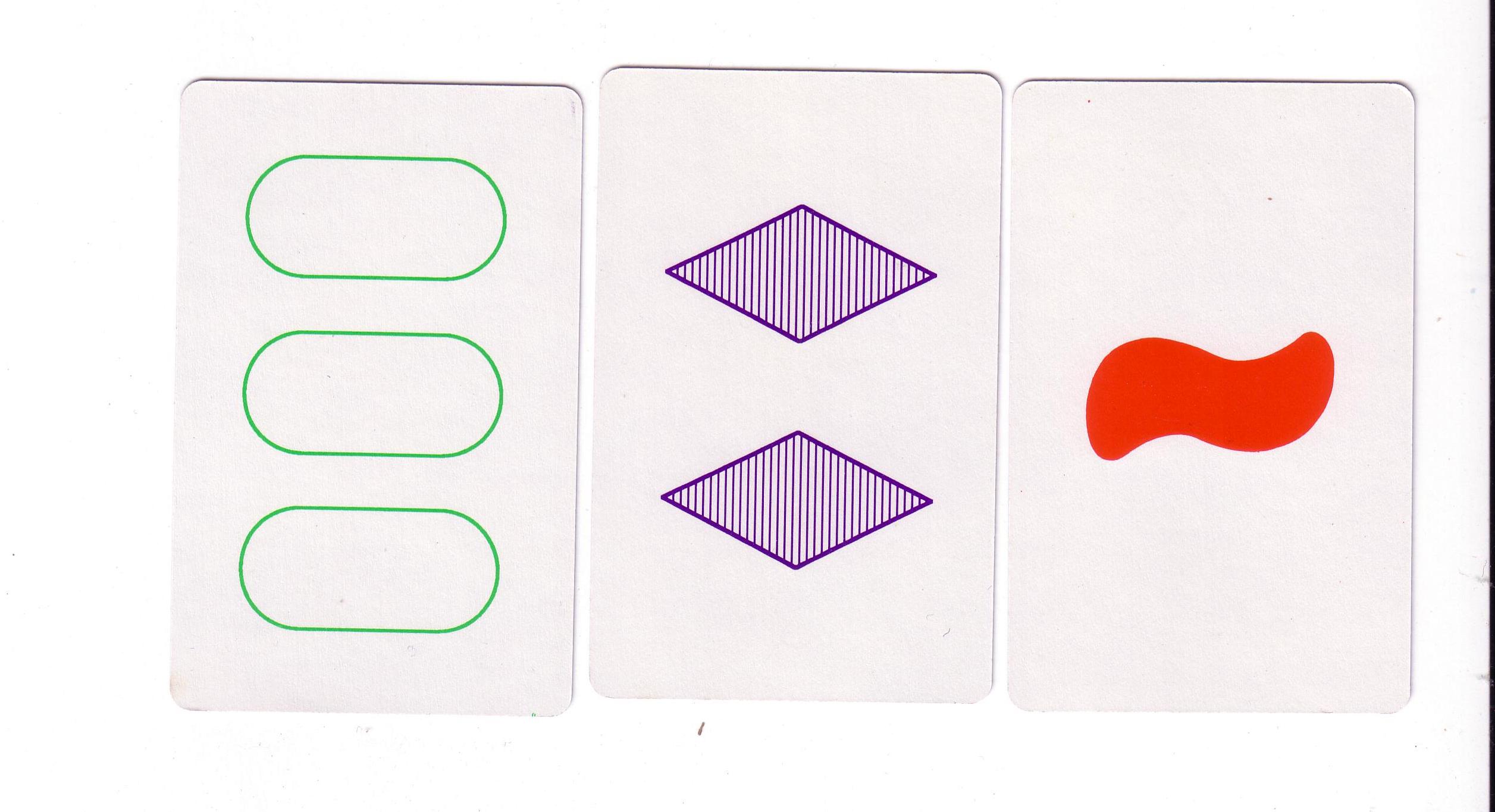
But other things can work, too. I’ll never forget the day my kids and I stopped by Kate Keller’s house for a quick visit, and learned now to play Set, from watching her play it–because she refused to tell us the rules. Obsessed, we came home and made our own version out of file cards. Later on, watching my students play Set was like giving them a diagnostic test. Some kids were quicksilver zippy at Set, and slow at everything else that happened in class. Some kids were slow, as I am, but warmed up as they went along. Clues, clues. And hilarious fun: in math choice times, I had to limit the number of kids who could play Set together, because that corner would get so loud.

This is not a Set:

not set aNeither is this:

not set b

But this is:

set c croppedand this is:

set a…and this is a particularly delicious Set:

set bTo learn more, you could track down Kate Keller, my all-time-most-important math mentor, who has more fun with math than anyone else I know. She also perceives and nurtures students’ math individuality with something I can only call math compassion, a power almost magical.

Or follow this link to the Set Wikipedia entry; it’s fascinating! There are ways to play Set online now, too–a discovery that could sharply curtail my future productivity.

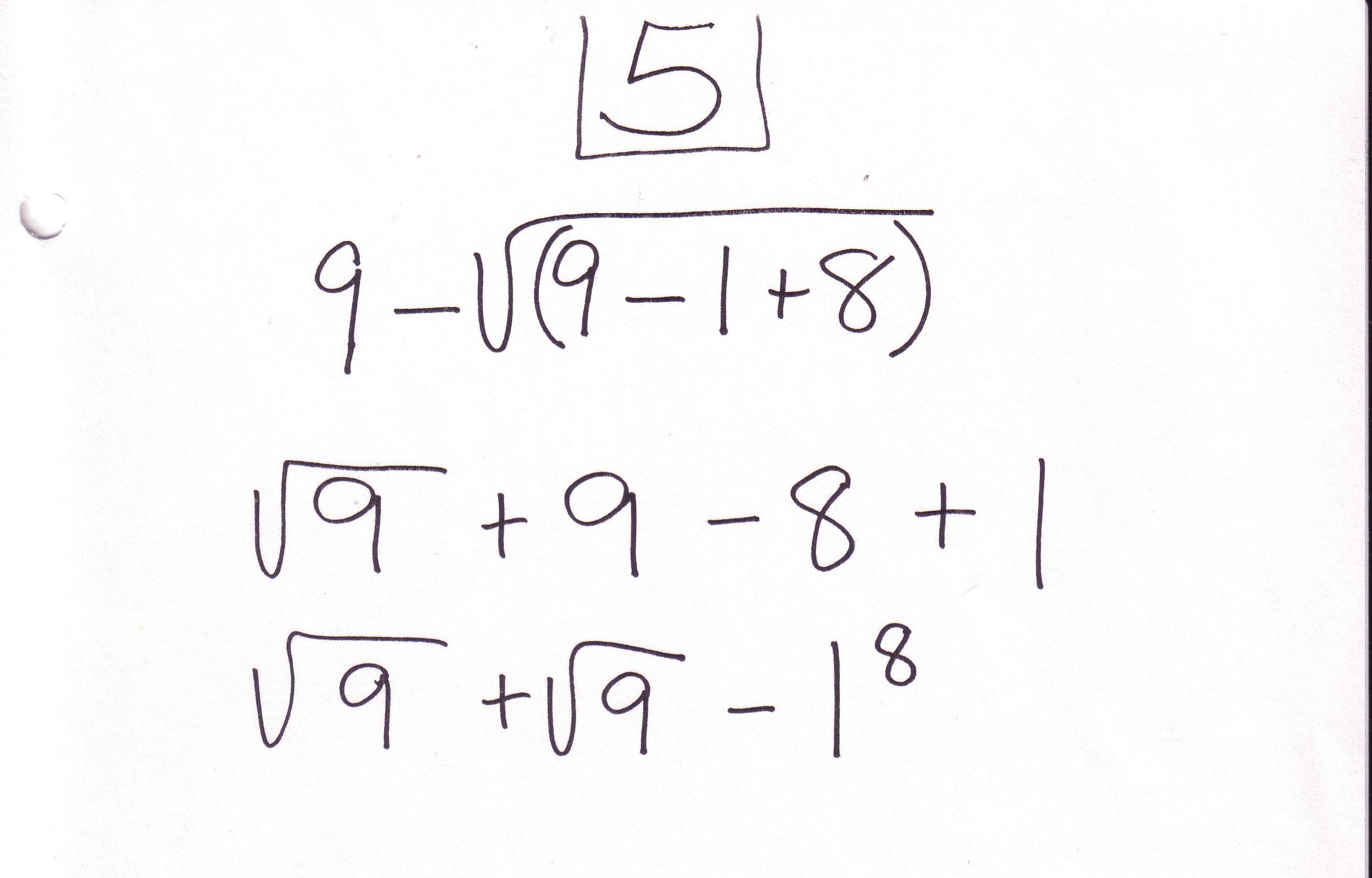
Finally, Lloyd’s Game. Of course, he probably called it something else. I’ve sometimes imagined Lloyd just up and quitting when one of his best whole class math games no longer worked. 1999 was a great year for this game, but the very next year, 2000, was hopeless.

In Lloyd’s Game, you have access only to the digits in the Gregorian calendar’s count for a given year. You combine those with math symbols (no quota on those) to create expressions equaling the numbers from 1 to 100. You must use all four digits in each expression, and you may not use two-digit numbers made from combinations of digits (although I remember resorting to that a few times when nothing else worked.)

Generally, in class, we used the new year’s digits to create the numbers of the days in January, catching up with a burst of activity when we came back from the holiday break or weekends, but mostly targeting each number as it came up, day by day. We used the basic operation symbols, + — × and ÷, along with parentheses, the fraction bar, the square root symbol, and the exclamation point meaning factorial. We were allowed to use a number as an exponent, so 1 to the 9th power was an excellent way to dispose of a superfluous 9.

Here are two examples, using 1989:

Lloydgame27and2 cropped

The best fun came in class, as we compared multiple ways of arriving at the same target number. Gradually, as January progressed, we watched and cheered breakthroughs for kids who had initially feared the game’s challenge.

Here are three ways of making 5, from one of the posters we hung up around the room, again from working with 1989:

LloydGame cropped

After 2000, a flop for obvious reasons, we sometimes used the year in which the largest number of kids in the class had been born. Sometimes I chose numbers relating to our themes: the year Charles Darwin was born, the year the Blackstone Canal was first opened, etc.

Try it out, alone or with some pals. You can use the birth year of your favorite politician—they’re all still creations of that wonderful (for this purpose) century past.

In any case, life is short. Go ahead and feel human. Play with math while you can!

My Place and Our Places

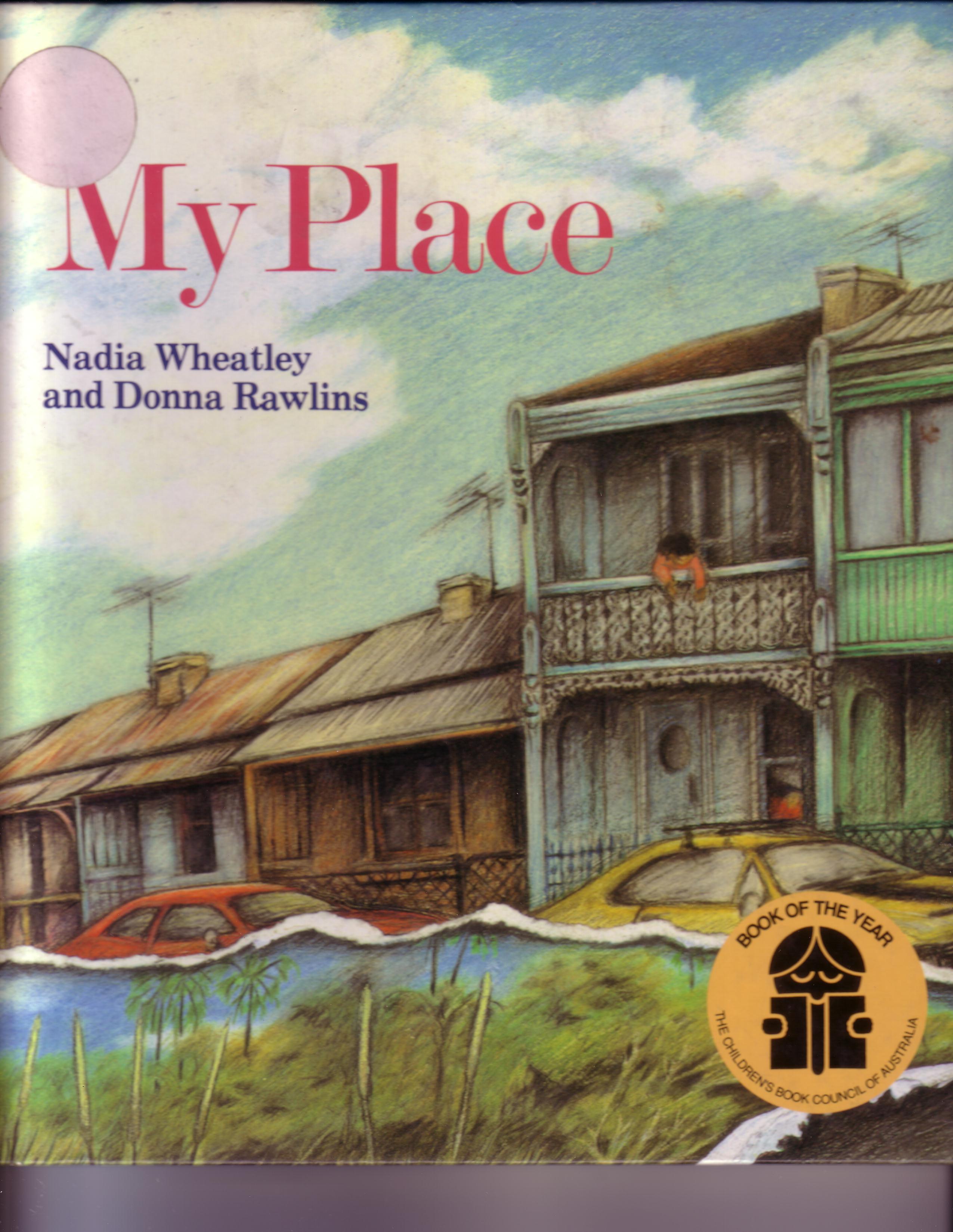
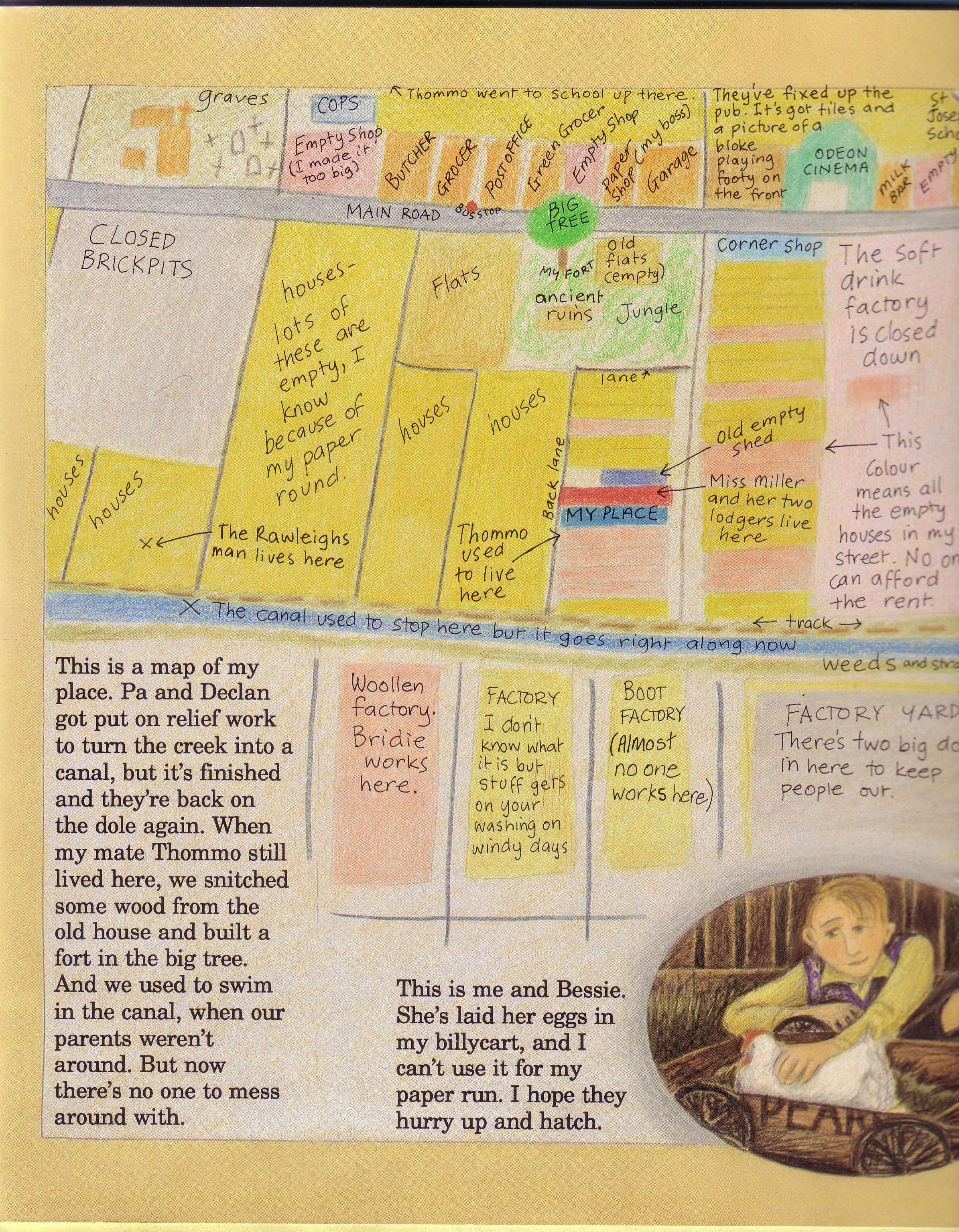
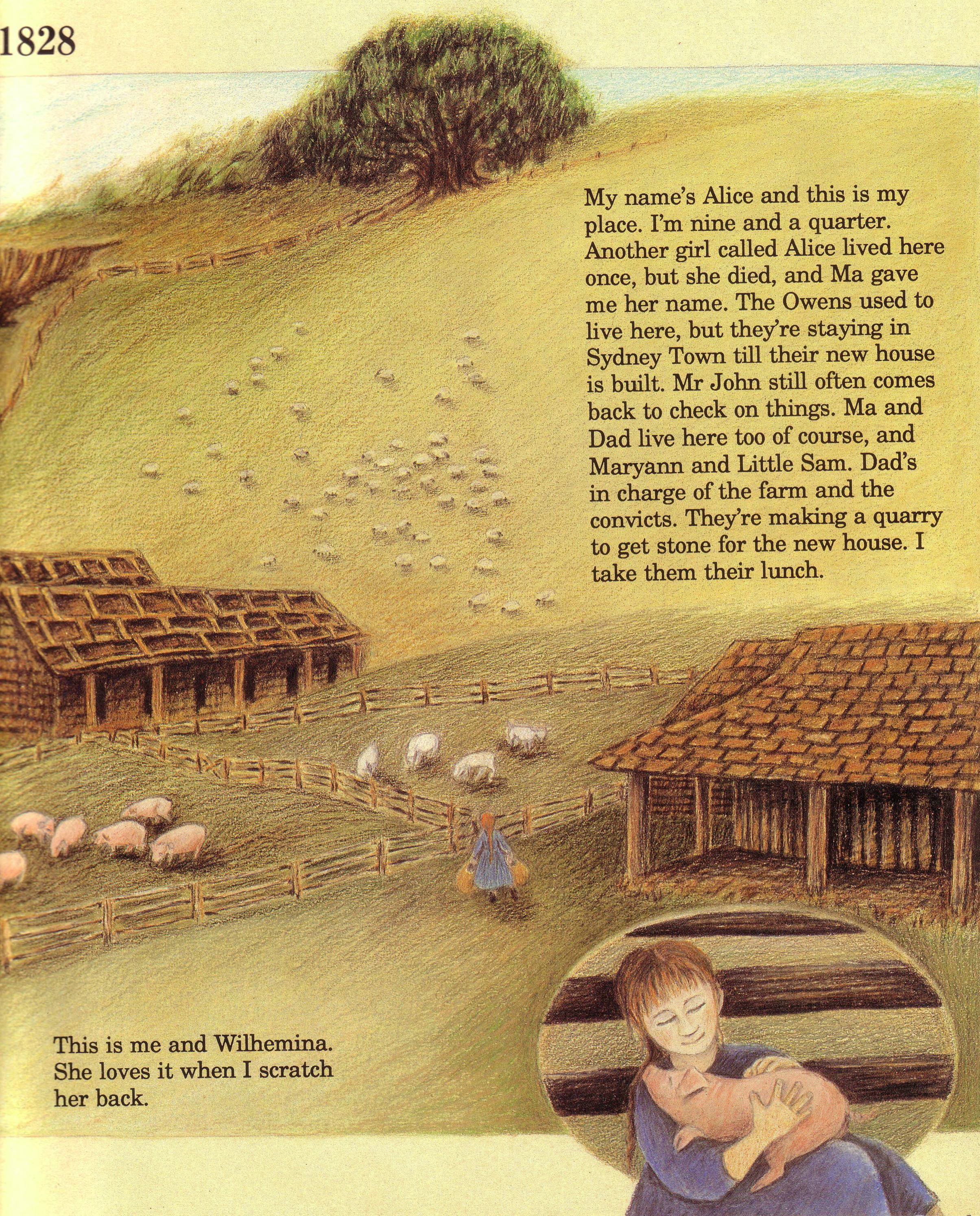
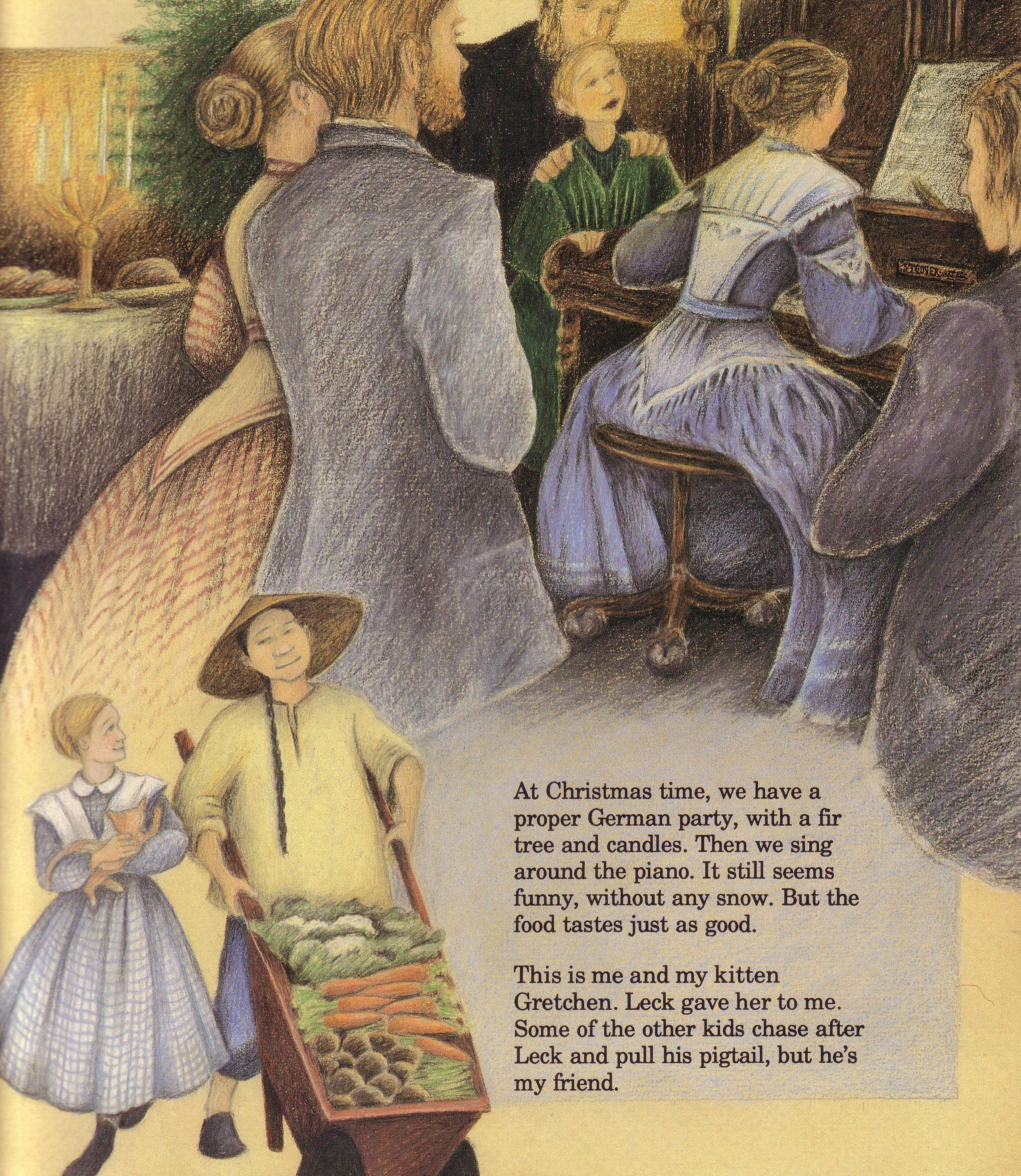
Last week, I focused on the book My Place, by Nadia Wheatley and Donna Rawlins, in which a series of child narrators describe the place where they live–always the same place, on the same hillside, changing as the book moves backward through Australian history. Each of the child narrators has his or her own sense of that same place.

What builds a sense of place, for any of us? What do we even mean by that? What can adults do to give kids a sense of place–or to stay out of the way of their process of developing one?

The book My Place inspired Our Places, a book created by one of my classes in the spring of 2010, when the kids with whom I had worked that year decided that they wanted to make their own maps of their own places, and put them together into a book.

We had discussed other final group projects, but this was the one they chose. “Only it can’t be different years, like My Place, because we’re all living in this year.”

“Just our different places.”

“And we’ll tell about the same kinds of things.”

Here’s a detail from Anwyn’s pages: Our Places Anwyn 1 detail

Pets

By “the same things”, the kids meant the motifs we had noticed in My Place, and then listed, common threads from child narrator to child narrator. For example, in both books, My Place and Our Places, almost every child’s place includes a pet.

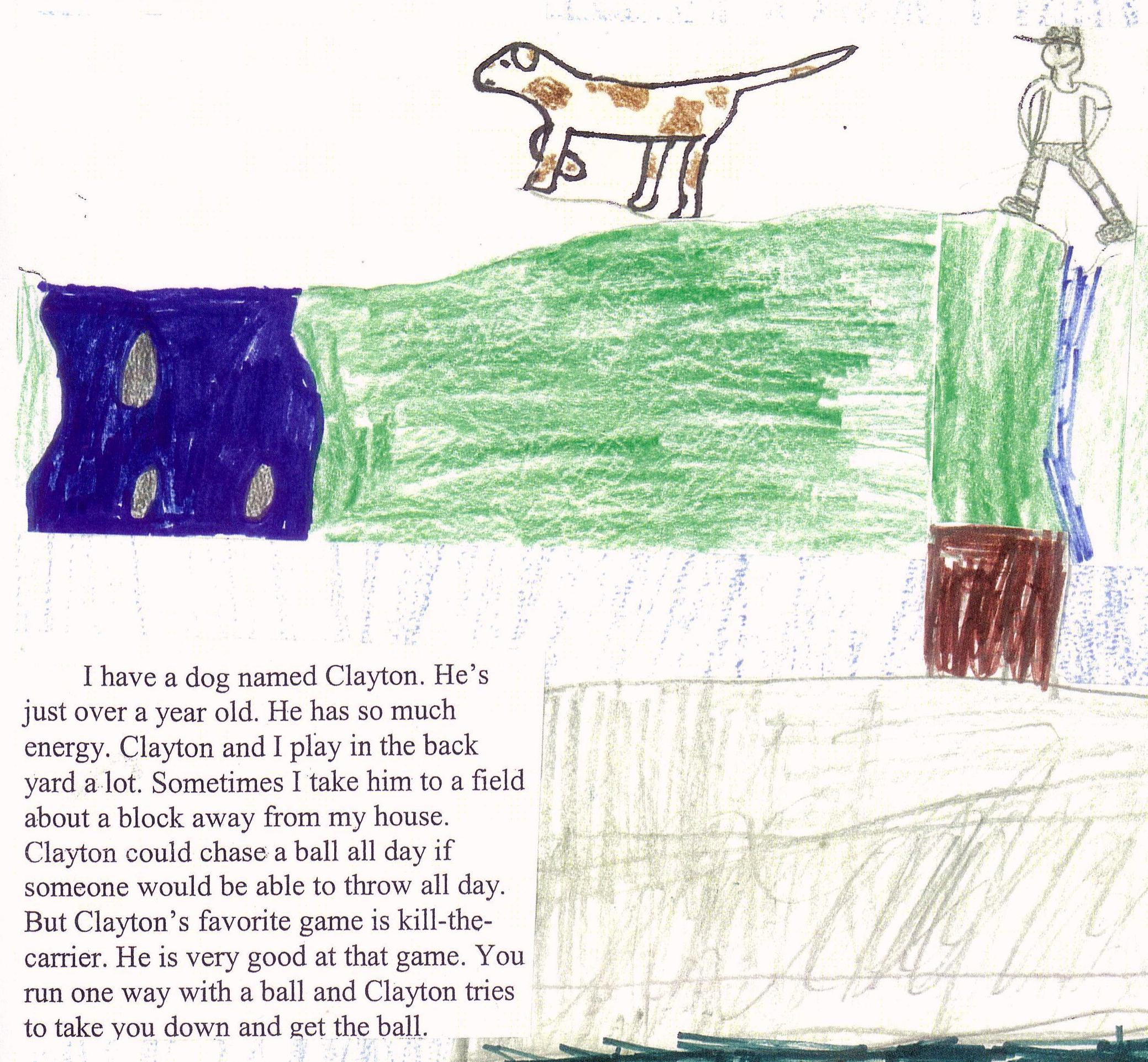
Jose wrote about his dog, Clayton. Our Places Jose 1b detail

Other kids wrote about cats named Oliver, or Shelly, or Scout. One described a parakeet named Tweety. Our Place Isy 1b detail with Penny

Another wrote about her hen, Penny, who is “smarter than the other chickens and always bosses the other chickens around, even though she is the smallest.”

Parties

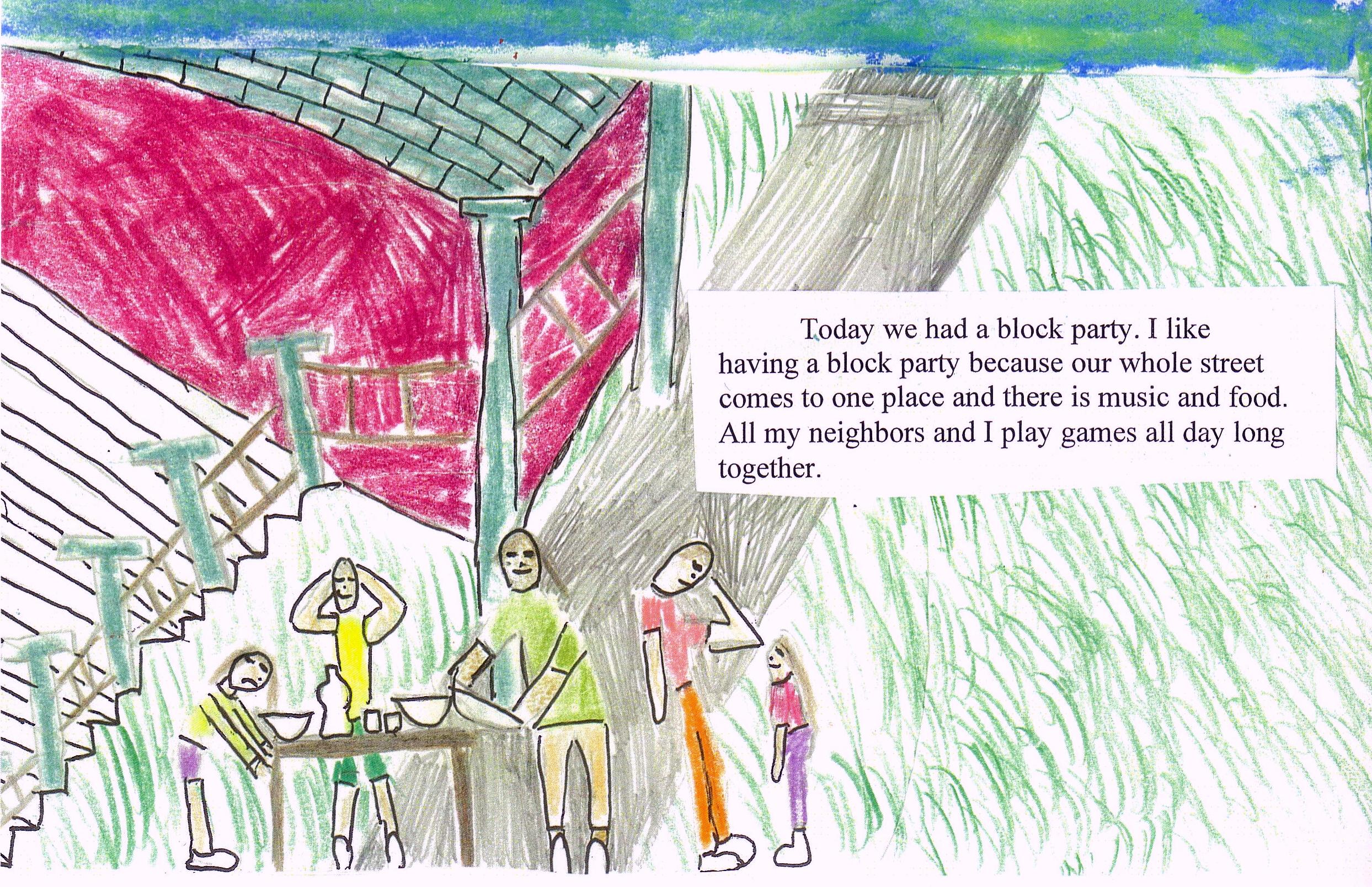
In both books, there’s always some kind of party. Luke lives in two separate houses with the two sides of his family. He decided to write about the place where he lives part of the week with his dad, in a section of Boston. Our Places Luke 1 block party

The detail below is from Caroline, who had already explained that her next-door neighbors were “almost like grandparents.” Our Places Caroline 2b party detail We didn’t coordinate which kinds of parties which kids would write about, but we wound up with an interesting variety: birthday parties, generic summer parties, a Halloween party, a Super-Bowl-watching party, a Fourth of July party with lots of fireworks, a Christmas party, and the gathering to send a big sister off to her prom.

“Some of the parties in My Place are for sad occasions, not happy ones.”

“Like Michaelis going away to Vietnam.”

“Or Thommo’s family getting thrown out of their apartment.” 

“Or there’s the time when the war is over, and some people cry because they’re glad the war is over, but sad that their boys aren’t coming home.”

“But that year’s kid walks on stilts and gets everyone to stop crying.”

Connections to the past

We talked about what the students could include that would be like the giant fig tree at the top of the hill in My Place, a landmark experienced and valued by every child narrator across a 200 year span.
Should the students each focus on some natural feature? They settled on just something old: an old tavern, the stone walls along which chipmunks and squirrels run, an old car, cemeteries, a big rock.
Our Places Dean 1 rock detail

 Freedom

Growing up in a time when some kids are asked to check in with their parents by cell phone as often as every half hour, my students had been interested in the way the My Place kids roamed all over their neighborhood or hillside, with and without permission. Although we hadn’t chosen it as a common thread, several students wrote about their range of freedom, and how that had changed as they’d gotten older.

For example, Abby described being allowed to bicycle further: Our Places Abby bicycling detail

Another girl marked in green the streets on her map where she was allowed to walk by herself.

Maps

These were sketch maps, like the ones in My Place, made to scale as well as kids could manage, but not based on detailed measurements. (That would be another project.) Here’s Abby’s map of her newly enlarged territory: Our Places Abby 2 map Some kids made their maps more accurate with the help of published maps, by tracing or just looking at an existing map or aerial photo to get a sense of relationships. Our Places Nate 2 map detail Like the maps in My Place, the student maps told parts of each child’s story. Our Places Max 2b

So what builds a sense of place?

A sense of place can’t require staying put. In My Place, the final narrator, an aboriginal child, says, “I belong to this place,” instead of “This is my place.” But the place shown is just one of several places where that extended family stays for different parts of the year.

What would it be like to stay in one place? Barangaroo’s grandmother says nobody would do that; it would be boring. For sure, though, Barangaroo has detailed knowledge and a strong emotional connection with that place.

When I moved to the house and neighborhood I think of as “where I grew up”, I had already lived in seven previous places.

Our Places Polly map detailMany of my students spoke in discussion about special summer places, or even, for one, a place she’d been only once, but memorably. I too had been strongly influenced by places where I’d never actually lived, including my Maine grandparents’ dairy farm, and my other grandmother’s urban lot in Brockton, Massachusetts, where I met the kids who lived on the street, and established hide-outs in the bushes.

Who knows? The sense of contrast between a variety of places may focus a child’s attention on the uniqueness of each place. Our Places Matt treehouse detailIn any case, here’s what seems to be more important than duration: a child’s active experience of the place. To bond with a place, a child needs experience of that place within some kind of freedom to explore, to take risks, to know a range of emotions, to act on a sense of possession. To grow her own garden and decide what to plant in it; to build a treehouse with his uncle, or a dam across the creek, or to follow the path across the brook; to create a little secret get-away under a wisteria bush.

Each experience becomes a tag, a label on the mental map the child is constantly creating, partly unconsciously. Each tag gets reviewed with revisits either physical or mental. Few kinds of learning more clearly deserve characterization as constructive learning, learning fitted together and made coherent by the learner; learning that constructs meaning instead of receiving it–in this case, meaning that is especially deep and nourishing.

I’m struck by the importance of peers in this process of place-bonding: siblings, or neighborhood pals, or cousins, or even rambunctious dogs–fellow explorers, with their own impulses and their own hesitations, often useful.

Time on one’s own matters also, and this is demonstrated in all my students’ equivalents of the hide-out in the My Place giant fig tree: their solitary bike rides, walks over to Dean Park, and charitable activities for ants.

On the other hand, for anyone who thinks that young adolescents don’t care about grownups: notice the importance of both parents and other adults, the next door sort-of-grandparents, the almost adult who babysits, the neighbor who takes all the kids for a ride in his old car, while everyone squeals going around the corners.

I loved how much I learned about each of these students, in the process of learning about their connections with their places. Teachers have to live with various kinds of grief, and one of them is this: it’s not possible to do every wonderful thing with every class. But I can’t help wishing I could have, and sometimes, in a group of adults, I have an almost irrepressible impulse to give them this assignment.

(Maybe some readers will comment with labels you would write on your own map, if you made one.) (Or with your own map.)

When we agreed to make the book, I said I would figure out how to send a copy to Nadia Wheatley. It took several steps of contact, and involved some suspense. Eventually, that summer, a package came back from Wheatley with thanks warmly expressed, and with a wonderful surprise: a DVD of episodes from the video series made for Australian television in the year of the book’s twentieth anniversary, with extra episodes to carry the story to 2008, exploring new dimensions of belonging or not belonging.

The video is wonderful, and does special justice to the book’s theme of transcending differences. Still, I feel as I often do about film adaptations of books I love: the book means more to me. It’s less about excitement, television style, and more purely about the role of place in our lives, the responsibilities a place can grow in us, and the ways sharing a place can connect us.

My Place

We’re sitting in the meeting area–not in the circle we use for meetings in which we all talk with each other, but in the arc facing my corner, that works better for read-aloud books with illustrations. For a larger class I would need to make a Power Point. The intimacy of leaning forward, leaning together into the world of the book, can work here.

In this memory, I’My Place Nadia Wheatleym reading My Place, a book created by Nadia Wheatley and Donna Rawlins, originally published in Australia in time for the bicentennial of their European settlement. One of my early class parents discovered the first U.S. edition, and donated a copy. (Most of the copies I’ve bought over the years have been from the later U.S. edition, from Kane Miller, who bring books from other countries to the States.)

After that first reading, one crop of kids have linked to the next, and students spending a second year in my mixed-age class have said almost every year, “You should read My Place again.”

As I begin to read aloud, puzzled faces remind me that the book can be confusing. Each year, reading My Place refreshes my appreciation for the full, rich range of interests and attention styles represented among my students. I’ve learned to trust them: they’ll get it, together.

My Place 1968 editThere’s the kid who always notices numbers of any kind, including dates. She figures out, already on the second two-page spread, that we’re going backwards in time. “Before it was 1988, now 1978. The next one will be 1968.” It is, and that year’s child narrator, Sofia, has posters of the Beatles on her bedroom wall. She writes about an older brother who’s a soldier in Vietnam.

That step to the side–to a history both different from our own country’s, and similar to it–lets us notice things we may have been programmed not to notice. Kids say, “So they were involved in the Vietnam War, too?” “Both countries were settled by waves of immigrants?” Eventually, “This stuff about how the Aborigines were treated–it makes me think about our own Indians.”

Always, at least one kid is especially interested in maps–visual records of things that stay in one place. He looks at the progression of child narrators’ maps, a new (older) one for each jump back in time, and he begins to imagine a similar map of his own neighborhood: how far from his house he would include in each direction; what scale he would use; what he would put in and what he’d leave out; what he would label, and what colors he would use for different kinds of buildings–all the decisions we’re meant to imagine the book’s child narrators making. (The map below is from 1938, which was a hard time in Australia, too.)

My Place map 1938 edit

Other kids make sure I read all the labeling on each map–partly because they’ve figured out that important clues are often embedded there.

Another kid is crazy about geography as lists and facts. She quickly picks up on the clues that we’re in Australia, something I try not to give away. Some years, we take this further: we use the detailed clues to convince ourselves that we’ve found the bay and canal near Sidney. (The map below is from 1838.)

My Place map 1838 edited

My Place 1898 railings and Miss Miller detail

Some kids are particularly able to pick up on detail in illustrations, and they’re the ones who say, “Wait! This is all the same house! Look at those railings!” Then we go back and compare, page by page: yes, yes, yes, yes.

My Place 1988 railings detail

My Place 1828 hillside cropped And for much of the book it is the same house–each child narrator is the right-aged child living in that place–until the house hasn’t been built yet, and we’re with the sheep and pigs, on that hillside, below the big tree, above the bay and creek.

In every class, some kids will have unerring radar for family relationships, They’re the ones who first point out that Sofia in 1968 is the unwelcome baby sister in 1958; or that the Miss Miller who is almost 90 in 1948 is the zippy aunt with the bicycle in 1898, and also the nine-year-old Minna who makes friends with a Chinese immigrant vegetable farmer in 1868.

My Place Minna and Leck recroppedBy 1798, almost the end of the book, everyone has learned to follow these connections through the book’s strangely inverted time. When 11-year-old Sam, indentured convict laborer, climbs up into the big tree and pretends that he can see all the way to Shoreditch and his mother and sisters and brother, the class grows even quieter. They know that he will become the Sam remembered in 1838 by one of his children, the father who has fallen off the rich landowner’s roof, and died.My Place last map detail

I don’t want to tell about the actual ending of the book; I want you to go find it and read it, and join all of us in the complicated feelings it generates.

My Place and Place Based Education

There’s a new name for something I’ve always tried to do as a teacher: place based education, arising out of the resources of a place, helping students develop a sense of place, helping students feel responsibility to their place and empowered to make a difference there. (If this sounds good to you, you should go find the wonderful books David Sobel has written to explore place based education and document its effectiveness.)

Nadia Wheatley and Donna Rawlins were also doing place-based education before it was named that. Clearly, they created My Place to help Australian kids know more about their country, and to encourage those kids to know their own local and particular places, their personal equivalents of the big tree that is a landmark for every one of the child narrators, or the canal that was once a creek, or the ridge where the main street was once a footpath. Because there are so many narrators, the place itself assumes unusual importance.

I’ve always been fascinated that their book’s strategy works for American kids, too. Immersion in this other place encourages kids to notice their own places, and I’ll write more about that in a future post.

It seems to me that Wheatley and Rawlins must have wanted something else, too: they wanted to show their narrators experiencing the local versions of big picture history: the pros and cons of the immigration experience; the hurt of economic injustice and waves of joblessness; the recurrent mercilessness of war, and the injuries and losses and dislocations left in wars’ wake; the environmental impacts of economic development, as we travel back to a time when it was actually safe to swim in the creek. But also kids’ perennial delight at new technologies: streetlights! personal automobiles! television!

Within all that big picture stuff glimpsed small and made real, Wheatley and Rawlins have shown us each child narrator’s way of assembling and creating his or her own experience out of what is available. We see all the different reasons for perching or hiding in the big tree. We see the comfort children find in animals, and the things that can be learned about each child’s adults from the parties they throw.

Always, in each new older time opened out for us, something has been lost; always, something has been gained. Each child narrator exists within the river of time, which gives and takes away. The book itself, its spirit, becomes that river, revealed to us in a special way by the authors’ device of making it flow backwards.

For just a minute, I want to address directly all those years’ worth of kids sitting in a series of meeting areas together, taking up the book’s back-cover challenge: THIS BOOK IS A TIME MACHINE! Again and again, you showed me details and connections I would have missed by myself. But also, in the deep and brave way you experienced the book and its place and world, you helped me feel what it all meant, and for that especially I thank you.

My Place Sam in the tree detailThere’s more to this story: the book’s wonderful success in Australia, and its transformation into a video series, brilliantly updated to the present; one class’s decision to make a spin-off book called Our Places. For various reasons, I’m saving those things for another time.