Deadlines and challenges

Jackie Lockney, amazing Touchstone physical education teacher, advocates something she calls “Challenge by Choice.” She helps students identify the skill–or the level of participation in a game, or the form of safe risk-taking–that they can move into when they’re ready, and she gives them whatever support they need–but they get to choose, kid by kid.

Jackie can talk a kid through a climbing element high in a pine tree, in a way that has felt almost supernatural to me when I’ve observed it. Not many people with Jackie’s personal physical skills can enter the mind of a kid who freezes, physically, unconsoled by the safety harness and line, and unable to talk himself or herself through–the kid who can only take that kind of risk with a copilot.

Out of her sight, without her even knowing, I’ve sometimes borrowed Jackie’s coaching-from-the-ground voice, to help myself get back on my bicycle, or tackle a mess.

Of course, we don’t always get to choose our challenges. People close to me are facing hard things right now, things they chose only in the sense that they agreed to love each other.

As teachers, we can’t always offer our students total flexibility or total choice in the timing of challenges. The deadline of an announced performance date always becomes a kind of emergency, no matter how carefully we plan the preparation. Teachers feel terrible, sometimes, putting kids on the spot by saying weeks ahead of time–the way we must–that a class will share some finished product on a given night.

On the other hand, here’s my image of what can result from that leap of faith–a physical expression of this class’s pride and relief at being done with their individual presentations for the Alhambra Banquet. I wish I could share the sound clip of whooping joy.

Alhambra cheer

Teachers need to take risks outside their teaching, in situations in which they themselves are fully the ones at risk. Especially in the beginning, every time I agreed to read poems publicly I knew the benefit of putting myself in my students’ place. I felt that even more whenever I participated in a class or workshop, and had to follow someone else’s directions, or perform a task with others watching. (In one math workshop in Maine, with the leader standing next to me, I completely lost my memory of how to use a graphing calculator. Gone.)

I took a risk this past month, agreeing to be one of several poets who are writing poems in response to sculptures, for a special online chapbook associated with the exhibit’s website. Here’s the big risk for me: less than two weeks for the writing and revising. What’s so risky? My usual process as a poet involves months, often years, of revision. To produce something on this schedule has been like writing in a completely different genre–as if I’d worked in fabric for decades and suddenly tried to work in clay.

One side-effect: an unusually long gap between blog posts. Nobody is hollering, but I’m worried, for my own sake, that after too long a break I’ll forget how to get back on this horse, too.

On the other hand, I’ve learned some things, launching myself out of my comfort zone this way.

The process of revision that means so much to me, within which I invariably learn and grow, consists of a conversation among various versions of myself, with an odd commitment to democracy and equality among those selves. Facing this deadline, I’ve been figuring out short-cuts for staging that conversation among selves, without waiting for years to go by.

For one thing, I’ve hollered for help, showing drafts of the poem much earlier than I usually would, to family members and to fellow Every Other Thursday poets. They’re not different versions of me, of course, but they trigger different versions, as I respond to their thoughts.

I’ve also pushed hard on something I’ve always known: that I could bring a different mind to a piece of writing, maybe especially a poem, by taking it with me somewhere outside my house. I’ve experienced breakthroughs for these sculpture poems while listening to 50’s and 60’s rock in the vintage McDonald’s on the Massachusetts turnpike; also listening to spring peepers near the Milford bike path; also in a nearby greenhouse tea-shop; also while listening to the sleeping breath of my youngest grandson, staring out at the hemlocks behind his house.

Obviously I’ve had to do some express writing (and express risk-taking) for this blog, too. No, it’s not death-defying, but I know myself better than you do; I’m up a pretty high tree, on this also.

What are these sculptures about which I’m writing? They’re sculptures by Boston area artists, in a show organized by the Energy Necklace Project at the Jackson Homestead in Newton, Massachusetts. They’re stunning. Here’s a detail from one of the pieces about which I’m writing, a fiber piece by Linda Hoffman and Margot Stage, called Forest Fall.
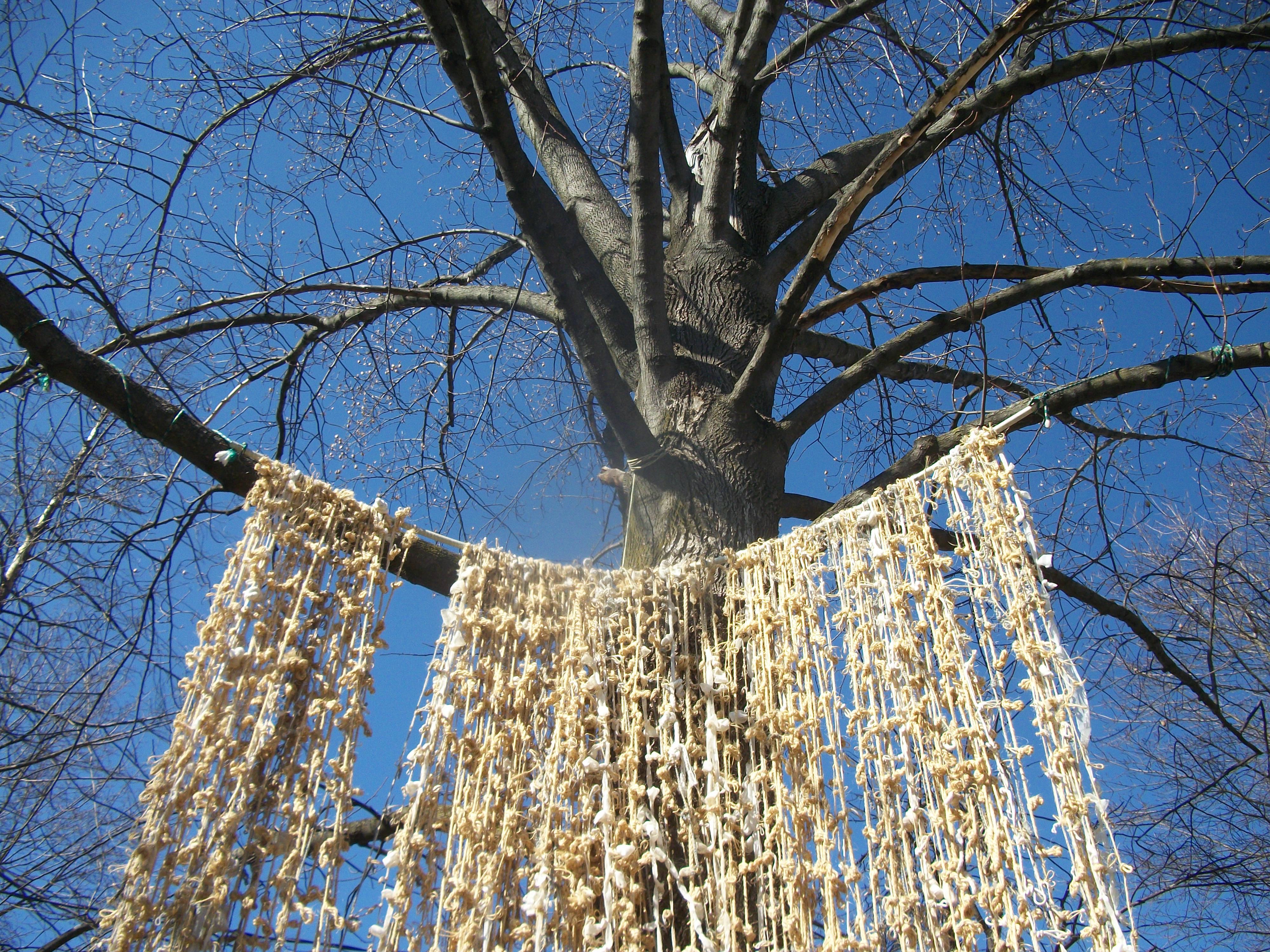
100_0807And here’s another, Reaching Hand, concrete cast from clay by Peter Kronberg:

100_0830If you follow this link, you can see the official photographs for the whole show.  The artists I heard speaking, at the exhibit opening, intrigued me with their descriptions of process, and moved me with their stories.  If we have good weather, the poets will walk from sculpture to sculpture, reading, on June 1st.

And any hour now–really soon–I’ll decide that I’ve done the best I can to live up to the sculptors’ work and courage, and I’ll let go of the poems they inspired. I’m planning to have my surrogate Jackie Lockney voice at hand when I press send.

Absence and presence

In the end, it’s not really the topic of grades that’s so huge for me— It’s the topic of no grades: what can happen, what I’ve seen happen, in their absence.

graduation JuliaThis is Julia Miller, who graduated from Touchstone long enough ago that she’s about to graduate again, from high school. Behind her, draped on the greenhouse, you can see the flag her Older Student Program group made the previous fall, just before going on their fall hiking trip. If you look closely, behind Julia’s right elbow, you can see the word CREATIVITY and the beginning of the word RESPONSIBILITYtwo of the values that group chose as their watchwords for the year. She’s about to dance–

graduation julia dance cropped–mostly as a joke, but I love the way this photograph shows her blooming along with the petunias, and reaching for the literal and figurative skies.

As they go through their experience, students in an ungraded situation aren’t thinking, “no grades no grades no grades.” They’re making connections from topic to topic and theme to theme and school to home (and vice versa); they’re trying out different voices and different genres and new strategies for understanding the world; they’re thinking a lot about the community of each other.

Teachers who aren’t giving grades aren’t thinking “no grades no grades no grades.” They’re making connections themselves, learning about their topics, watching and planning for ways to include other adults and experiences outside the classroom; imagining the world of each student from inside that student’s perspective; nourishing the community that can do more for each individual than any teacher’s plans.

As we went along, the missing grades barely figured in what I said about the teaching and learning I shared with each year’s class. At parent meetings, I never said, “First, I want you to know that I’m not giving grades.” It was taken for granted, invisible.

Still, that absence of grades was constantly at work in the presence of other energies and outcomes.

I saw the benefits: for kids whose learning experience had never been assessed with grades; but also for kids who had come to my school after experience with grades elsewhere.

Now and then, a transplant–or his parents–couldn’t make that transition. Most were like people woken from a long and troubled sleep. They stretched; they looked around; slowly, or quickly, they became active, in a new way, in the scene of their lives.

Still, I don’t have available the experimental control, in which the same teachers worked with similar kids and gave grades. I don’t know how that would have worked for any of us.

Close friends have said that I would probably have blown all my fuses and quit; that I would have left teaching very early in the game, if I’d been forced to translate my students’ growth and learning into graded assessments.

I wonder: how many teachers have been driven out of teaching by the necessity of an activity ultimately so alien to their original hopes and intentions? How many others, not questioning grades, have nonetheless abandoned teaching out of disappointment with the state of mind grading has induced in their students? What have we lost with this attrition, these departures?

My own history meant that I didn’t take the absence of grades for granted. I first started questioning the effectiveness of grading long before I was a teacher, long before my husband and I went looking for schools for our children. I became skeptical of grades at a time when I was being graded myself, and getting good grades. Not always, but sometimes, I could feel how addictive that was; I could glimpse how few risks I was taking; I felt, often, the price of that labeling.

Beyond that, I remember watching the effects of grades on some of my friends. I knew their talents and strengths, and wondered why their grades didn’t represent them more accurately. In fact, there didn’t seem to be any way for some of my friends to live in their strengths, in the classrooms we were encountering. Looking back I can see how the learning was often shaped to be easily measurable, easily graded.

If you’ve read previous posts, you know that I had some wonderful teachers. I don’t blame them individually. I was in the first wave of the post-war baby boom, and our classes were large. To some degree, increased testing and grading pressure attempted to manage that suddenly increased demand.

Like them, still, many teachers don’t have a choice of not assigning grades. Some give the grades they have to give, but play down the importance of those grades in any way they can, putting their energy into those other products and outcomes I tried to describe in the previous post:

  • Teacher support, and student goal-setting, guided by targeted, individualized, meaningful assessments
  • Learners who know and understand and respect themselves as learners
  • Authentic and rewarding group learning
  • Deep meanings held in community
  • Powerful connections with significant content

One of those “teachers without a choice” lives under the same roof with me, and his frustrations were part of what finally goaded me into writing about not giving grades. So I want to end this series of posts, at least for the time being, with a nod to him and to all those teachers past and present, saddled with the obstacle of grades and making the best of it, for their students’ sake.

I think I’ve said this before, and I never forget it for a minute: I was lucky.

But that’s enough (finally, or at least for now) about no grades. Next time, I want to start thinking about structures to help teachers and students meet each other halfway, beginning, I think, with the seasonal feast of the Skimathon!

In Praise of Colleagues

When I reread my last post, it hit me like a ton of bricks: I had left out something important. It’s easy to overlook something so pervasive that you come to take it for granted. My mother goes to a new doctor, and forgets to mention the mobility and visual impairments that define so much of her present life (along with her continuing eagerness and whimsy.) I write about resources for understanding student writers, and don’t actually mention the sturdiest resource of all–my peers.

After school, teachers gather in each others’ rooms and talk shop. Not every day—there are a few other things to get done: meetings and parent conferences to attend, notes to write on the whiteboards, math manipulatives to locate, photocopies to make, plain old ordinary messes to clean. Still, at the end of the afternoon, for many grateful years I could go stand in Susan Doty’s doorway. ‟Help!” I could yelp. ‟What’s going on with this kid? Why is he so afraid of writing?” I knew she would stop and think carefully about her answer, giving me the same kindness she gave children.

farmer in Crete croppedWhen Marian Hazard taught her own class, before she became the school’s garden wizard, she would wander down to my room and share insights provoked by the most recent book she was reading, about how to help children move forward as thinkers and writers. She often had more patience than me, for reading about education, and, later, for the work of cultivating both plants and gardeners. I gained, always, from sharing what she discovered.

For a while, Kate Keller taught in a room very near my room. When she was trying to describe a breakthrough in the writing of one of her students, she could easily invite me across the hall and produce evidence. ‟Look!” she would say, pulling a file from a pile of folders. ‟Can you believe this?”

four potsOur endeavor, in teaching writing, and in all things: to meet kids where they were, to travel with them as far as they could travel, to help them recognize and celebrate triumphs, and then move forward again—all that was collaborative, in a way not necessarily visible to students or parents.

A thriving faculty conversation is a living thing, like yeast in good bread dough. Over the years I came to see how hard it must be, how delicate, for a principal or head of school to trust and support and strengthen that conversation–and how essential.

three gourdsI also learned that I had to nourish myself, because any individual teacher has to punt, again and again. On the September day when I guided a new class through their first writing fluency exercise, and one child sat in her place at one of the tables and wept for the entire five minutes, and beyond, while everyone else counted the words they’d just written—on that day, like most teachers most of the time, I was the only adult in the room. The student had only recently entered my school; nobody knew her well. So she and I shared something: both of us were stumped. I wasn’t just stumped; I felt awful.

I didn’t scold, since I knew that she was doing the best she could. We talked briefly in the privacy of the hallway. I told her that I wasn’t worried. (I lied.) I told her what was true: that I would ask her to do the same thing again the next day—to brainstorm ideas, to choose one, to write for that little chunk of time that I knew could feel like forever. She would have another chance to try.

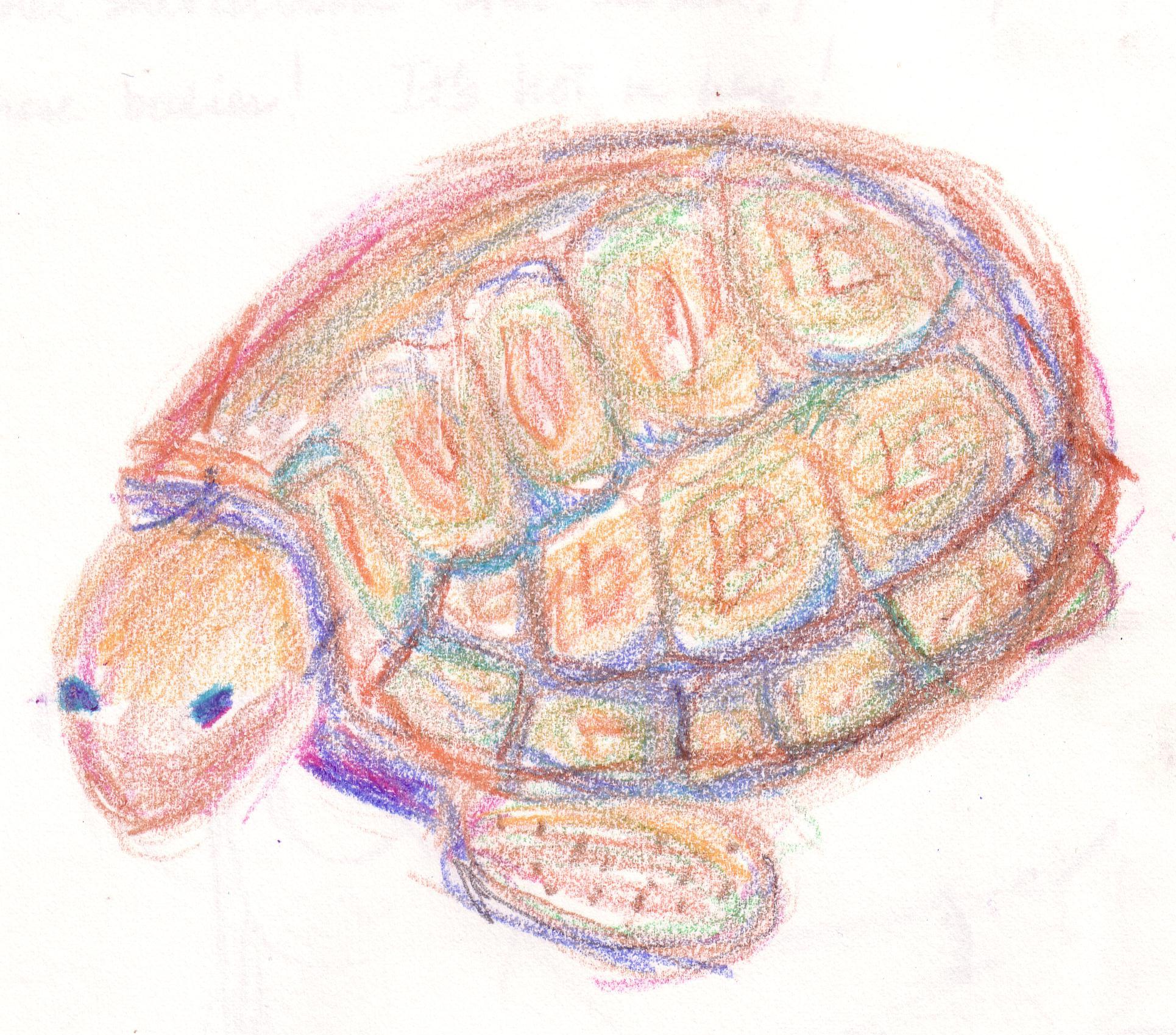
redblue turtleI also told her that she could do what I’d done in college: write about why she couldn’t write. If she had to—and she wouldn’t be the first to resort to this at least once—she could write one word again and again, until the second word came to her, and the third.

The next day she did brainstorm and choose; she did write. Not a lot, but some, and that was all the exercise asked for. She went on, that year, to write some pieces that took my breath away. ‟Look!” I said, to whatever colleague I shanghaied that afternoon. ‟Can you believe this?”

I’m telling this story, before I really describe that exercise (next time, probably), because I don’t think there’s any guaranteed approach, exercise, bypass strategy, or technological support for writing difficulties–and because, in my experience, the best source of wisdom, the best source of quality control, came from my fellow teachers. Also the best source of energy to keep going.

Knowing the results of testing or external observation can help, but parents and teachers both can easily make too much of such things. We need to know, by asking the child and by intuiting with all our senses, what challenges a child faces; we also need to offer the bypass strategies that can help. Ultimately, though, we have to do the same basic thing again and again: ask a child to keep trying, and give her credit for everything it takes to try.

I loved my school and my colleagues because our support for each other, so consistently, was support for our highest mission. We supported each other not by blaming the child—even though that’s sadly common in situations in which teachers are hard-pressed (and teachers tend to be hard-pressed.)

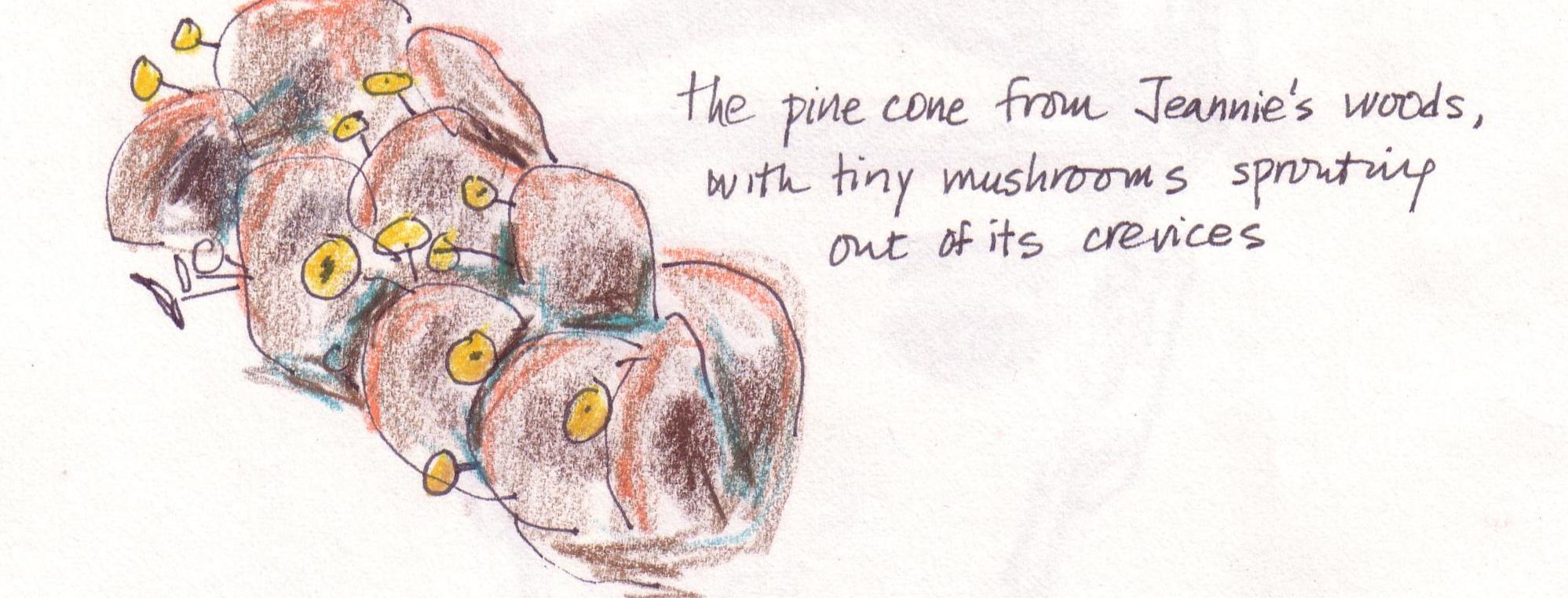
pinecone with mushrooms croppedWhen Julie Olsen, having seen me in the hall with a student, asked what was going on, she wasn’t looking for a chance to commiserate about those awful kids we were stuck with. If she knew the child, she always helped me see the world of the classroom from that child’s point of view. If she didn’t know the child, she asked questions that would help organize whatever I’d been able to observe. She laughed her wonderful raucous laugh with a particular twist that acknowledged the profound challenge of teaching—but it was never a laugh at a kid’s expense.

The colleagues I’ve named taught near me, literally or in the sequence of the school’s groupings, for many years. Others, not named here, taught older or younger children in other corners of the school, and helped me understand where my students were coming from, and where they were headed.

We supported each other by honoring each others’ efforts to know each child; by holding firm, together, on the issue of class size, so that knowing the individual child was possible; and by understanding, always, for each other, that all our hearts were doing hard work.

Last but never least, in moments grabbed from the ongoing intensity of our lives, we cheered each other on by sharing our euphoria about progress. I could not have asked for more.

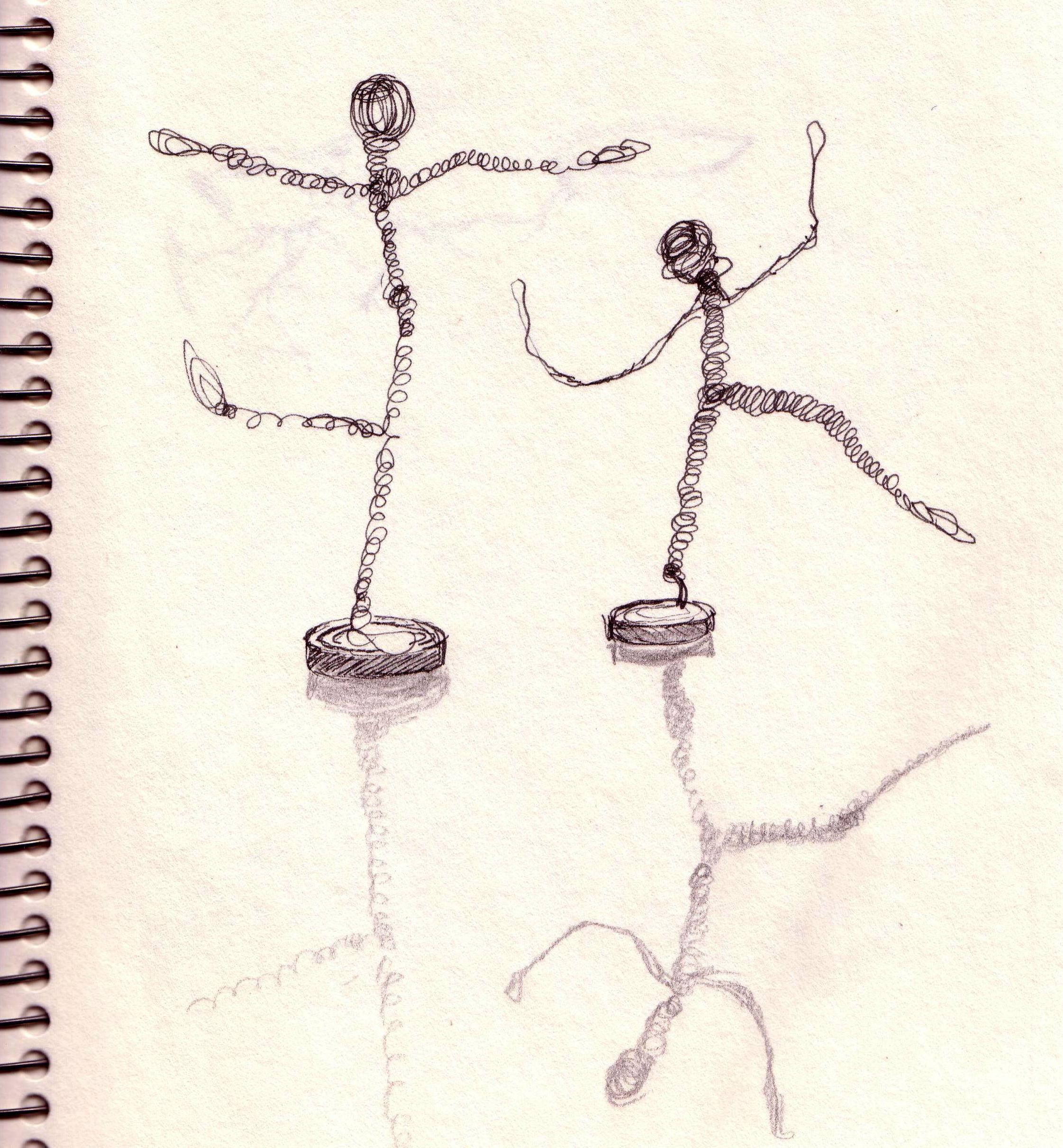
wire sculptures narrowerThe sketches are in thanks and praise for another teacher, Marjorie Weed, who came to volunteer at Touchstone after a long career as a public high school art teacher. She helped me encourage my students as creators and composers, by working with them herself, while I watched and learned along. Mrs. Weed inspired me to give kids time for sketching during our settling time, almost every morning. I was her “oldest and most improved student,” one of many who still value her influence.

a year to think it over

About ten years ago, my teaching partner and I were forced to look back at a big joint project. (Our grant required a lot of summary writing, to be posted on the organization’s website.) Six months after our giant thematic exploration ended, we went back to reconsider students’ writing and models and illustrations, and our own plans.

Looking out my kitchen window during a break in our work, Kate Keller said, ‟What if we always taught for one year, and then had a year to think it over?”

We did, of course, think as we went along. If we hadn’t engaged in ongoing reflection—grabbed chances for that out of the hurly-burly of teacher life—our teaching would have withered, our students suffered.

Still, what extra dimensions did it give Kate and me, to look back after a good-sized chunk of teaching was actually over? So many things:

  •  When we no longer needed to evaluate each child individually, we got a really clear picture of their work together, as collaborators—especially the ways they had taught each other. And us—the ways they had taught us.
  •  We got a clearer picture of some ways our students had struggled with the theme. Parts of our thematic study of transportation had asked students to consider their own transportation choices, and the impact of different choices on the environment and on other people. One student said, ‟I’m never getting into a car again,” as we walked down a Boston street after hearing a presentation by Stephanie Pollack, from the Conservation Law Foundation. At the time, we weren’t sure whether to laugh or cry. Later, looking back, we remembered a follow-up discussion about all the reasons why a person might not be able to make the ideal environmental choice, and valued, even more than at the time, what kids said to each other in that conversation.

We were critical; but we were also proud. We looked at the study whole, and saw that it was good.

Now, by Kate’s plan, I’m due about 25 years ‟to think it over.”

I’ve left my full time teaching gig. I’ve walked away with binders full of lesson plans and observation notes, boxes full of copies of kids’ work, folders full of communication to kids and parents, and from them.

I’ve brought it all to a barn in Maine, a place where I can open the back doors and look out at a wide meadow and a long pond. It’s a barn very full, already, with family treasures, so I have to compress this new pile radically.

barn back view try 4

As I stare at the meadow, listen to the crows, and sort (radically),  I’ll see what there is to think about. Already, for the posts I have in process, I’ve called people, written emails, asked questions.  Others’ responses have reminded me of additional topics I want to explore and reconsider–and of everything I’ve loved about teaching! What will find its way into actual posts? Time will tell.

Somehow, though, I am sure that looking back–carefully, thoughtfully, mercifully– will be a good way to start looking forward.

I’m so curious to know, if you’ve gotten this far, read this much: how do you reflect on your own learning and practice and profession, whatever they may be? What does it give you to do so?