Heels-over-teakettle, and Other Festivities

Today I’m thankful for all my fellow word-lovers, past and present.

I’m thankful for my grandmother, who chatted with everyone she met, and picked up other people’s conversational expressions the way a dog picks up burrs. She kept and passed on treats like enough blue sky for a Dutchman’s britches and one pickle short of a quart. Listening to my mother and my grandmother talk together–with a what in thunder is he celebrating? here, and a heels-over-teakettle there–marked me for life, in the best possible way.

Once again, I’m thankful for George Batchelder, brilliant junior high English teacher, the one who gave us whole class periods for the Times crossword puzzle. He also asked us to list, on a page in our notebooks, plausible but nonexistent words: words with English prefixes and suffixes and blends, that were nonetheless fake, of our own manufacture: beautaceous, recrunk, preventicate, loombipuddle.

I’m thankful for a host of word-crazy students, including Andrew Cozzens, who often leaned over at dismissal to confide his word of the day. Even after he had left my school, he wrote emails telling me wonderful words he had recently discovered, such as loquacious.

I’m grateful for the poets of Every Other Thursday, whose recent poems have included the words moonbeamedcantedphlegmatic, and loris, and the phrase crammed and nuzzling.

I’m everlastingly thankful for Alex Brown, and his children (who are also my children), and for our tendency, when together, to lapse into the synonym game without warning. Why stop with playful, when you can keep right on with lively, exuberanthigh-spirited, festive and frolicsome?

That leads me (inexorably, but also gleefully) to word games. Today I offer just a few, in honor of long car trips to and fro, and in tenderness toward family relationships more amenable to word games than to talk about affairs either local or international.

Warning: there may be a sequel, down the road. In my family, word games were not scarce as hen’s teeth; we were two-thirds wealthy with them. (What?) And then I went on to invent some.

First, my grandmother’s (and mother’s) special rules for Scrabble.

  • You may let a word edge over the boundary of the playing grid, by just one letter, any time you need to, in order to play a particularly satisfying word.
  • If you have the right letter to replace a blank, you may do so, and take possession of the blank, at any time; this doesn’t count as a turn. (My cousin’s wife Terry, during one particularly hilarious game, replaced a blank with a blank, but I can’t remember why, only the way we were reduced to mirthful tears.)
  • At the end of the game, everyone collaborates in an effort to place every last orphan letter on the board, in genuine legal words.

My mother, at 86, still won’t play Scrabble scored, because she wins so reliably that her opponents become discouraged (down-at-the-mouth, or even mad as a wet hen.) Once in a while, we’ll calculate the point value of a word just because it’s so delicious.

All my successive families have played the geography game in the car. My class used to play it when lining up for gym or dismissal.

  • The first player names a place: a town, a country, a street, a river, a mountain–anything that could be on an ordinary map. Let’s say Merrimack River.
  • The second player ignores parts of the name like River, focuses on the last letter, and comes up with a place name that begins with that letter. Given a K, the average person will say Kansas, but you can be playful–that’s the point, right?–and say Kalamazoo. I always try to, unless someone else has used it already in that game.
  • Small children may name a place somebody else has already used, if they need to, and anyone may have help with the spelling of tricky place names with ph making the f sound, like Phoenix, or endings that sound like ee but are actually spelled with a y. Etc. Our language, including our geographic language, is full of these opportunities, but adults should go easy on the pedanticism. (No, you won’t find it. It’s in the category of plausible but manufactured.)
  • You’ll want a good supply of place names that start with y, such as Ypsilanti.
  • Do not be alarmed if your game drifts into the dreaded A-swamp: America / Australia / Andalusia / Africa…  My class once made it through the entire line (becoming slightly late for dismissal in the process) using place names that begin and end with A. Like many hardships, the A-swamp arose there in our geography to test your indomitable spirit.
  • In the days of smart phones, it’s easy to resolve arguments about spelling. In my family of origin, I was definitely not the final authority, having the spelling memory of a flea, or maybe a rock.

Speaking of spell-checkers, you can play a solitaire word game by typing in the names of your friends and seeing what the spell-checker makes of them. Or follow the eight-year-old Colby Brown’s example: randomly type a paragraph entirely in gibberish; then let the spell-checker do its best; then write an actual paragraph around whatever words the spell-checker has found.

Last, for now, here’s a game that requires either a dictionary or, if there are no dictionaries available, a referee. It’s called the Syllable Game, and this one I invented.

  • We played this game many times beginning with the word Touchstone, the name of our school. Compound words generally work well, but the rules just require words of at least two syllables to start, and for every turn. In fact, you’re better off beginning with a word of three or four syllables. In class, this was often a word central to our current study. So, for example, transportation, or, for the purposes of the game, trans / por / ta / tion.
  • The second player comes up with a word that preserves one of the syllables of the first word. This is where you need the dictionary, to check the official syllabication of the word, which will often contradict your first impression. (On the other hand, there is nothing like a car full of people carefully enunciating the word metamorphosis to judge its syllabication. Just designate a syllabication referee as well as a driver, and you’ll be fine.)
  • In class, students were absolutely required to use a dictionary, which gave them great practice, exposed them to related words, and could lead to all sorts of pleasant detours.
  • The pronunciation doesn’t have to be preserved, but the spelling has to be preserved exactly. So trans / late or por / tion or im / por / tant could all work as second turns, but port / man / teau or tran / scribe could not, because the por has been changed to port, and the trans has been changed to tran.
  • Let’s say that the second player decides on trans / at / lan / tic. In a two-player game, the first player now jumps forward from that word, with all sorts of lovely possibilities: lan / guage or fan / tas / tic or at / ten / tion. Etc.
  • The syllable you’re preserving can show up anywhere in the new word, jumping from second syllable to first, or third to first–so long as it’s the exact same syllable spelled the same way.

Assigning this as homework, I asked students to play with a parent or older sibling, and to record the whole ladder of turns, showing syllable breaks. Parents notoriously resisted using a dictionary, but came up with wonderful words.

syllable gameFinally, for whole class play, to help the game move faster, I invented a variation called The Syllable Web Game, which we played on the spare white board at the front of the room. Any syllable on the board was available to  any player, even if it had already been re-used. (In the illustration, you can see how the ce from cement was reused in celesta, and then in celestial and cerulean and something I can’t read in the photograph.)

Usually we played this game during morning sketching time; sometimes also writing time and silent reading time. Players showed the syllabication and initialed their words, and then explained their meanings in the class debrief.

So now I bow, gratefully, to all the sources and innovators and playful practitioners of the language we share. It’s a very full room, and you’re all in it!

syllable Touchstone

Using Picture Books with Big Kids

Lately I’ve been trying to imagine my sixth-grade teacher, Mrs. Tuthill, reading a picture book in class, or letting any of us read one. Within the school day, I can’t remember being encouraged to read anything but textbooks. (I was lucky, though; I had a much younger sister to read to at home, and my mother was well on her way to becoming a children’s librarian.)

The people who taught my daughter and son in middle school, good and competent teachers, never used picture books, to my knowledge.

Right now, this minute, most teachers face intense pressure to demonstrate rigor and grade-level competence. I would be thrilled to hear about a sixth-grade teacher in my town, using picture books or urging students to include them in their own reading. I know it’s improbable.

On the other hand, the teachers who taught me how to teach, and the colleagues who challenged and nurtured my teaching spirit, all used picture books in inspired ways. I can’t imagine the life of each class community in which I was honored to work and breathe, without picture books.

It’s amazing what is controversial in this world.

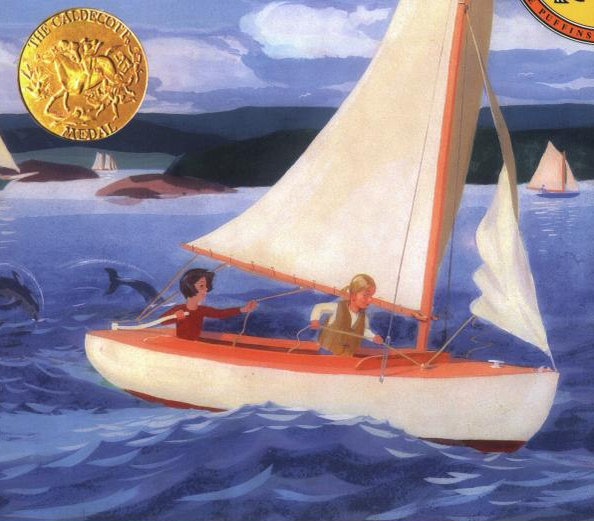
Time of Wonder crop aSusan Doty and I were setting up our classrooms, chatting now and then. She said, “I think I’ll start the year with Time of Wonder,” a Robert McCloskey book I didn’t know yet. It seemed like a sweeter book than I would usually choose for my cool and savvy 11 and 12-year-olds.

Still, I liked it, and tried it out on them.  As I read aloud, the room grew quieter and quieter. I could gauge the attention of many of my listeners by their faces; could tell others were with me when they grinned at the book’s very subtle humor.

Like all the best picture books, Time of Wonder is powerful and efficient. Reading Time of Wonder together, my class and I shared summer, and summer adventures, and the inevitable ending of summer. We shared what it’s like to listen to adults talking about possible trouble, a hurricane coming. We shared what it’s like to sit with your grown-ups and sing through the storm, and wake up the next day to explore the branches and roots of a fallen tree.

A good picture book, like a poem, and like so much of our everyday storytelling for each other, means more than one thing by everything it means.

We talked about students’ experiences of a recent hurricane. The book had given us permission to admit to having been frightened–if we were–along with a model of opportunities for discovery everywhere–and we had had those, too.

Recently I appealed to past students on Facebook. What picture books stood out for them? Taylor Davis responded almost immediately, “The one about the red canoe… something about a boy and his aunt…I remember falling in love with it!”

Three DaysTwo kids, two women who are sisters, a wonderful adventure with danger and glory, and a cat named Sixtoes waiting back at home for an offering of fish.

Some years I used “the red canoe book” as read-aloud to start the year, especially if we were going to be studying watersheds (or map reading, since they use maps to plan their trip.)

Some years, though, the canoe book waited with others to be chosen by individual students, out of a crate full of books brought from home, from my family’s picture book collection. That crate supplemented the classroom’s shelf of picture books, and another bin of books borrowed from the school library, and another from the public library. All together, kids could choose from an enriched and enlarged collection, in the two or three weeks at the start of the year when everyone read picture books during silent reading time.

That happened by my decree, a rare state of affairs which always met with some initial resistance. At home, for their official homework reading time (and, of course, in any additional time they spent curled in a tree or a favorite chair, or walking around a safe path in an open room) they could read the big thick fantasy novels in which they were immersed. In school, though, for those first few weeks, I needed to watch them choose, begin, read, finish, and pass along book after book after book.

go dog go p d eastmanIt’s true that I felt grave concern about a real and present danger: without my intervention, students might get to adulthood never having read highlights of English literature such as Go, Dog. Go! by P. D. Eastman–or never having read them with their new-found, big-kid powers of observation, and sense of irony.

We needed picture books to help us take ourselves less seriously. We also needed picture books to help us take ourselves more seriously, to take us on an express trip into important questions about life and the world.

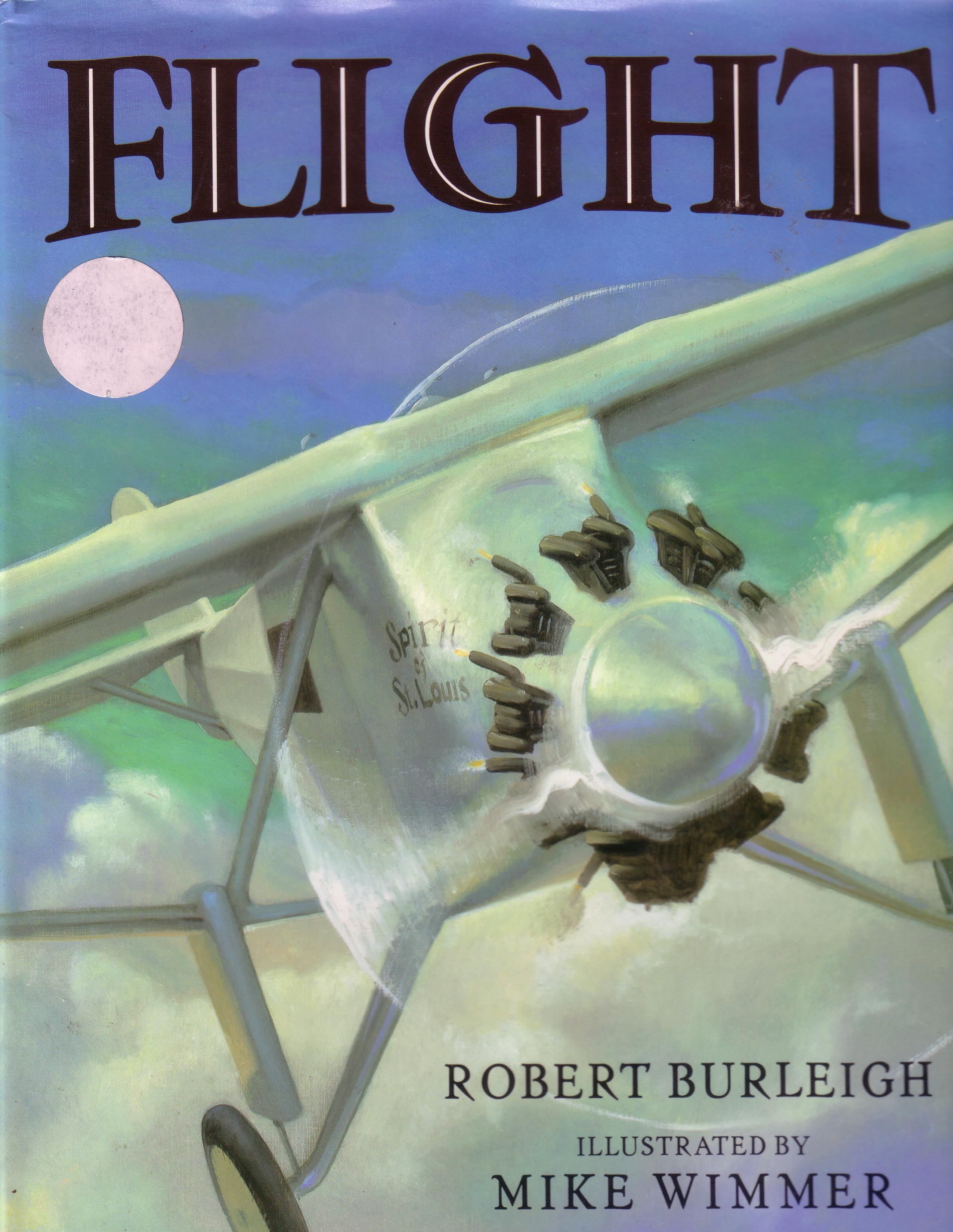
Jessica Unger, responding to my Facebook invitation, remembered Flight, in which the young Charles Lindbergh struggles to stay awake on his trans-Atlantic voyage. (In other words, in which the perils of lost focus or failing attention could be lethal.)

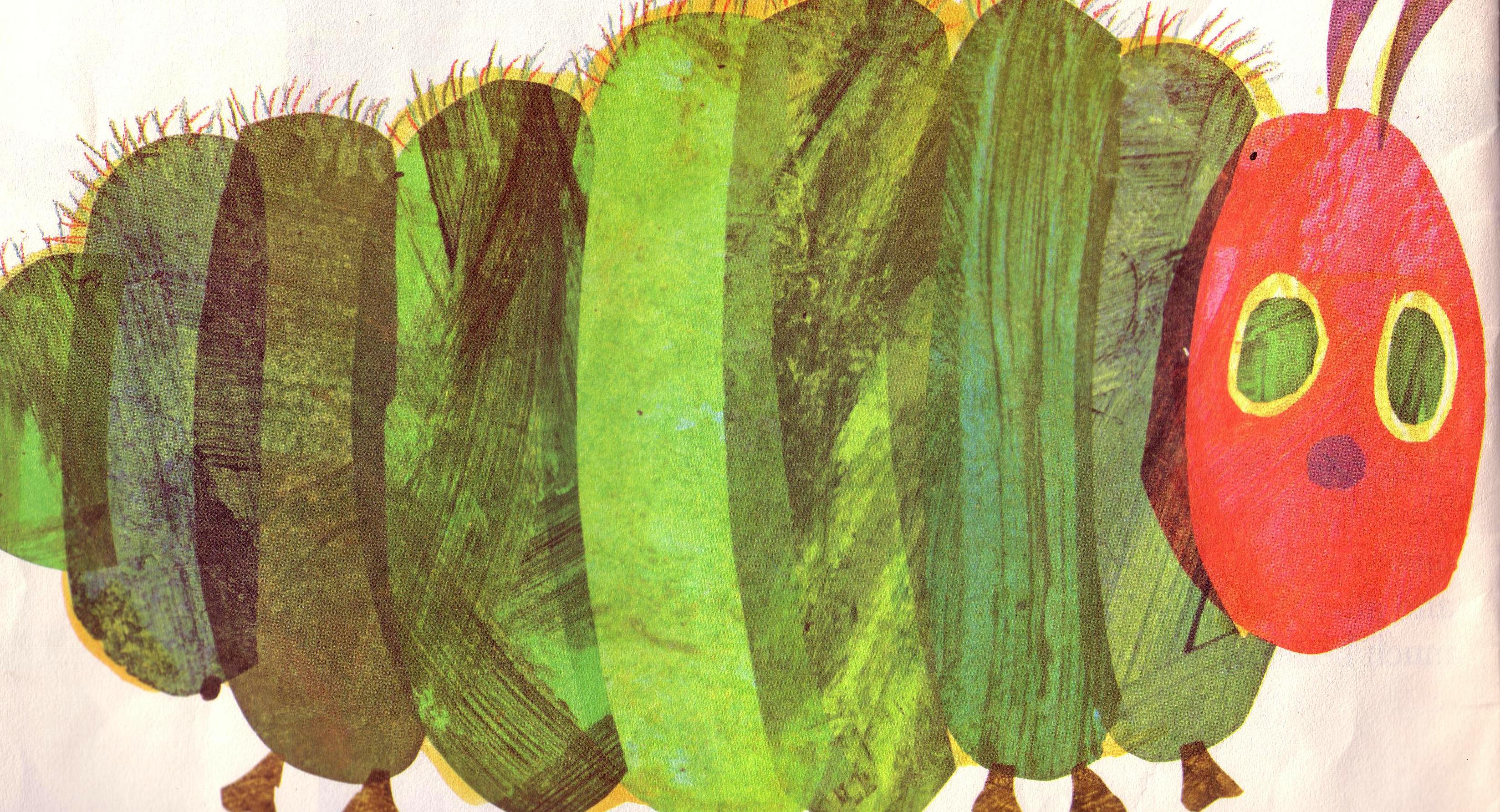
Flightt Robert BurleighSeveral past students remembered Eric Carle’s Very Hungry Caterpillar, in which eating and eating, and growing and growing, result in transformation.

Very Hungry Caterpillar Eric Carle cropped

galileo croppedUltimately, picture book season in September worked out well for everyone in the class, partly because many of the books I had gathered were what is known in the trade as “sophisticated picture books”, books definitely intended for somewhat older audiences.

Here’s one of many wonderful picture book biographies. This one, by Peter Sis, doesn’t dodge the horror of Galileo’s being put on trial for his life, for saying what he could see.

Non-fiction picture books could work well later in the year, too. If a group of students were exploring a topic together, reporting to each other on separate individual readings, the right picture book could enable a strong contribution even from a reader still overwhelmed by long blocks of text.

After the first couple weeks, for their individual reading, and for the read-aloud books we shared, the students and I mostly chose novels. I might suggest time with picture books for a student who had left her book at home, or a kid marking time until the next book in his series came out on Wednesday.

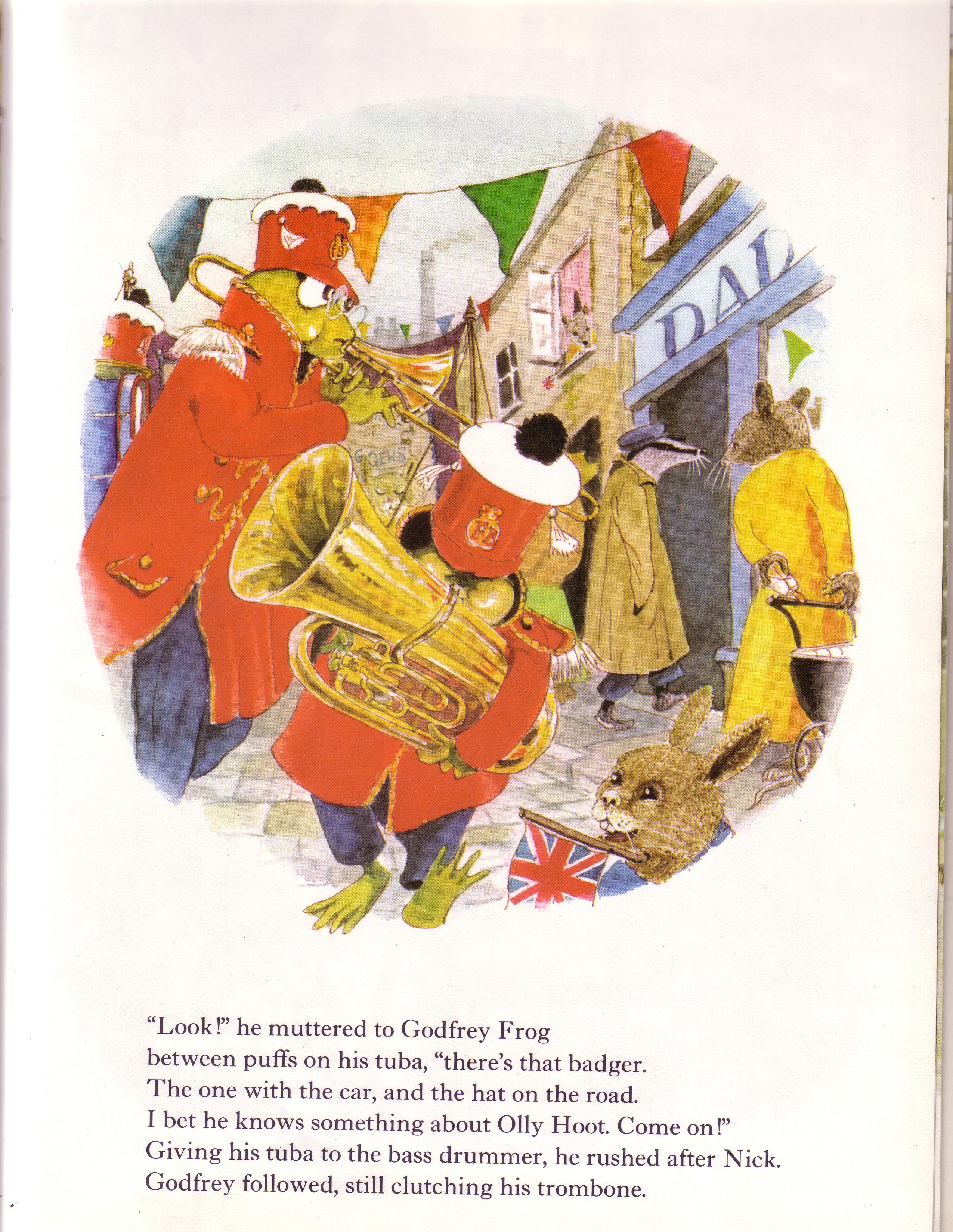
Frog Band and Owlnapper Jim SmitSometimes this detour back into picture books would become extended, as a student tracked down all the available picture books by a particular author, or discovered a wacky series that satisfied a taste for British humor, juvenile grade, like this one. (This is a page from The Frog Band and the Owlnapper, by Jim Smith.)

Often, also, a picture book or two could launch a new thematic study–launch in the sense of full throttle forward.

Henry Hikes to Fitchburg D.B. JoFor example, Henry the bear (Henry David Thoreau just barely in disguise) makes a case for his preferred mode of transportation–and a bet with a friend–to prove that hiking to Fitchburg takes no longer than working to pay for train fare.

rows and piles of coins

Henry’s argument with his friend opened a thematic study called Transportation Choices. Other picture books helped us think about people with limited access to choice: people in our own world unable to drive due to disabilities or aging–or youth; people in places where a bicycle can change a family’s possibilities. In My Rows and Piles of Coins, by Tololwa M. Mollel, a young boy wants a bicycle not just to ride, but to serve as a mechanical pack animal, getting farm products to market.

The right picture book could widen–powerfully, effectively, almost magically–our sense of “us.”

Miss Bridie straightenedBefore my school opened an older student program, all my 12-year-olds graduated from our school and became immigrants into the cultures of other schools. Immigration made a particularly strong thematic study topic then, and picture books helped focus on the choices made by immigrants, including what they chose to bring–which could mean how they chose to be prepared. Miss Bridie Chose a Shovel follows Miss Bridie across the sea, and then through her life in her new land, where she uses her shovel to plant, to clean up after a fire, to dig a grave. Here she is, walking away without looking back, setting out into her new life with her shovel in hand.

There are so many other wonderful picture books I’m sad to leave out. My Place, an amazing book from Australia, which I read aloud almost every year, I’m saving for its own special post. The picture books we used to explore ideas about evolution, ditto.

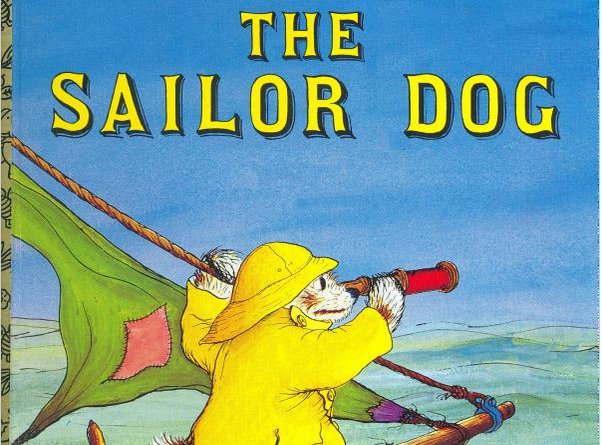
sailor dogFor now, just one more. Almost always, on the last day of school, I read aloud this book. If you were ever in my class, you may remember how we created instant background music for certain pages. Singing the final song, to the tune of Popeye the Sailor Man, was a great antidote for any tendency to get weepy, especially my own.

According to my daughter, I’ve given at least three copies of Sailor Dog to her children, Abe and Julia. “That’s okay,” she says. “It’s good to have one on every floor of the house.”

Some notes:

The round shapes visible on many of the books shown aren’t part of the illustrations. They’re just stickers that marked the books belonging to the classroom collection, or my family collection.

I want to give you publisher information here, in gratitude to the people who keep these books in print. Some are in fact out of print, and harder to find, but I’ve discovered that I can often locate used copies of old favorites through web sellers. So here’s the list:

Time of Wonder, written and illustrated by Robert McCloskey. Puffin.

Three Days on a River with a Red Canoe,  written and illustrated by Vera B. Williams. Greenwillow.

Go, Dog. Go! written and illustrated by P. D. Eastman. Random House.

Flight, by Robert Burleigh, illustrated by Mike Wimmer. Puffin.

A Very Hungry Caterpillar, written and illustrated by Eric Carle. Philomel.

Starry Messenger: Galileo Galilei, created and illustrated by Peter Sis. Square Fish.

The Frog Band and the Owlnapper, written and illustrated by Jim Smith. Little Brown.

Henry Hikes to Fitchburg, written and illustrated by D. B. Johnson. Houghton Mifflin Harcourt.

My Rows and PIles of Coins, by Tololwa M. Mollel, illustrated by E. B. Lewis. Clarion.

Miss Bridie Chose a Shovel, by Leslie Connor, illustrated by Mary Azarian. Houghton Mifflin Harcourt.

Sailor Dog, by Margaret Wise Brown, illustrated by Garth Williams. Golden Books.

Seven more thoughts about silent reading

reading on floor cropped#1   I’m beginning this post the way I wanted to end the previous one, with photos of kids reading, in the various positions and conditions my students adopted for silent reading time. (I finally found photographs, and got permissions.)

Some sat on the floor leaning against the wall. Some sat on the big rug in the meeting area, often snuggled up next to each other like puppies.

reading line-up cropped

Some sat at their table places, books on the table, heads benreading at tables croppedt over, sometimes inside a curtain of long hair.

(The girl in the background is going through a book stack, as in A Stack of Five.)

Some liked to hide in what kids called “the cave”, a little passage formed by the non-fiction bookshelves, with a rug on the floor, and with less visual or sound distraction than anywhere else in the room–which made another reason, besides privacy, to choose it.

One year I learned that I had to check that corner carefully if the fire alarm went off during reading time. A particular child remained cave-bound, reading straight through the horrific racket of the alarm. To my other overlapping mental categories of readers, I added, “children who could probably keep reading through an earthquake.”

#2   Intense mental adventures are happening in almost complete silence. I move around the room taking notes, but rarely interrupting. Conferences, one-on-one chats with an assessment often included, I try to do in the cubby area, outside the room.

The intensity of that quiet, a kind of sacredness, comes back to me as a I watch my grandson sleep, sense when he is dreaming, wonder what is happening in his dream.

#3   Reading is not sleeping, not dreaming, but reading fiction can be like dreaming someone else’s dream, so in a class of 15 there could be 30 minds dreaming, either creating or recreating stories: 15 students and 15 authors.

Often, though, there were local rages for particular authors. Several kids, recommending books for each other, might all be reading various titles by Nancy Farmer or Gary Paulsen, say. That could throw off my math.

Sometimes I imagined thought balloons above kids’ heads, full of the words they were reading, jostling with each other in the air space of the room; words perhaps moving from bubble to bubble, the way people can move from painting to painting in Harry Potter. The way enthusiasms can move through a reading community.

#4   When I first started teaching this age level, watching whole rooms full of kids reading, I was startled by how much I could tell about them as readers, just by watching their reading behavior, without even hearing them read.

Kids with strong reading skills, who nevertheless had to struggle to maintain focus / kids who were thrillingly a little drunk with the glory of new-found reading fluency / kids who were just too tired to read without falling asleep / kids for whom reading offered a sanctuary they might kill to protect / kids who began book after book but could never manage to finish one / kids who strongly preferred certain kinds of books / kids who could not read funny books without at least shaking slightly, or more likely poking a neighbor. All of that showed, with no need for assessments.

#5   I also discovered that assessments could be very useful. I used the Burns & Roe Informal Reading Inventory, a fairly standard assessment tool to which I had been introduced in graduate school. It gave me lists of words to hand a child, in order to check for ability to decode words without context clues. Then the child would read a passage, and answer the comprehension questions provided.

On my own, I requested a free retelling, which teased out slightly different aspects of a student’s comprehension. Finally, if we had time, I often asked for kids’ reactions, things the passage made them think about or wonder.

Depending on the child, I sometimes shared the results, and we talked over whatever they seemed to show. I wanted to get the kids’ own insights into their experience and history as readers.

An assessment of this sort is often used primarily to get a sense of the grade level at which a child is reading. More than that, I valued the way this series of activities gave me a sense of a child’s approach to reading.

Does the reader seem confident and engaged?  Will she stop and deconstruct and parse out unfamiliar multisyllabic words, and use other clues besides the word itself, when those are available? Is he self-monitoring, or is he willing to tolerate and ignore meaningless readings? Is she finding a balance between inferring things the author never intended, and failing to make any inferences at all? Does he start out strong but wear out, or start out faltering and warm up?  Does she read aloud flawlessly but then have no memory of what she read? Is he one of those slow and patient readers with lots of miscues, who nonetheless gives an inspired free retelling, and then answers every comprehension question perfectly?

Above all, is she comfortable enough to laugh out loud at my all-time favorite reading assessment line, about the ratio of sheep to humans in New Zealand? (18 to 1.)

Jokes aside, it’s how a child is reading, the kinds of energy a student brings to reading, that can tell us how to help that child move forward. We need to know what strengths can be the seeds for new growth, and we need that especially if there are also weaknesses. The same assessment tool I was taught to use in graduate school, with its capacity for pigeonholing, nonetheless turned out to be a great way to find out what I wanted to know: how a child’s intelligence was meeting the world of print, and what I could do to cheer and help.

#6   There are some important lessons to learn about reading, it’s true, and some of them can be taught in a whole class setting. For a while we received a classroom set of Boston Globes every Monday. (We were sad when their distribution arrangements no longer worked for us.) One day, we would read the bridge column–easily decoded words, all of them, that conveyed almost exactly nothing to a person without the right background knowledge.

This was a great way to encourage students to think about the difference between decoding and comprehending, and then go beyond that and think about the dimension of remembering. It’s hard to remember something that is gobbledygook in the first place–even if all the words are words you know. Remembering requires understanding, and understanding requires not just decoding–turning symbols into sounds–but thinking.

Definitely there’s a place for teaching reading skills. But…

It’s even more important to talk about the meanings in a piece of reading, and what the author has done to let them bloom. It’s important to write about reading, to use the discovery process of writing as a way of opening out the experience of reading, and sharing it with others. But…

None of those other peripheral activities should ever be allowed to displace actual time for reading, because actual time for reading is what most builds readers.

All that other stuff is what you do whenever you have enough time in the schedule. Reading itself has to happen no matter what.

Lecteur_-_statuette_pierre#7    It’s part of your religion,” a kid once said. She felt the same way, and probably had some truth on her side.

I imagine the same feeling in whoever made this little statuette, which I found on wikimedia commons, with no other attribution besides the name Pierre. Thank you, whoever offered this for us to find and remember!

Marian and the Gardens

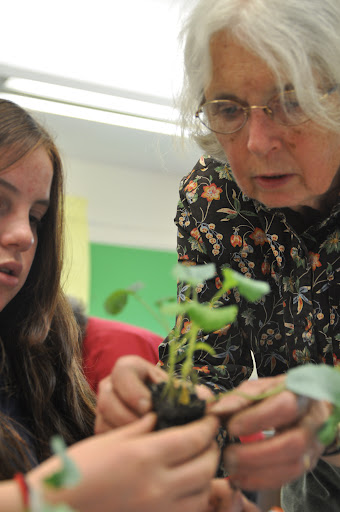
garden marian and cecily plantingMarian Hazzard thinks that every school should fit a garden into its landscape somehow, even if it’s just in a couple of buckets. Every child should have the enlightening and empowering experience of producing food.

As one of Touchstone’s founding parents, teachers, and guardian angels, Marian always put her heart and soul into nurturing the school. She taught reading and writing and math, along with interdisciplinary approaches to science and social studies, in classes of her own. She gave special effort to helping groups of students become communities of learners.

Then, after many years, she decided to focus on a part of children’s learning that mattered especially for her, and she put the same energy and spirit–the same combination of fierceness and tenderness–into helping kids learn to garden. She did that on a wider scale than most folks in the community realized, through organizations devoted to helping young people understand the production of food. (She’s been most active in Massachusetts Agriculture in the Classroom, serving on the board, chairing a Mini-Grant Committee, mentoring novice gardners, and presenting  workshops at conferences.)

Meanwhile, Marian also spent many hours of every week back at Touchstone, and could be seen at any hour of the day, often grubby and muddy and wearing a trademark straw hat, gardening herself, working with groups of students, and helping other adults learn how to work with gardens and kids, in the fullest and richest ways possible.

A garden gives so much to a school.

violet and anjali planting Growing beings, every one of us, we nonetheless don’t necessarily expect to be interested in the growth of plants from stage to stage—but almost every student is captured by the actual phenomena.

Here, older and younger kids work together to plant seeds that will germinate and sprout under grow lights in the classrooms. Translate that into: right under the kids’ noses; cheered on by kids’ voices; handy to be measured or sketched.

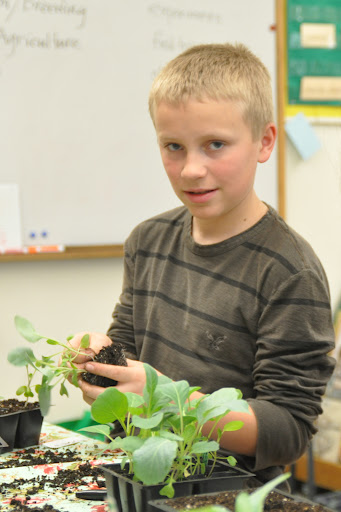
garden sam plantingHere, a student transplants a seedling into  a larger container, to sell at the school’s very own Farmer’s Market, which did a land-office business on a table off to the side at dismissal.

garden seedling sale

Below, another student writes a careful label for her tray of plants. The labels were cut-up strips of plastic yogurt containers. Marian encouraged not just a school garden, but a sustainable, green school.

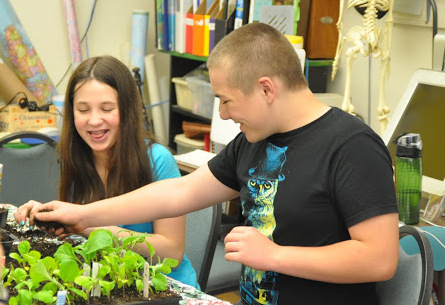
garden mia planting croppedIt’s interesting and fun to help a garden grow. This class took part in several giant transplant-athons, joking as they went. (Many thanks to Whit Andrews for contributing his photographs of the fun.)

Of course, group work on garden tasks builds more than the garden. It nurtures social and emotional connection, building community.

garden Ben and Emma planting cropped

Engaging science investigations can be centered on the garden. In one project, students examined compost samples at different stages of decomposition, to see what small invertebrates they would find there. (The school greenhouse can be seen in the distance, and a helpful book, Compost Critters, can be glimpsed in the foreground.)

garden studying compost greenhouse

garden change leavesA garden teaches kids about life cycles, and that counts, always, as both science and emotional education. In this photo, taken in the greenhouse by students combing the campus for evidence of change, some plants are flowering while others are dying. Many years, some of the garden’s plants were grown from seeds produced by plants allowed to go to seed the previous year.

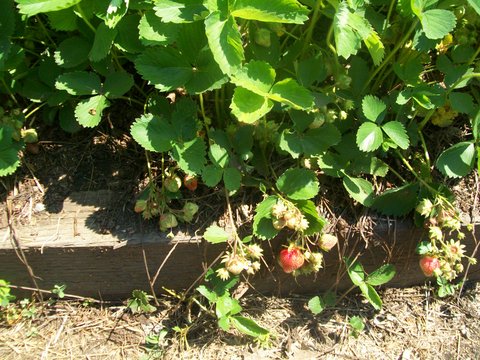
garden strawberriesThrough all this, kids and adults both, we observe food webs and nutrient cycles, both like and unlike the ones the adults memorized in high school biology. Sunshine helps strawberries ripen. Teachers and older kids help younger kids figure out how to share the strawberries. Strawberries too squoogey for human eating become wonderful treats for the chickens, who produce fresh eggs, which are a revelation for anyone who’s only known store-bought eggs.

chicken eating plant scrapIn another example, it’s easy to observe how much living things need water, a lesson likely to have life-and-death importance in the times in which these students will live. Here, you can see a watering can for the strawberries in the background, and a water dispenser for the chickens. This chicken feasts on plant scraps pushed through the chicken wire by kids at recess.

garden slugThe garden is a great place to sit and sketch, and sketching can be a wonderful way to notice what’s happening. Here, a small slug explores the squash leaves in a garden planted near the school’s parking lot–well-placed for sun, and thus good for squashes. But the leaves in shadow, or early in the morning, are also good places to find slugs. (One year, we had a bumper crop of butternut squash, and Tamara’s class did an official census.)

I loved also the plants nobody would ever eat, and spent many recesses standing by the morning glories along the fence, sneaking peeks into the universe of each flower.

garden sketch morning glory

I wish I had more photographs of what we harvested, which often disappeared quickly: salads, potatoes, cherry tomatoes. Real food. I hope that someone who reads this will have (and post, in a comment) a photograph of Marian’s amazing car, embellished by colorful graphics of carrots and beets and garden invertebrates, a rolling advertisement for vegetable glory.

Marian has a wonderful laugh and smiles often, but she is deeply serious when she says, “The world is changing, and these kids may well need to know how to grow their own food.” We all need to know how to take care in these ways; how to harness various kinds of natural magic in real and practical strategies that could mean survival.

For everything she gave to the garden, Marian had a small supply budget, some years, and several gifts from particular grateful parents, to do things like build new beds and erect a greenhouse. Her own work she donated, as a volunteer. I’m putting that in the past tense, because Marian has stepped back, after recruiting a garden teacher–and raising the money to pay his stipend.

I know you’re still there, Marian, in the background, offering advice and support. Here, in November, as the days suddenly shorten, I want to send you my thanks in the form of flowers, wisteria climbing on the school gazebo. May the Touchstone garden, and you, Marian, and everyone whose sense of the world you’ve greened, continue to thrive and grow.

garden wisteria

Just for Five

If you’re stumped and blank as a new field of snow, at least try writing, without removing your pencil from the paper or your hands from the keyboard, for five minutes. Just five.

The previous post focused on brainstorming a topic list, but said almost nothing about actually choosing. Although decisions often challenge me, even I can just ‟go with my gut,” as my daughter says, if I’ve brainstormed first. Students seemed to share that.

taking care of ducks recropHere’s part of the writing that came from one of the brainstorms shown in the previous post, about taking care of baby ducks.

(Once in a while, a student would ask, ‟What if I can find a way to put all of my brainstormed ideas together?” This made me think of my friend John Hodgen, a poet who sometimes seems to have done exactly that: to have noticed and listened to and named the different crickets chirping in the dark corners of his mind, and taught them to sing their brightness-against-the-dark songs together. How could I be doctrinaire about any of these instructions, given such models of make-it-your-own?)

One way or another, all of us sitting in the classroom together, almost always, could choose—just like that—and start writing—partly because this exercise only committed us to writing for five minutes.

I sat at the front of the room, at the little old wooden student desk I had rescued from the basement. (My big desk was back in the corner.) For other writing activities I moved around the room, conferencing, but for the fluency exercises I sat with half an eye on the clock and my heart in my throat, inspired by all that energy around me–and I wrote like mad, myself, for most of the five minutes.

As a young adult I attended Quaker Meeting, sitting every week in silent meetings of collective reflection and searching. In addition to meeting for worship, Quakers have specialized meetings, always beginning with silence, for specialized purposes—‟meeting for business,” for example. This intense short writing in my classroom was a silent meeting for writing, and we were all in it together, reinforcing each other.

Unlike ordinary open writing time, we weren’t asking each other questions, or getting up to consult dictionaries or spell-checkers, or losing time over punctuation, if that got in the way. We were just writing, writing, writing. The brevity—five minutes, no more, at the beginning—helped to create an intensity, a suspension of self-conscious critiquing, a focus on the act of inventing and constructing with words—and that led to some amazing beginnings.

test taking amanda croppedSome students at this age (in this case 12) are able to use conventional spelling and paragraph breaks, even in a quick first draft. 

What about paper vs. screen? I wrote in front of my students on paper, by hand, but I do this exercise at home on the computer. On the other hand, I don’t carry my laptop in my backpack when I’m out walking or bicycling, so plenty of writing, including brainstorming, happens in a paper journal. For me, different kinds of writing have emerged in the two different situations. It makes sense to me for students to be comfortable with both, if they can, and to have that additional option of switching, like having another gear on a bicycle.

With more and more computers in the classroom, I could encourage students who had already developed some typing fluency, or for whom writing by hand involved special difficulties, to use typing in this situation. Increasingly, over the past decade, students with writing challenges, throughout the older grades of my school, have been allowed to bring and use their own laptop computers. While some kids found their sheets of paper and pencils, others set up their laptops, or got settled at one of the classroom computers. It worked fine.

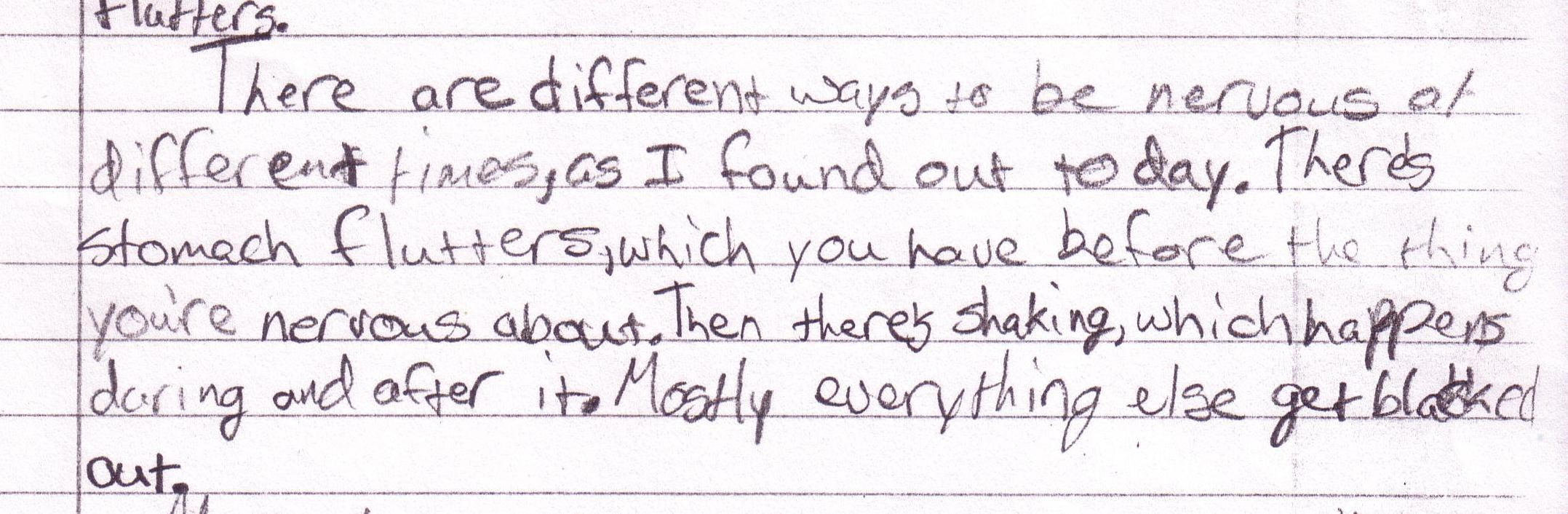
As the days and weeks went by, even the most challenged kids would figure it out: you can write about almost anything if you’re only committed to writing for five minutes, and if you focus on the meaning of what you’re exploring, not the mechanics.

I loved that point somewhere in the second week when kids would start looking at me warily, or actually wave their hands, in a universal gesture meaning, ‟No! Don’t you dare call time!” If everyone else seemed okay, I’d just go for it and give us a few minutes more. This could lead to sudden exhilarating jumps in word count. At the rational age of 11 or 12, kids knew they couldn’t make a direct comparison between quick writes of different durations—but they felt the power of their own stamina, and that’s what I wanted them to be able to feel.

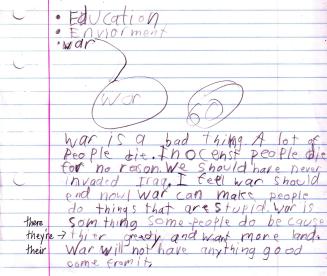
about war2 croppedWhen I did call time, students counted words, including any words crossed out. (Those crossed out words got written first, so they represented part of the writer’s output.) Nobody was allowed to marvel publicly about how many or how few words they’d written. They were meant to compare not with each other, but with themselves, day by day, page by page in their notebooks.
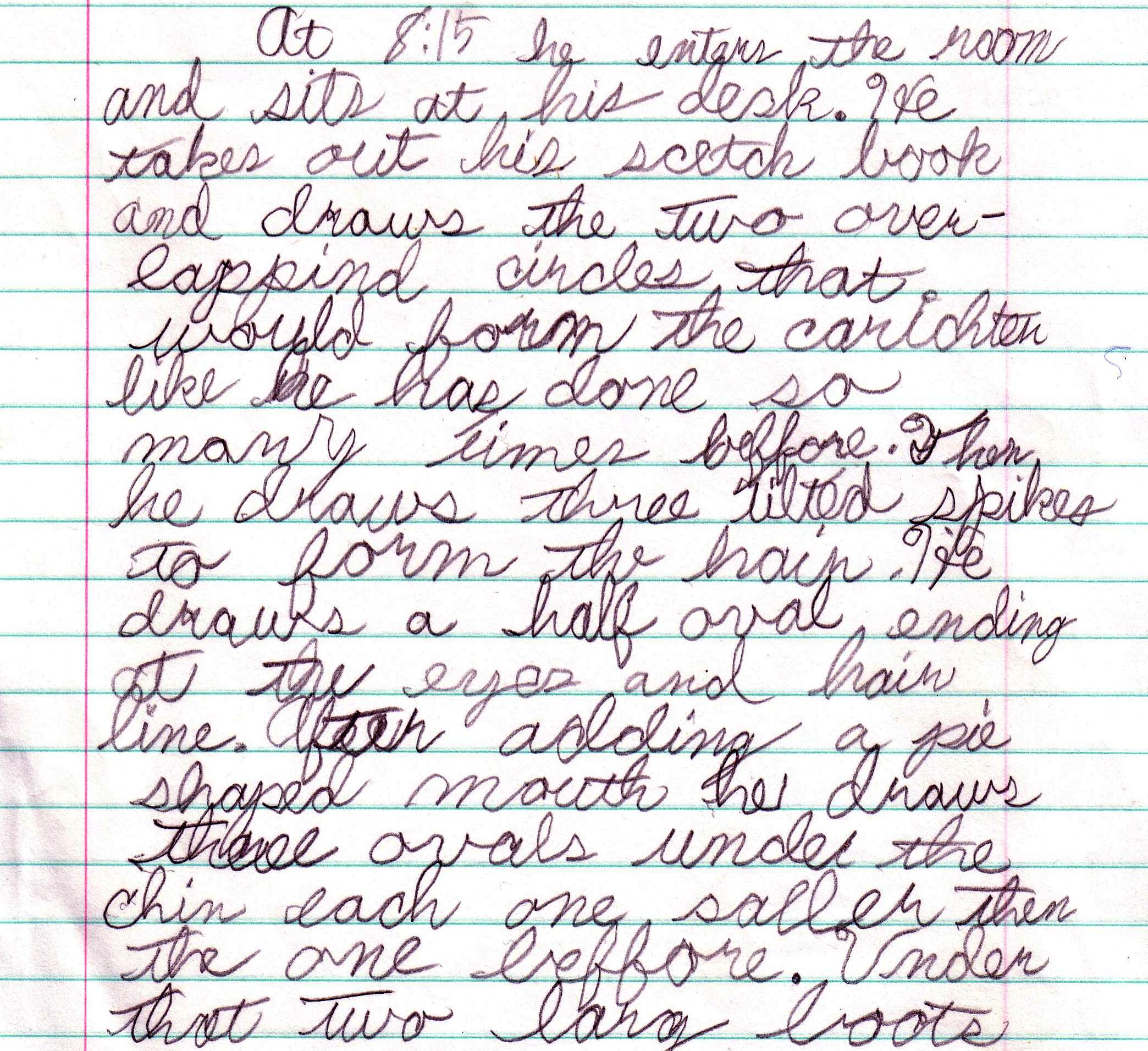
I think of a child who wrote just nine words the first day, and was proud to do that, but even prouder to get to 43 after a few repetitions of the exercise format, over the next week. I think, also, of other children whose word count actually started high and went down, as they worked to figure out how to think and write at the same time. That, too, was a good thing.

So: if you need to write and you’re stuck, just write for five minutes. If you want to cast a line into the file cabinets of your mind, and see what comes up, you can make a surprisingly good start in five minutes. If you think you know nothing about a topic, five minutes is long enough to prove yourself wrong—to prove yourself ready to begin.

drawing cartoons croppedFinally, although there’s a special power to this exercise when a whole group does it together, you can do it by yourself, and kids sometimes did, in open writing time. I could see them glancing at the clock—or forgetting to glance at the clock, which is even better.

All in all, another slogan to live by.

On days when we did this exercise, kids typically had a choice for how they used the rest of that day’s writing time. A child could keep going with that piece she had just started within the exercise, and many students chose that. A child could also work on something else entirely, a story in progress, a letter to an editor, a menu, a poem–maybe a poem in the form of a menu? Some kids spontaneously began revising what they’d written in the exercise; many waited until we were all working on revision together, when I did mini-lessons to help support that.

Of course, the writing curriculum as a whole was much more complicated than this one brainstorm-and-free-write exercise. I want to write, in other posts somewhere down the road, about kids sharing their writing, and about revision, and about some specific genres of writing.

This exercise, though, was the fundamental practice, the opening of the heart, the first opening of that packet of seeds each of us carries, ready to germinate. We followed the exercise again whenever we needed to warm up, or to have a new beginning: after vacations, after the long individual research reports were finished in the spring, or after a week of very little writing time due to field trips or community events.

Writing this, I am moved all over again by the remembered hush of a class full of kids whose pens and pencils and keyboards are making the only sound; whose hearts and minds are brave, or surprised, or faithful, patient, excited—one version or another of busy. They could risk that little storm of intense composition; their hands and minds could work together that long; they could be that generous to themselves.

Troubles with Writing

According to family stories, I composed mangled (but apparently highly expressive) Christmas carols, almost as soon as I could talk. I used those little wooden alphabet blocks to build my own typewriter, and then imitated my mom, tap tap tap. I was getting a kick out of writing before I could write.

Year by year, in school, I loved most the teachers who assigned the most writing. Mrs. Duleba, second grade, shared her invaluable confidence that meaning mattered more than spelling. I’m forever grateful to George Batchelder, who thought English class should be fun, and to the State of New York for saying (in 1960) that seventh and eighth grade students should have two periods of English, every day—which gave us room and time to do actual writing, as well as diagramming sentences. Oh, and to the school administrators, for letting Mr. Batchelder be my English teacher for two full years of essays with titles like “When Mother Drives Father’s Car.”

Early attempts at humor aside, all my life I have thought more clearly with a pen in my hand or a keyboard under my fingers. In a rough stretch in college, I kept myself going by writing about why I couldn’t write what I was supposed to be writing. Writing has helped me survive many kinds of hard times, and it has been a source of joy, and a vehicle for joy, a way to let joy travel into other lives, or into my own life, later.

When I started teaching, I thought, “Aha, I finally have full right to read all the papers being passed towards the front of the room,” something I got in trouble for when I was younger. Gradually, though, I realized that the hardest thing to teach can be what comes naturally to you. I struggled to understand why writing was so hard for some of my students.

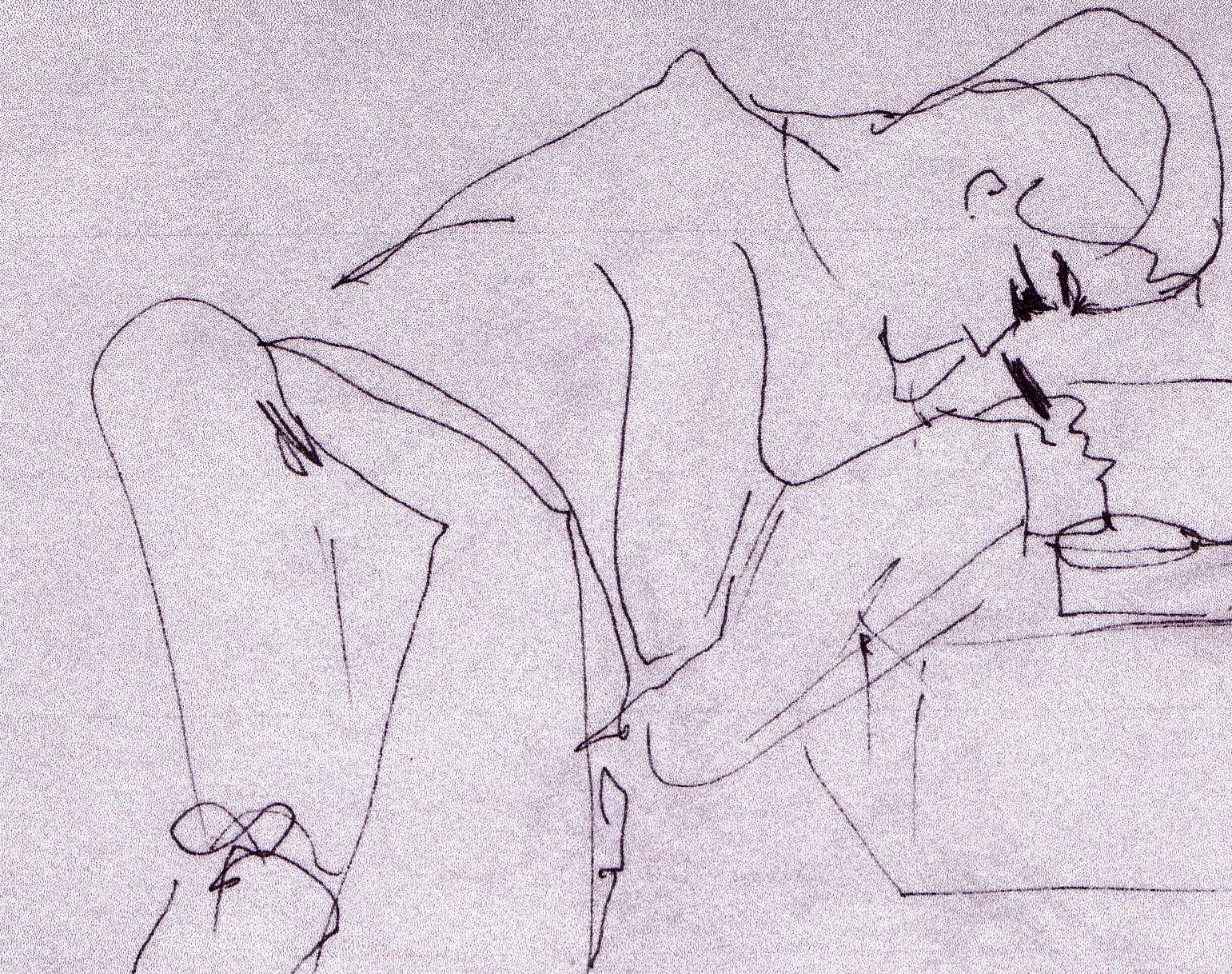
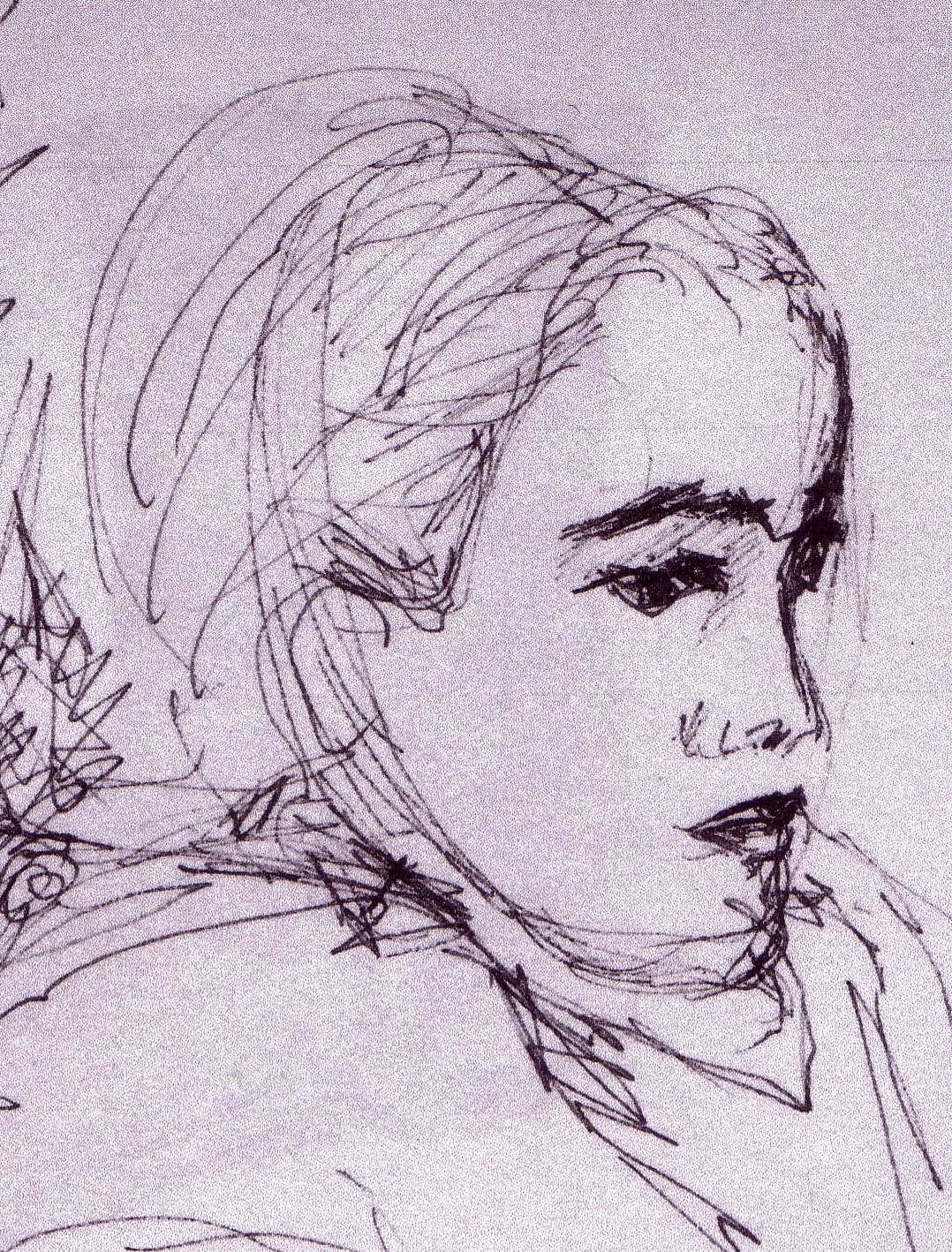
StefanI didn’t take photographs of kids not writing–too mean. Sometimes, though, when I was supposedly writing along with them, I did quick sketches. So this is Stefan (now a thoroughly successful adult) curled into a pretzel to hold himself still for long enough to get a few words onto paper.

Classes and conferences and reading have helped me understand better. I’ve also extrapolated, sideways, from the many other things that challenge me, and I’ve looked carefully at my own bouts with writer’s block. As teachers, we have to value whatever we know in our own learning selves about our students’ challenges. Above all, fortunately, the circumstances of my teaching let me learn from students.

Talking with kids, all kinds of kids, it came clear to me that written language is both commonplace and tricky in human experience.

Books and a long string of PBS documentaries told me that we haven’t been using written language very long, in the evolution of the human tool set. (By tool set, I mean both our physical equipment and coordination, and our cognitive abilities.) We’ve evolved to shout, to sing, to run, to dance. Also to gossip; to complain; to give praise. (So happy, for me, to visualize young adolescents doing all those things!) What comes naturally for us can overflow usefully into writing, can claim writing as tool. Still, we haven’t evolved to write.

Writing is complicated. I once heard Mel Levine make a powerful case for this. (Like many other teachers and parents and kids who learned from Levine, I’m trying to let his wisdom survive his wrongdoing.) Levine listed things a writer has to think about, all at once: ordering sentences; spelling individual words; forming letters; using the tiny, powerful signals of punctuation; structuring paragraphs; choosing between similar words that mean different things, or different words that mean similar things.

Listening to Levine, I thought: well, that makes bowling seem simple. For me, bowling is a nightmare. I stop looking at the pins to think about my feet, and suddenly my hand is no longer holding the ball reliably, and I’m liable to drop it. I’m easily distracted by the conversation of the people bowling in the next lane. (Are they sisters? Friends? Co-workers? What’s this they keep saying about horses?) I haven’t bowled in years, but I remember clearly the sensation of trying to solve the Rubik’s Cube of my own body, to do everything right at once, with all my limbs—especially while other more interesting things were claiming my attention.

I’ve come to understand that for many kids, that’s how it feels to write, either physically or cognitively.

Bearing in mind the evolutionary novelty of it all, and grateful for the supplement of human culture (including technology), I’ve watched some kids discover that they feel fine writing on a keyboard, which removes the difficulty with forming each letter—just a keystroke does it—and makes it so much easier to control spacing and organization on a page. I’ve watched other kids get a crucial power assist from software that translates a voice into written text.

Those bypass strategies for physical challenge don’t necessarily simplify complex cognitive challenges. Writing demands enormous coordination of attention and memory, enormous stamina for making choices and weaving them together. Pre-writing activities can help to some degree. Still, like me eavesdropping on the people in the next lane at the bowling alley, a kid can very easily be distracted by what’s going on in her head, including the other way she considered phrasing whatever she started to say. Kaboom—the two phrasings have a crash collision, and the reader is left to pick over the pieces.

In one of my favorite examples of the ways kids can advocate for each other, an eleven-year-old born writer once said to me, ‟You really can’t ask R. to worry about punctuation yet. He’s trying hard just to keep the beginning of the sentence in mind while he writes the end.”

sad girlThen there’s the endless circus of early puberty, easy to dismiss as generic, but in fact a different journey, with different rewards and different obstacles for each child. There’s also emotional trouble: for example, the kid who is keeping a scary secret so huge she can barely think, let alone write spontaneously or thoughtfully, since both of those require some inner freedom.

Sometimes I watched the struggles of the child who’d been told too many times that he was a good writer, who became, with the self-consciousness of early puberty, his own impossibly hard act to follow.

That brings me back to my own experience: writing helped heal emotional wounds, helped make sense of confusing changes and challenges, helped hold and channel euphoria. Wisely or foolishly, I wanted the powers of writing to be available to every child with whom I worked–wanted that just as intensely as I wanted the magic wand that could remove all their troubles. (Not a good idea, of course.)

I cared a lot about kids, and I had faith in the power of language—and that meant I had a huge incentive to figure out the strategies I’ll write about next time, for how to help kids just get words on the page.

Mapping the community

One of my grandfathers died when I was not quite two years old. Photographs show me sober-faced and blonde on his lap—but I can’t consciously remember him. As I was growing up, though, I treasured stories about him, souvenirs, evidence of any kind.

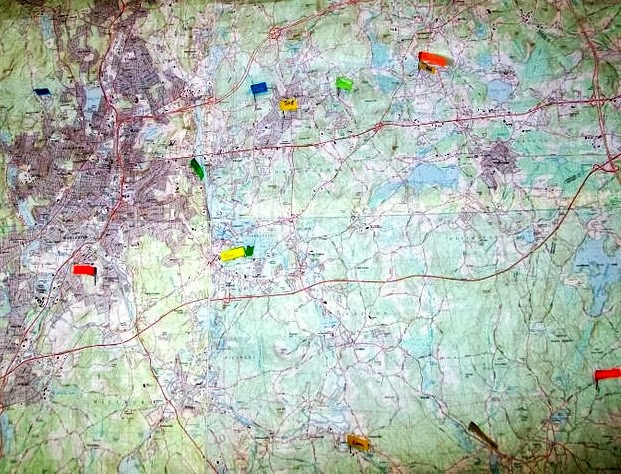
I remember a wall covered with maps which my grandfather had joined together, to show a wide area of many towns centered around the Maine farm he and my grandmother bought in the late 30s, when the world seemed to be falling apart. To make this map collage, he had used USGS topographic maps, first bought (pre-farm) for fishing trips, for knowing the ways of brooks and ponds. Tiled together, the maps gave both a huge view, and detailed views–the paths of the largest rivers, and the wiggles of the tiniest brooks, all on the same wall.

Fast forward many years, during which I grew up in a house with more maps on the walls than pictures, and then married a man whose idea of unpacking, after a move across several states, was to open a box labeled MAPS in the middle of the night, and put up a good selection. The Pisgah National Forest on the bathroom door; a map of the known universe on the wall of the dining alcove. Etc. (Some other wife might have been less pleased.)

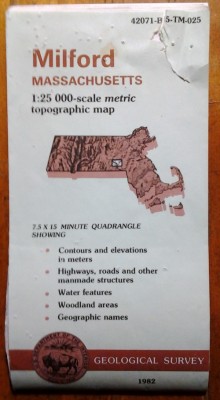
milford quad smallerFast forward again through several other kinds of work, and find me, eventually, teaching classes of kids from towns all over central Massachusetts and the northern corners of Connecticut and Rhode Island. I wanted to help them know where they were all coming from, and use that as a start for thinking about the worlds we didn’t share and the worlds we did.

It was my husband who said, ‟You could get a whole lot of USGS topo maps.” And it was my memory of my grandfather that said: in a classroom, there are really large walls.

For years, then, a new school year officially began for me when we put the maps back up.

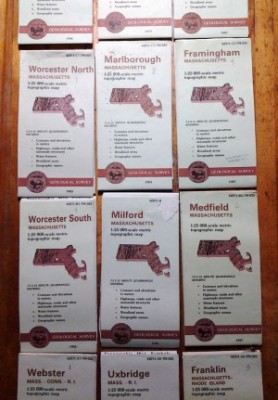
map array smallerI arranged the array of maps, still folded, on a table, and then handed them one by one up to my husband where he stood, somewhat precariously, on a counter below the largest bulletin board space. I folded back the margins to the edge of the map itself; he worked to make the edges of the maps match up as well as possible, so that roads, in red, or brooks, in blue, or town lines, in black, wouldn’t stagger from one map to the next. We marveled again—him from two inches away, perched high; me from the middle of the room—at how much of our relatively urban state was still woods (in green) or swamp (stippled with those funny little swamp symbols.)

Enter students. I usually began, the first week of school, by encouraging kids to compare the map array with the satellite photographs hung nearby. Those big purplish splotches on the maps matched up with cities easily visible from space. The major highways, 9 and 90 and 495 and 290, showed as arteries on the satellite photos also.

But then we zeroed in. If their houses or apartments or condos weren’t too new, and if they didn’t live in downtown Worcester, kids could find on this public document a piece of their private lives: their homes, in the form of tiny black squares. We marked each student’s place with a flag pin specially augmented with page markers, to hold their names.

Here’s most of one year’s map flags:

map array with pins

The kids who lived at the top of the array, up near the ceiling, had to call instructions to a grown-up climber, but the kids down in the nether regions of the Blackstone Valley could stand on a low stool and place their own map flag, sometimes finding the pinprick left by an older brother or sister in a previous year.

Students who lived in city neighborhoods or new houses—or, oftener and oftener, as the years went by, on brand new streets—had to look carefully at nearby streets and intersections, tiny ponds back in the woods, the shapes of hills given away by topographic lines, in order to see and mark where their houses would be. Sometimes it helped to replay the trip home from school: and here we turn left, and that’s where the old drive-in theater is.

Kids whose parents lived in different houses generally chose to mark both. Parents came in during morning sketching, to clarify confusing locations. Other grown-ups wandered by, and pointed out their own landmarks.

As we traced routes between each others’ houses; as we figured out who lived furthest from school, and who closest; as we crossed bridges and followed off-ramps—all of us developed increasing fluency going back and forth between our knowledge of the three dimensional world, and the abstraction of a two dimensional map.

Like a story, a map shows relationships that we didn’t realize before; it also leaves out things we know better than it does. We need the map and the map needs us.

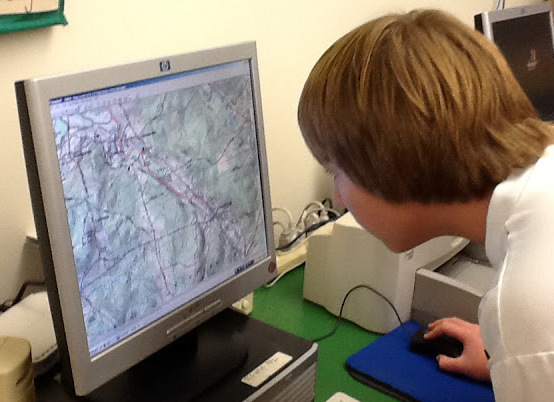
Next post, I think, we use maps to chase rivers. My grandfather would have approved. Andrew working with Topo cropped

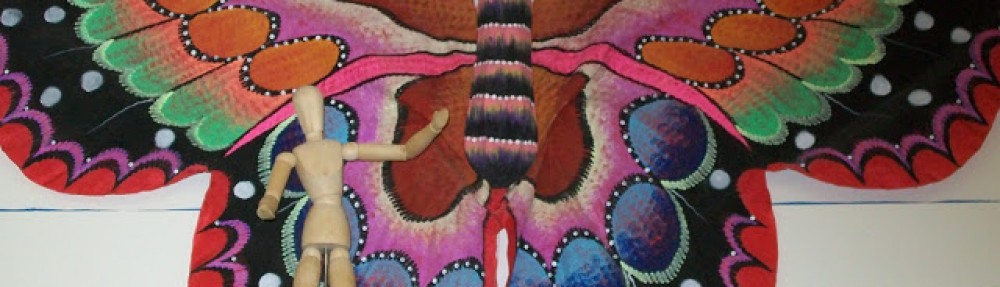
The butterfly

John Hildebidle, a dear friend from my poetry life, wrote to ask, ‟What about the butterfly?”

Sheryl Erickson and Martin Fuchs gave me the butterfly, which is a kite, at the beginning of their daughter Sophie’s time with me.

It felt like an apt emblem for everything parents gave, year after year, to the life of the class:

  • the gossamer but tough, often hard-won strength of parents’ faith in our mission and methods;
  • the powerful, buoyant, transforming lift given by parents’ contributions of time,  patience, shared skills and new ideas;
  • the brightness of parents’ joy whenever students shared their learning– enthusiasm not just for their own child’s efforts but for every child’s.

That last one seemed especially apt. In classes before mine, Sheryl had put lots of volunteer energy into exactly that, to strengthen parents’ care for each others’ children.

I hung the butterfly high on the classroom wall, and waited to see what else it would mean for us.

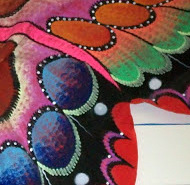
butterfly smaller detail sharpenedFor some students, the butterfly was above all a rich collection of colors. During morning sketching, over the years, many students chose to draw the butterfly, reproducing all its shades and shadings with our markers or colored pencils, as faithfully as they could. In this way the butterfly multiplied and flew away, onto shelves and into closets, but also into hearts–the way things can, even when they seem to disappear.

Meanwhile, gradually, privately, the butterfly became a reminder for me, to try to be fierce in moderation, as wacky as that may sound. I had had teachers myself who cared enormously about their subjects or their students or all of it, as I did. I knew that to venture into a classroom with the passion I brought inevitably carried some risks. Day after day, I looked at the butterfly and told myself to breathe, to ask questions and listen, to have faith in the fullness of time. To try, as much as I could and when I could, for a light touch. Of course, I often had to forgive myself and start over, every day, as all of us must.

None of that was what I wrote back to John, because ultimately all of that combined with something more, and the butterfly became, in the words of my email to him, ‟a sort of guiding spirit for the classroom, encouragement to use whatever freedom we had, to be vivid and colorful.”

The life of a progressive school is full of determination to do the right thing, to ‟make meaningful things happen,” as one past head of Touchstone School, Steve Dannenberg, used to say. Teachers and staff, parents and grandparents, all carry a profound sense of responsibility: to students, to the spirit of learning, to the truth of the world. None of that intends to be grim–or fierce–but it can become so, as the things most important to us can.

Early in my teaching career, I explained to a friend that I felt weighed down by the incredible opportunity, the freedom, to teach exactly the way I believed. If I could do that, I had to do that, and I was getting very little sleep in the effort, straining too hard.

I can’t say that ever completely changed. Still, here’s what I’ve learned about freedom: We never have as much freedom as we want, for pursuing what matters to us–and yet we never actually use all the freedom we have. But there’s also this: the more earnestly we try to inhabit our freedom, the more we become like butterflies whose wings have grown too heavy.

So the butterfly kite is flying high on the virtual wall of my blog, to remind me that yes, I want to be true to many important things; yes, I want to make meaningful things happen, in what I explore and write about in this “year to think it over.” But I want to do that with the wind in my sails, with the wonderful colors of classroom life in my heart, with a grin and a whistle when that’s called for. With joy. manikin sharpened

As for the artist’s model with her arms spread wide, gesturing: it’s possible that you just had to be there.

Building Average

I’m here to confess: I’ve spent a good portion of my teaching career guiding students in freaking out the cleaning staff.

Each year, in Level 6 math, we built a model of the Average Student, statistically accurate, earnestly assembled, vaguely lifelike. We set it up in a chair toward the back of the room. Usually the students chose a book to balance on its lap. I myself sometimes entered the room, at the end of a long meeting after school, and did a double take.

Traditionally, we took a group photo of the assembled class, with the dummy. Here, for example, is an unusually small class, from the fall of 2010. (Clockwise from the top, Kelly, Ben, Seth, Anna, Lydia, and Gianna,)

average 2010 better

A few weeks post-portrait, when stray arms or eyebrows began to fall off and litter the classroom floor, we held a funeral, usually with dual caskets–since one cardboard box couldn’t hold it all. We paraded more-or-less solemnly to the dumpster, and gave heartfelt testimonials about everything Average had helped us learn–

–which was a lot. If you ask a typical adult what an average is, chances are you’ll get the series of steps followed to find the mean of a set of numbers: add up all the numbers; then divide by the number of numbers.

That’s not wrong, as directions. But what does an average really mean? What can it tell you about a situation or a set of data? What can it not tell?

MathLand­—a wonderful math curriculum no longer in print—gave Level 6 students a chance to explore the idea of ‟average” from the inside. Many years after we had shifted to another curriculum, I kept starting the year with this unit, because it was perfect from so many points of view.

Setting a goal

You could build an average kitten, or an average bookbag–but it worked really well to build an average math class student. Kids took it all more personally, and paid more attention to interesting questions: Is Average identical to any individual in the group? How does the model represent each person’s data?

MathLand provided a data sheet which included a variety of measurable attributes—such as the girth of the neck, or the length of the upper leg from the hip to the knee. The sheet also asked about attributes that had to be described in other ways—such as the color of eyes or hair.

Some questions were yes or no: Do you wear a watch most days? Some questions had been wisely left out. Average was always just Average, neither he nor she. We weren’t asked to measure around the waist, or chest, just shoulder to shoulder.

Some questions deliberately provoked discussion. How do you measure the length of the neck? From the bottom of the ear? From the hairline? The whole class had to stop and decide, together, or the data would be meaningless.

Gathering and recording data

Before we could begin collecting data, we had to choose an appropriate unit of measurement, and an appropriate degree of precision. I did specify metric units, partly because I wanted students to get some practice with decimal numbers. The kids agreed that the measurements had to be at least as precise as the nearest centimeter. Even that could result in very unrealistic hands, though; so we almost always wound up agreeing it should be to the nearest millimeter, which we recorded as a tenth of a centimeter. (Fertile fields, of course, all of this.)

Boys helped boys measure, and girls helped girls. All the data was kept anonymous—and we said that the study subjects were unreachable for clarification of messy handwriting, so the recorded data had to be both readable and reliable.

Working with data

On the other hand, the occasional inscrutable handwriting also offered a relevant opportunity, once we reached the computation stage: If you can only read the data for 11 of the 12 members of the group, what should you use to divide the total? What would happen to the mean if you divided by 12 instead of 11?

Also, once you got your mean, would it tell you anything about the huge variation in sizes of kids this age? No–only if you added information about the range, which wouldn’t actually get built into our model.

Could a very long-legged class member and a very short-legged class member cancel each other out? Yes, in effect. But in a class with several unusually long-legged people, would the mean probably be affected? Yes, again.

Meanwhile, what about the attributes described by words? For those, we found the mode, the most common answer or value, with interesting results. A math class with only 4 out of 13 blue-eyed students could wind up building a blue-eyed Average, if the rest of the kids were divided evenly among brown, green, and hazel. ‟So my brown eyes have disappeared from our Average representation?” a certain kind of kid would ask, even without being paid or prompted.

Representing data:

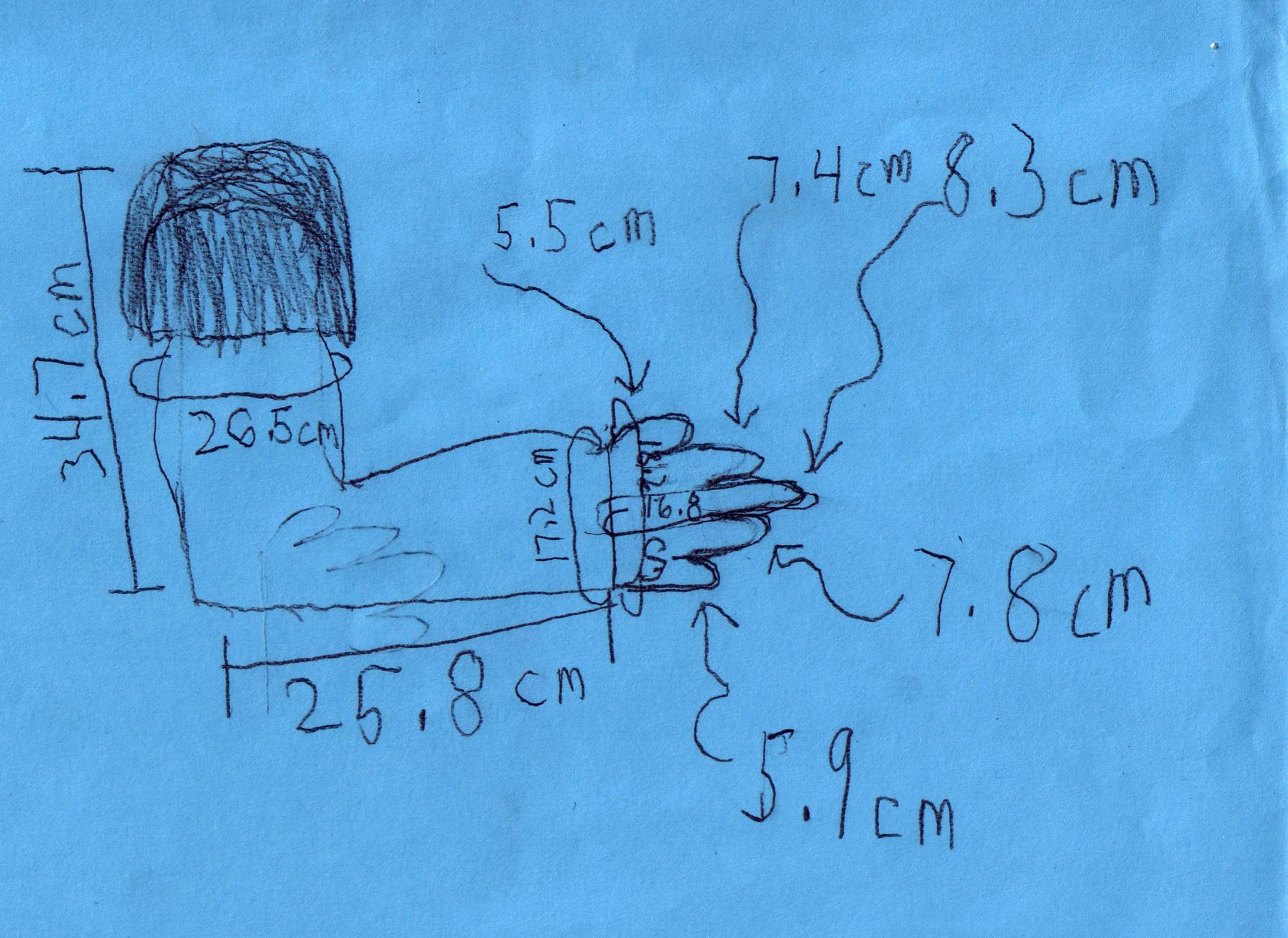
Ed's arm blueprint croppedAlthough they were working together, every child measured, and recorded measurements. Every child took part in finding the mean or mode for the attributes of his or her team’s assigned body part. Finally, every child drew a “blueprint.” Here’s Ed Pascoe’s blueprint for the arm and fingers.

Julia's face blueprintEach person on the team assigned to manufacture the head and facial features, for example, started out by making a basic sketch of a face, and then labeled the mouth with the mean width of the mouth, the eyes with the color of the mode for eyes, and so on. Here’s Julia Bertolet’s blueprint for the head.

Then, following the suggestion of the curriculum, but apparently against common practice in most places using MathLand, we actually built our model. We were armed:

  • with blueprints, measuring tapes and invaluable partners, for quality control;
  • with brown grocery bags for skin, crumpled newspaper for insides, Sculpey for ears and nose, and miles of masking tape to hold it all together;
  • with paper fasteners for knee and elbow joints and a meter stick taped to the back of the chair to make this character a vertebrate, able to sit up proudly;
  • with the almost invariable blue jeans and t-shirt that fulfilled those modal mandates;
  • and with endless jokes. “Where did you put our torso now?” Etc.

Being mathematicians

All this took time, it’s true. Gobs of time, all of it worthwhile. As teacher, I could observe difficulties with measuring technique, awkwardness with calculators, challenges maintaining focus even with the physical reminder of the unfinished body part. I could identify unusual ability to ask the salient questions, or to solve construction problems, or unusual gracefulness in helping a partner stay on task. The kids could figure out what to expect from, and give to, each other. I could cheer on strengths, provide the necessary re-teaching or skill-building support, and encourage insight—and kids could do all that for each other—within an atmosphere of fun.

We were having fun. We were also thinking about questions central to so many math applications: questions about reliability of data; questions about precision; and questions about whether a calculated answer fits an intuited estimate, given the range of the data. We were doing what many adult users of mathematics do: using that language to explore the world.

And of course, we were united, and found truly memorable group satisfaction, in making life more interesting for the cleaning staff. Or anyone else who wandered by.

average 2010 goofy

Down the turnpike and around the world

A kid named Ben Redden wrote this almost 20 years ago.

One of the most interesting parts of the trip to Boston University was the part when we could go around the room and collect everyone’s signature. It was hard to remember each person’s name, and what country they came from. The lady from China was sitting in her seat, and I came up and asked her if she could sign her name in Japanese instead of Chinese, by accident. But it was fun and neat to see the way she wrote my name. I’ll try to write it at the bottom of the page. It was neat to meet so many people from different countries.

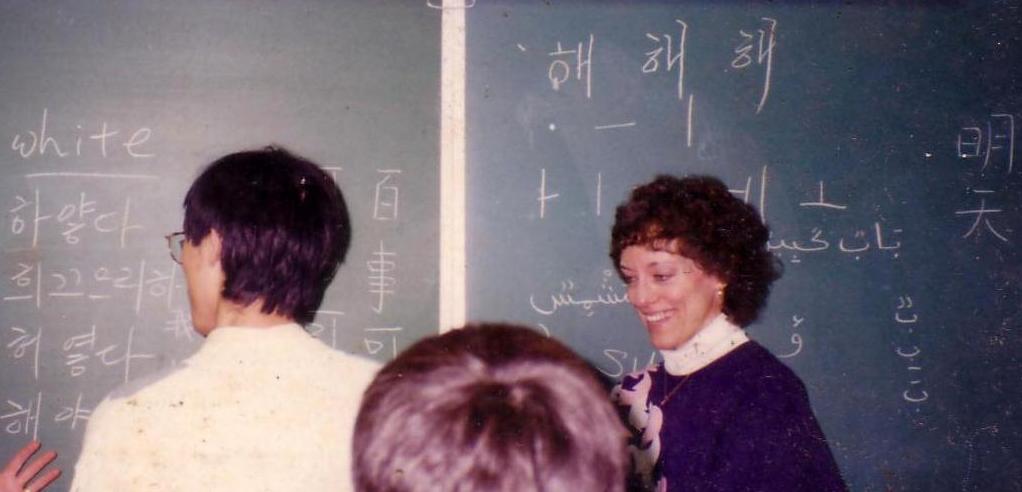
For many years, my class made annual trips to Boston to visit the classes of Janet Entersz, a Boston University teacher of English as a Second Language.

Each of Janet’s classes included students from all over the world. Mostly in their 20’s, some older, they had traveled far from their homes in Korea or Colombia or Saudi Arabia, and many were lonely for younger brothers and sisters, for their own children, or for nieces and nephews.

My students, averaging eleven years old, lived in rural or suburban towns well to the west of Boston, where they were exposed to plenty of ethnic variation, but few speakers of other languages.

Janet’s students and my students, and the parents who came along to drive us and join in the fun, all were equally exotic to each other, and in some way equally thirsty for each other.

To help us feel less ignorant, Janet sent me her current group’s country list, a couple weeks ahead. The kids and I ran a country treasure hunt, seeking and sharing information. We practiced skimming by searching the Boston Globe for references—a crash course in world geography.

During the visit itself, our conversations evolved into another kind of crash course, in comparative linguistics. A typical group of Janet’s students spoke ten to fifteen different languages, just counting their first languages. They wrote in four or five (once seven!) different alphabets or writing systems. Seeing samples of all these languages was a treat for the international students, too, since their ordinary class sessions focused on the language they were working hard to share—English.

janetatboard cropped

Many of Janet’s students could write English beautifully, but resisted speaking in class. Others spoke easily in class, unafraid of making mistakes and eager to make contact—but they dreaded writing.

In any case, almost all the international students relaxed, faced with the eagerness and innocence of my students, who soaked up a sense of shared language as a source of power, and of unshared language as a source of possible confusion—but also a source of fun. The richness of difference; the value of work to bridge difference.

One year, Janet suggested that the international students tell the Massachusetts students what various animals said in their languages. We all laughed and laughed, hearing what cows say in Japanese or Ibo; what roosters say in Italian or Arabic.

Janet Entersz, wonderful teacher, dear friend, brave soul, developed cancer when she was still in her 40’s; continued teaching with a scarf on her head through rounds of chemo and remission and return; and left us in 1999. Moments before she died, I sat at her bedside, reading aloud her favorite Antoine de Saint-Exupéry story about air flight over northern Africa.

And Ben Redden, the student I quoted at the beginning of this post? He eventually learned Chinese, and now lives and works in Beijing. No kidding. Here’s a link to his blog full of wonderful photos and wild tales from his travels in China and nearby: http://benredden.blogspot.com/

And here’s his rendition, from long ago, of how the Chinese lady wrote his name: Whatever it lacks in accuracy, it makes up for in spirit!

beninchineseenlarged