Taking Temperatures

insulation mittsSomeone, in a long proud parade of projects time parent volunteers, knew she would be doing temperature experiments with her small group, and arrived carrying these perfectly designed mitts.

(If you know where the credit should be assigned, please comment!)
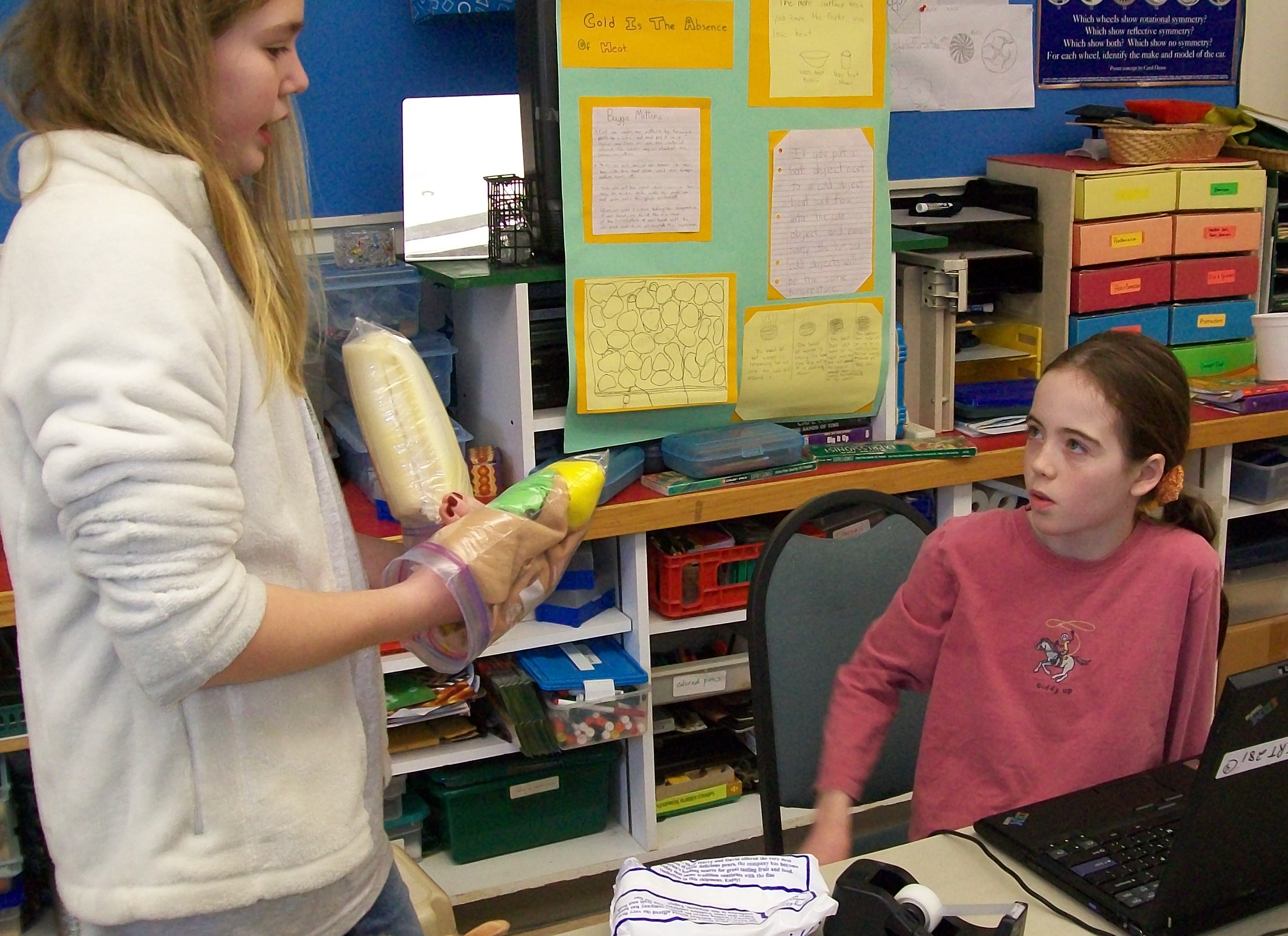
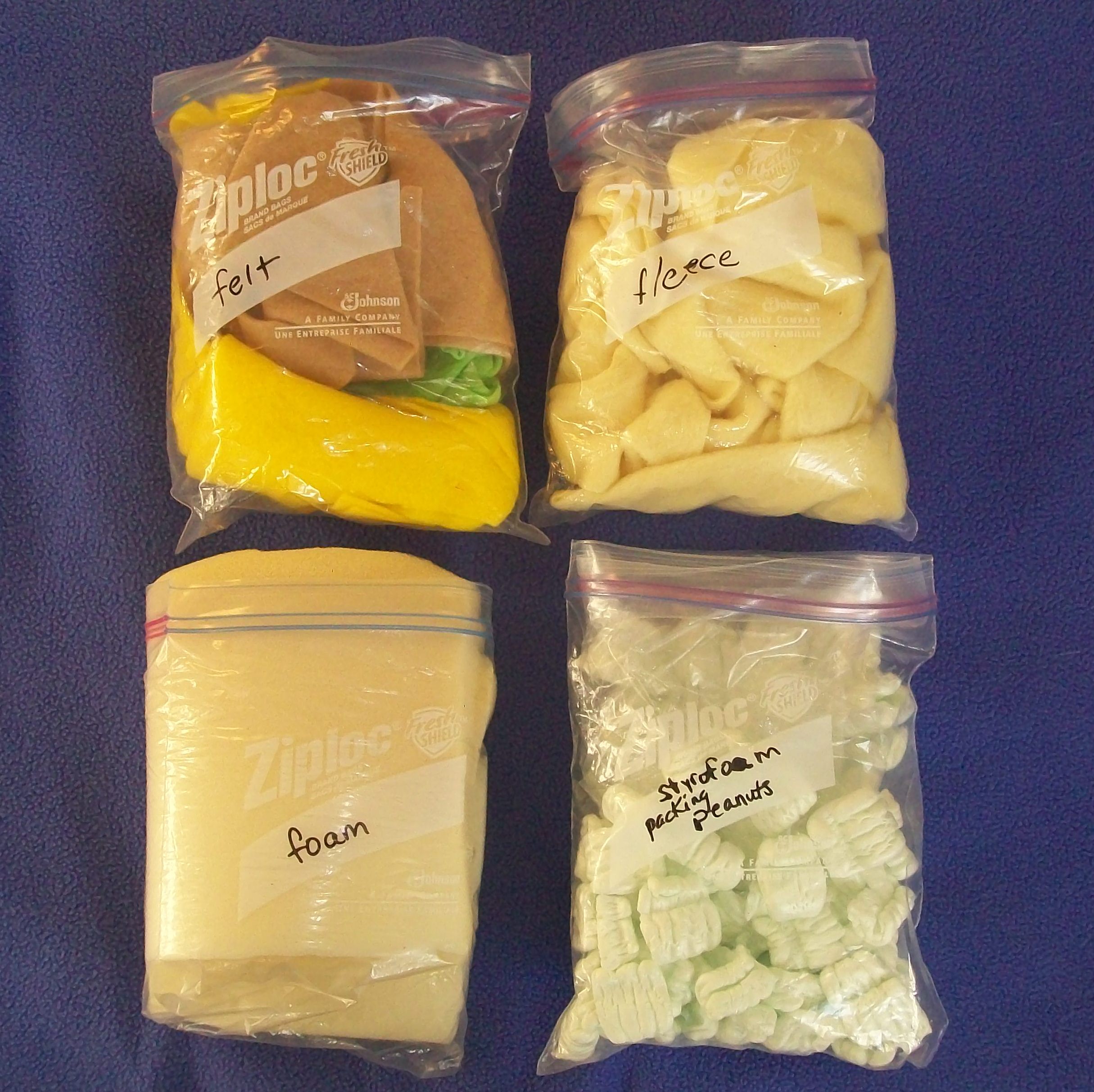
using temperature mitts editThe mitts are made of plastic baggies, filled with puffy stuff for insulation. For the plastic peanuts and the fleece, there are two bags, one inside another, flipped edge to edge so they could zip together and contain, between them, a consistent depth of insulation.

Into the baggies, kids inserted a Vernier temperature probe, a specially designed thermometer with a line to attach it to a computer interface. Measuring the temperatures of small buckets of ice or heated water, they examined the data on real-time graphs, which were created by Vernier software on the computer. Students could see the curve as the temperature rose or fell. The mitts let them compare the effectiveness of various kinds of insulation.

Without a live demonstration of the use of real-time graphing using probes of this sort, I find it difficult to convey the dramatic POW! of the experience. The whole activity of graphing suddenly makes more sense. Kids see clearly the relationship between the x axis (usually time) and the y axis (measurements of temperature, light, force, gas pressure, sound, proximity…or any of a number of attributes for which probes have been designed.)

Here’s a graph of a very simple trial, in which a student held the temperature probe directly in her hand. The graph rises gradually to a peak, then falls off quickly—but not instantly—when the person’s hand is removed.

heat graph

Sometimes we compared: which hand was warmer, right or left? Did that correlate with the person’s handedness in any way? Could we be sure of the correlation, or were there too many other variables, not controlled?

(In many programs, it’s possible to graph several trials on the same screen, using different colors. For example, we could graph the data from the right hand in red and the data from the left hand in green, or graph multiple trials for each hand in assigned colors. The software also provides a full table of the data, and instant statistics including the range and the mean.)

We did experiments of this sort before we had computer probes, of course, just using regular thermometers. In the very earliest years of using The Voyage of the Mimi, thinking about whales and the insulating effect of blubber, we found ways to test the effectiveness of insulation, and these mitts would have been perfect.

More recently, working with the occasional use of a small classroom set of iPads, we used a Vernier temperature probe along with a interface called a LabQuest2, to let us gather and graph temperatures outside, streaming the graphs, as they were drawn, on multiple iPads.

Here’s a group who’ve come inside to debrief. (You can see the temperature probe in Abi’s hand.) They were playing a game called Microclimate Tic-tac-toe, and looking at the tic-tac-toe grid on the small whiteboard in Patty’s hand, to review what they’d found. For now, it’s enough to say that they were searching for microclimates: localized, specialized conditions of temperature, light, and moisture.

microclimate group with Patty

ipad temp workThis group has found very hot temperatures on a large black tire on the playground. They can feel the high temps even with their fingers.

Another student uses a second iPad to watch the graph  as it’s drawn from the probe data.
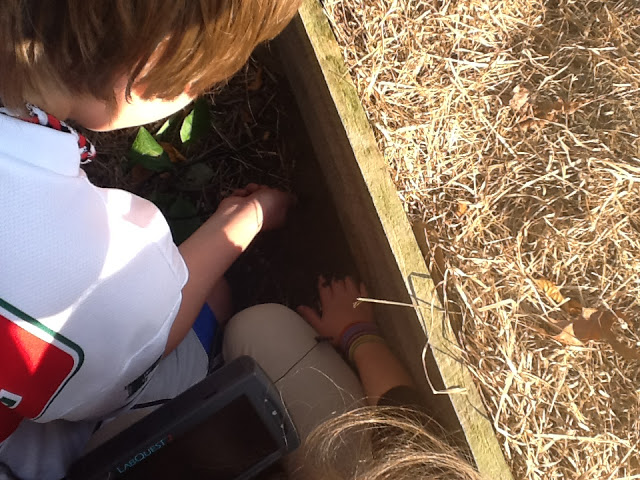
temp work damp soil

Meanwhile, there’s a much cooler place nearby, in the shadowed, moist soil next to the tire.

The very compact LabQuest2 device is just visible in the lower left corner of the photo. It communicates with the iPads using one of the school’s WiFi networks.
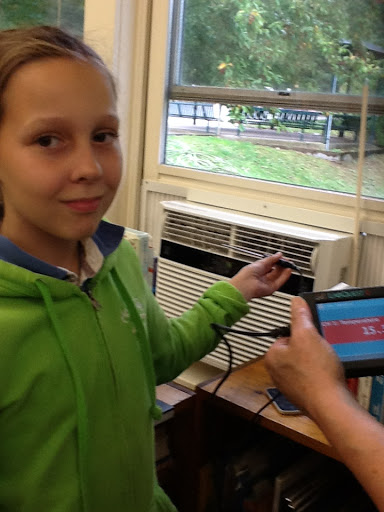
fall projects Morgan

Here are members of another group working inside, finding the coolest and warmest temperatures they could locate in the classroom.

John reaching edited

What did we want the kids to get from all this data collection? We wanted students to join the admirable horde of humans who’ve started out understanding the world by figuring out how to measure it. We wanted students to feel comfortable describing the world in quantitative terms, in numbers with a unit of measurement attached.

In this case, measuring temperature, we wanted students to become flexible about using either Fahrenheit or Celsius, and we wanted them to operate at an intersection between data collected with appropriate measurement tools, and the testimony of their own senses, so that the numbers acquired sensory meaning.

I’m working on this post on a perfect day for searching for microclimates outside: a chilly wind, bright sun. In conditions like these, kids could easily find temperatures varying by as much as 20 degrees Fahrenheit, often within a few feet of each other.

And if students were hungry for something really dramatic, we’d send them off to check the hood of a black car in the parking lot. They might never look at a black car on a sunny day in quite the same way again.

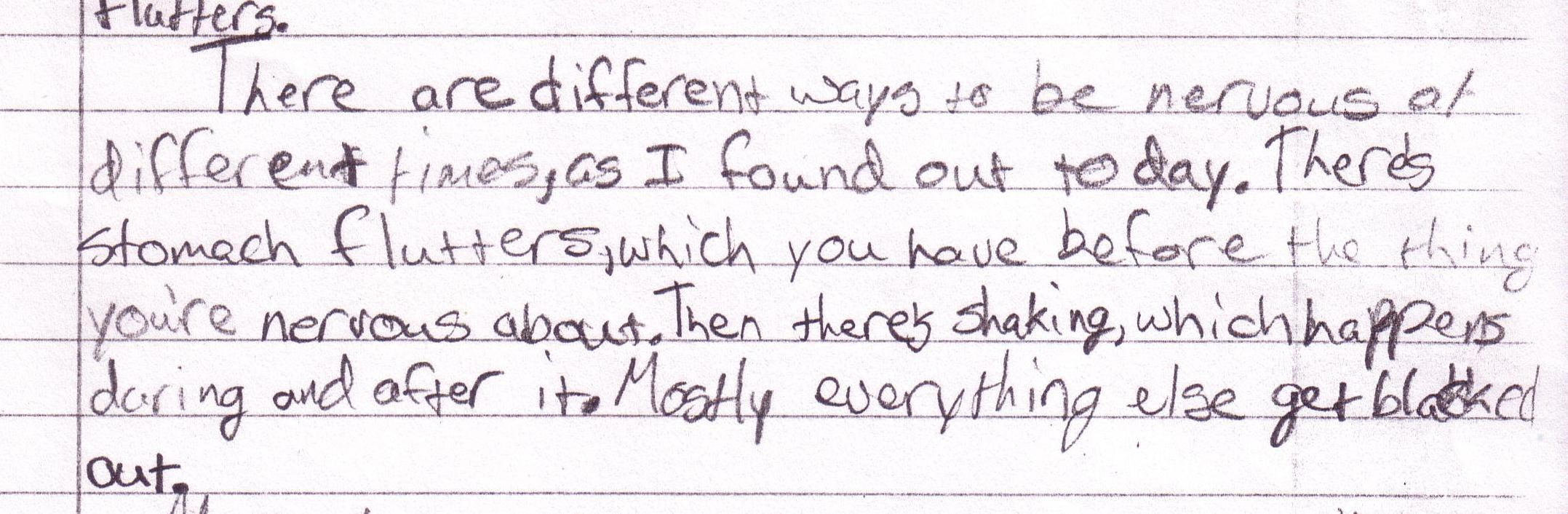
Just for Five

If you’re stumped and blank as a new field of snow, at least try writing, without removing your pencil from the paper or your hands from the keyboard, for five minutes. Just five.

The previous post focused on brainstorming a topic list, but said almost nothing about actually choosing. Although decisions often challenge me, even I can just ‟go with my gut,” as my daughter says, if I’ve brainstormed first. Students seemed to share that.

taking care of ducks recropHere’s part of the writing that came from one of the brainstorms shown in the previous post, about taking care of baby ducks.

(Once in a while, a student would ask, ‟What if I can find a way to put all of my brainstormed ideas together?” This made me think of my friend John Hodgen, a poet who sometimes seems to have done exactly that: to have noticed and listened to and named the different crickets chirping in the dark corners of his mind, and taught them to sing their brightness-against-the-dark songs together. How could I be doctrinaire about any of these instructions, given such models of make-it-your-own?)

One way or another, all of us sitting in the classroom together, almost always, could choose—just like that—and start writing—partly because this exercise only committed us to writing for five minutes.

I sat at the front of the room, at the little old wooden student desk I had rescued from the basement. (My big desk was back in the corner.) For other writing activities I moved around the room, conferencing, but for the fluency exercises I sat with half an eye on the clock and my heart in my throat, inspired by all that energy around me–and I wrote like mad, myself, for most of the five minutes.

As a young adult I attended Quaker Meeting, sitting every week in silent meetings of collective reflection and searching. In addition to meeting for worship, Quakers have specialized meetings, always beginning with silence, for specialized purposes—‟meeting for business,” for example. This intense short writing in my classroom was a silent meeting for writing, and we were all in it together, reinforcing each other.

Unlike ordinary open writing time, we weren’t asking each other questions, or getting up to consult dictionaries or spell-checkers, or losing time over punctuation, if that got in the way. We were just writing, writing, writing. The brevity—five minutes, no more, at the beginning—helped to create an intensity, a suspension of self-conscious critiquing, a focus on the act of inventing and constructing with words—and that led to some amazing beginnings.

test taking amanda croppedSome students at this age (in this case 12) are able to use conventional spelling and paragraph breaks, even in a quick first draft. 

What about paper vs. screen? I wrote in front of my students on paper, by hand, but I do this exercise at home on the computer. On the other hand, I don’t carry my laptop in my backpack when I’m out walking or bicycling, so plenty of writing, including brainstorming, happens in a paper journal. For me, different kinds of writing have emerged in the two different situations. It makes sense to me for students to be comfortable with both, if they can, and to have that additional option of switching, like having another gear on a bicycle.

With more and more computers in the classroom, I could encourage students who had already developed some typing fluency, or for whom writing by hand involved special difficulties, to use typing in this situation. Increasingly, over the past decade, students with writing challenges, throughout the older grades of my school, have been allowed to bring and use their own laptop computers. While some kids found their sheets of paper and pencils, others set up their laptops, or got settled at one of the classroom computers. It worked fine.

As the days and weeks went by, even the most challenged kids would figure it out: you can write about almost anything if you’re only committed to writing for five minutes, and if you focus on the meaning of what you’re exploring, not the mechanics.

I loved that point somewhere in the second week when kids would start looking at me warily, or actually wave their hands, in a universal gesture meaning, ‟No! Don’t you dare call time!” If everyone else seemed okay, I’d just go for it and give us a few minutes more. This could lead to sudden exhilarating jumps in word count. At the rational age of 11 or 12, kids knew they couldn’t make a direct comparison between quick writes of different durations—but they felt the power of their own stamina, and that’s what I wanted them to be able to feel.

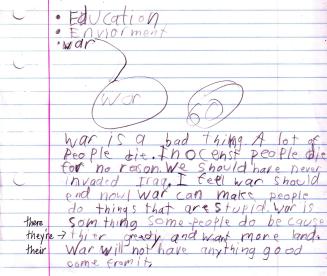
about war2 croppedWhen I did call time, students counted words, including any words crossed out. (Those crossed out words got written first, so they represented part of the writer’s output.) Nobody was allowed to marvel publicly about how many or how few words they’d written. They were meant to compare not with each other, but with themselves, day by day, page by page in their notebooks.
I think of a child who wrote just nine words the first day, and was proud to do that, but even prouder to get to 43 after a few repetitions of the exercise format, over the next week. I think, also, of other children whose word count actually started high and went down, as they worked to figure out how to think and write at the same time. That, too, was a good thing.

So: if you need to write and you’re stuck, just write for five minutes. If you want to cast a line into the file cabinets of your mind, and see what comes up, you can make a surprisingly good start in five minutes. If you think you know nothing about a topic, five minutes is long enough to prove yourself wrong—to prove yourself ready to begin.

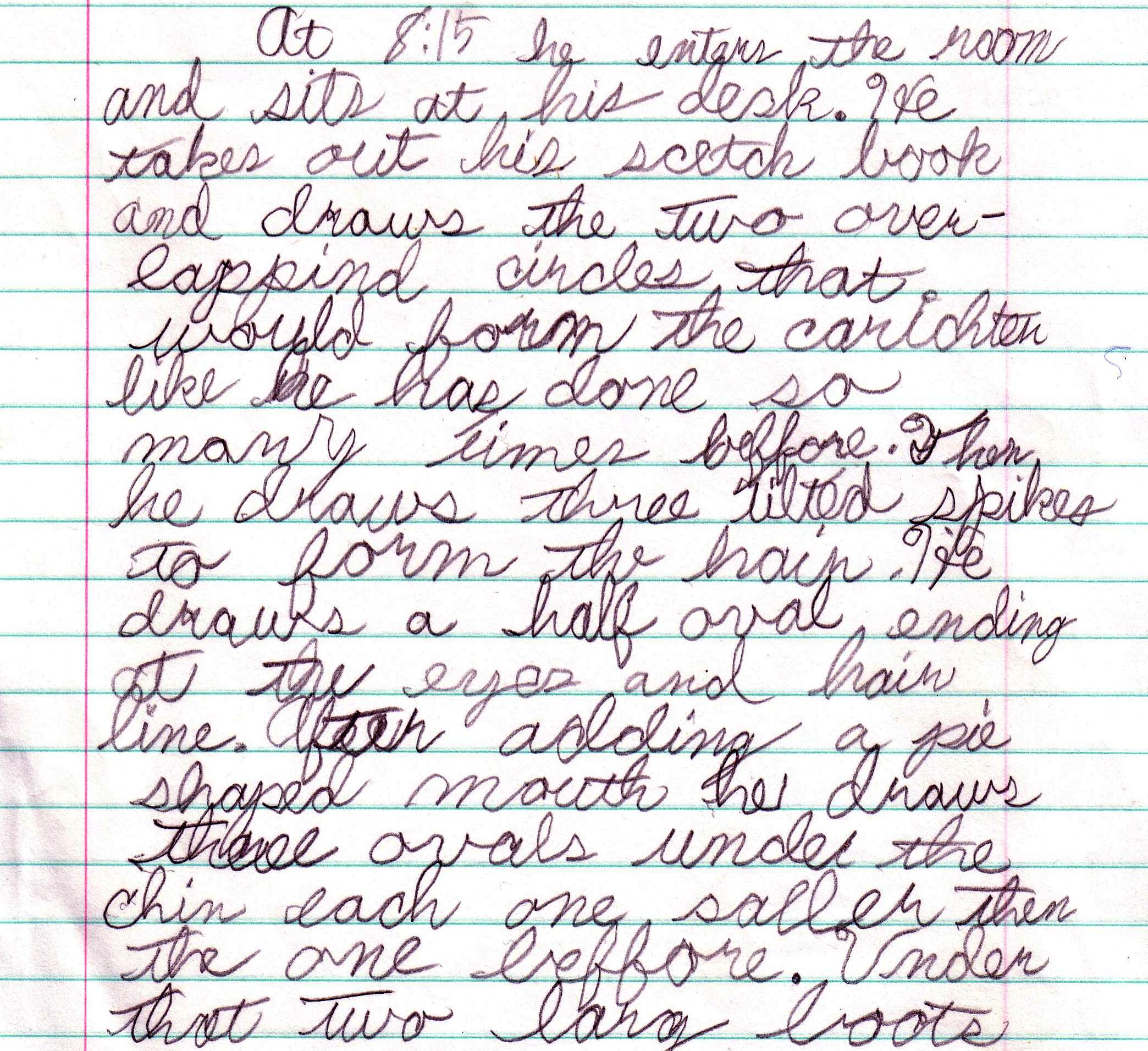
drawing cartoons croppedFinally, although there’s a special power to this exercise when a whole group does it together, you can do it by yourself, and kids sometimes did, in open writing time. I could see them glancing at the clock—or forgetting to glance at the clock, which is even better.

All in all, another slogan to live by.

On days when we did this exercise, kids typically had a choice for how they used the rest of that day’s writing time. A child could keep going with that piece she had just started within the exercise, and many students chose that. A child could also work on something else entirely, a story in progress, a letter to an editor, a menu, a poem–maybe a poem in the form of a menu? Some kids spontaneously began revising what they’d written in the exercise; many waited until we were all working on revision together, when I did mini-lessons to help support that.

Of course, the writing curriculum as a whole was much more complicated than this one brainstorm-and-free-write exercise. I want to write, in other posts somewhere down the road, about kids sharing their writing, and about revision, and about some specific genres of writing.

This exercise, though, was the fundamental practice, the opening of the heart, the first opening of that packet of seeds each of us carries, ready to germinate. We followed the exercise again whenever we needed to warm up, or to have a new beginning: after vacations, after the long individual research reports were finished in the spring, or after a week of very little writing time due to field trips or community events.

Writing this, I am moved all over again by the remembered hush of a class full of kids whose pens and pencils and keyboards are making the only sound; whose hearts and minds are brave, or surprised, or faithful, patient, excited—one version or another of busy. They could risk that little storm of intense composition; their hands and minds could work together that long; they could be that generous to themselves.

In Praise of Colleagues

When I reread my last post, it hit me like a ton of bricks: I had left out something important. It’s easy to overlook something so pervasive that you come to take it for granted. My mother goes to a new doctor, and forgets to mention the mobility and visual impairments that define so much of her present life (along with her continuing eagerness and whimsy.) I write about resources for understanding student writers, and don’t actually mention the sturdiest resource of all–my peers.

After school, teachers gather in each others’ rooms and talk shop. Not every day—there are a few other things to get done: meetings and parent conferences to attend, notes to write on the whiteboards, math manipulatives to locate, photocopies to make, plain old ordinary messes to clean. Still, at the end of the afternoon, for many grateful years I could go stand in Susan Doty’s doorway. ‟Help!” I could yelp. ‟What’s going on with this kid? Why is he so afraid of writing?” I knew she would stop and think carefully about her answer, giving me the same kindness she gave children.

farmer in Crete croppedWhen Marian Hazard taught her own class, before she became the school’s garden wizard, she would wander down to my room and share insights provoked by the most recent book she was reading, about how to help children move forward as thinkers and writers. She often had more patience than me, for reading about education, and, later, for the work of cultivating both plants and gardeners. I gained, always, from sharing what she discovered.

For a while, Kate Keller taught in a room very near my room. When she was trying to describe a breakthrough in the writing of one of her students, she could easily invite me across the hall and produce evidence. ‟Look!” she would say, pulling a file from a pile of folders. ‟Can you believe this?”

four potsOur endeavor, in teaching writing, and in all things: to meet kids where they were, to travel with them as far as they could travel, to help them recognize and celebrate triumphs, and then move forward again—all that was collaborative, in a way not necessarily visible to students or parents.

A thriving faculty conversation is a living thing, like yeast in good bread dough. Over the years I came to see how hard it must be, how delicate, for a principal or head of school to trust and support and strengthen that conversation–and how essential.

three gourdsI also learned that I had to nourish myself, because any individual teacher has to punt, again and again. On the September day when I guided a new class through their first writing fluency exercise, and one child sat in her place at one of the tables and wept for the entire five minutes, and beyond, while everyone else counted the words they’d just written—on that day, like most teachers most of the time, I was the only adult in the room. The student had only recently entered my school; nobody knew her well. So she and I shared something: both of us were stumped. I wasn’t just stumped; I felt awful.

I didn’t scold, since I knew that she was doing the best she could. We talked briefly in the privacy of the hallway. I told her that I wasn’t worried. (I lied.) I told her what was true: that I would ask her to do the same thing again the next day—to brainstorm ideas, to choose one, to write for that little chunk of time that I knew could feel like forever. She would have another chance to try.

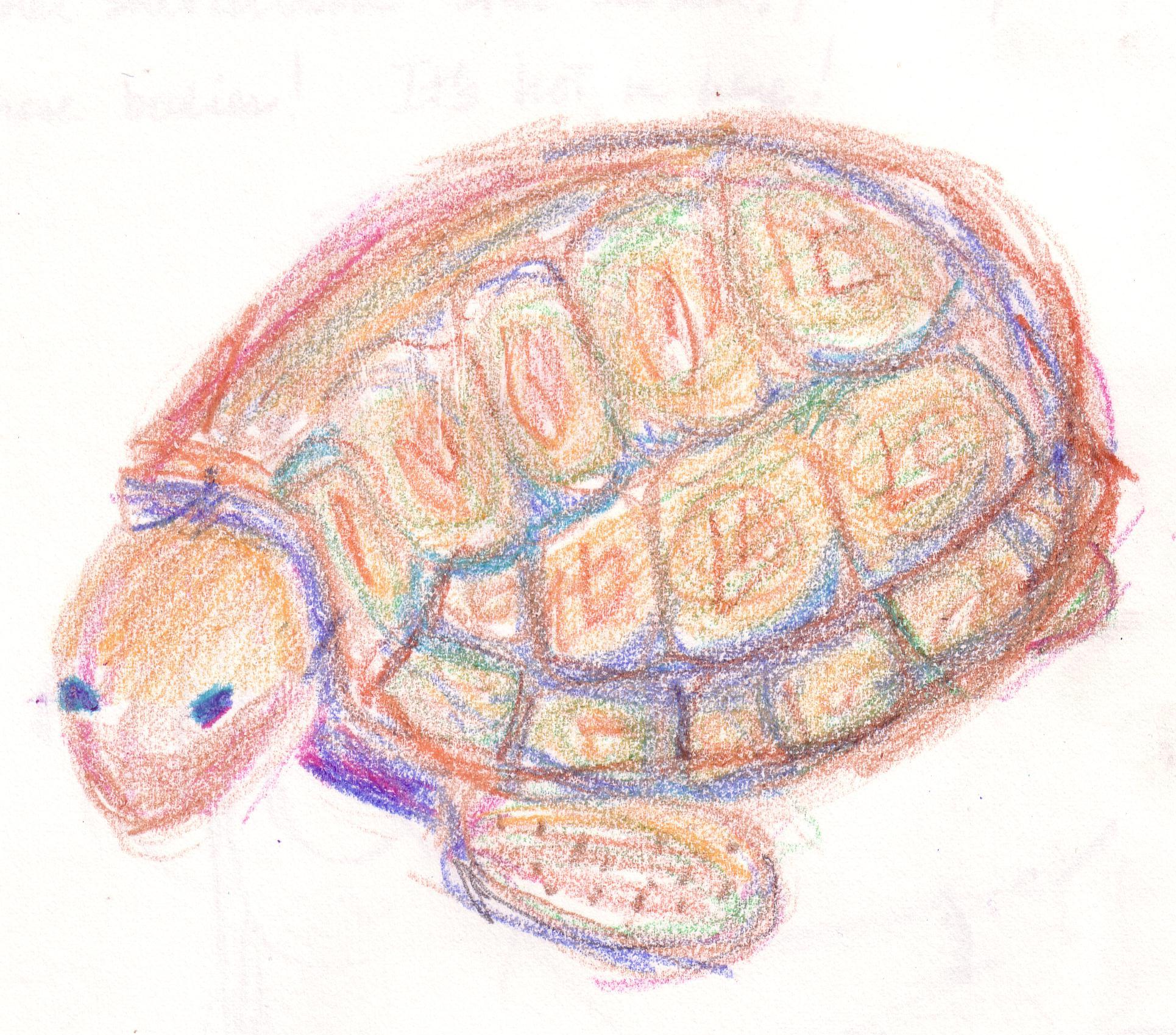
redblue turtleI also told her that she could do what I’d done in college: write about why she couldn’t write. If she had to—and she wouldn’t be the first to resort to this at least once—she could write one word again and again, until the second word came to her, and the third.

The next day she did brainstorm and choose; she did write. Not a lot, but some, and that was all the exercise asked for. She went on, that year, to write some pieces that took my breath away. ‟Look!” I said, to whatever colleague I shanghaied that afternoon. ‟Can you believe this?”

I’m telling this story, before I really describe that exercise (next time, probably), because I don’t think there’s any guaranteed approach, exercise, bypass strategy, or technological support for writing difficulties–and because, in my experience, the best source of wisdom, the best source of quality control, came from my fellow teachers. Also the best source of energy to keep going.

Knowing the results of testing or external observation can help, but parents and teachers both can easily make too much of such things. We need to know, by asking the child and by intuiting with all our senses, what challenges a child faces; we also need to offer the bypass strategies that can help. Ultimately, though, we have to do the same basic thing again and again: ask a child to keep trying, and give her credit for everything it takes to try.

I loved my school and my colleagues because our support for each other, so consistently, was support for our highest mission. We supported each other not by blaming the child—even though that’s sadly common in situations in which teachers are hard-pressed (and teachers tend to be hard-pressed.)

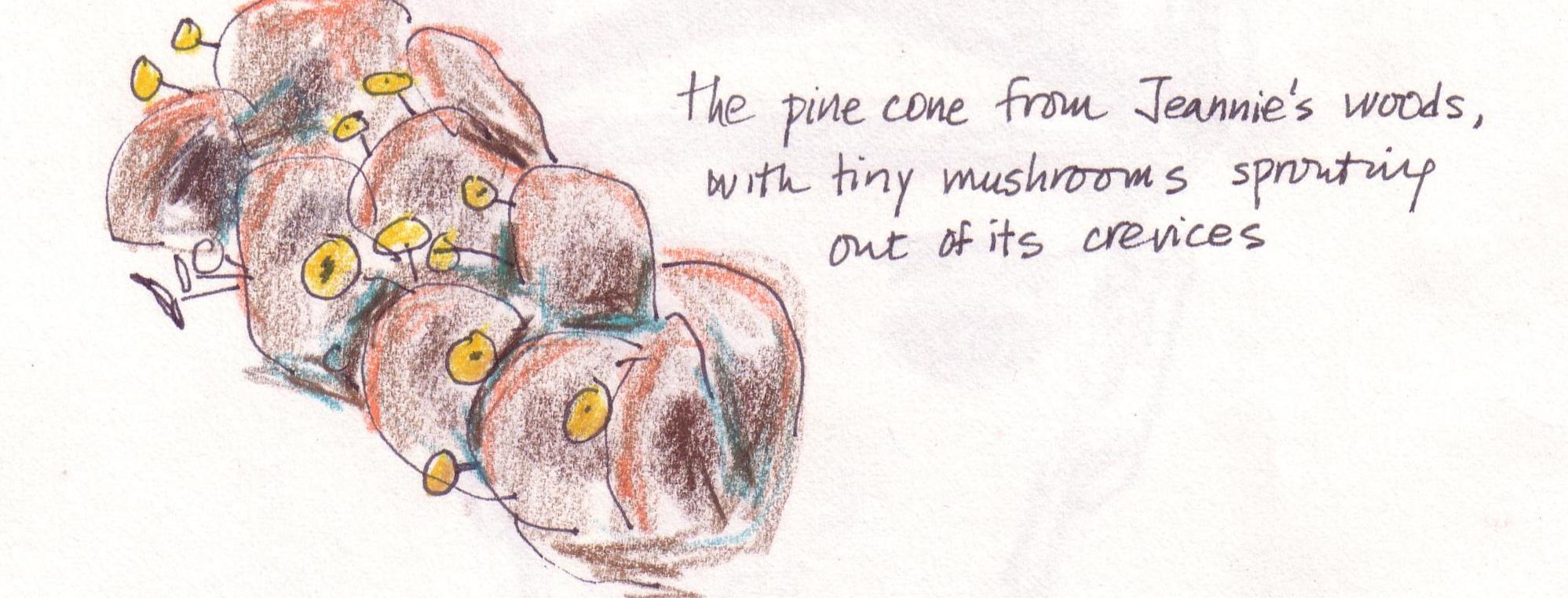
pinecone with mushrooms croppedWhen Julie Olsen, having seen me in the hall with a student, asked what was going on, she wasn’t looking for a chance to commiserate about those awful kids we were stuck with. If she knew the child, she always helped me see the world of the classroom from that child’s point of view. If she didn’t know the child, she asked questions that would help organize whatever I’d been able to observe. She laughed her wonderful raucous laugh with a particular twist that acknowledged the profound challenge of teaching—but it was never a laugh at a kid’s expense.

The colleagues I’ve named taught near me, literally or in the sequence of the school’s groupings, for many years. Others, not named here, taught older or younger children in other corners of the school, and helped me understand where my students were coming from, and where they were headed.

We supported each other by honoring each others’ efforts to know each child; by holding firm, together, on the issue of class size, so that knowing the individual child was possible; and by understanding, always, for each other, that all our hearts were doing hard work.

Last but never least, in moments grabbed from the ongoing intensity of our lives, we cheered each other on by sharing our euphoria about progress. I could not have asked for more.

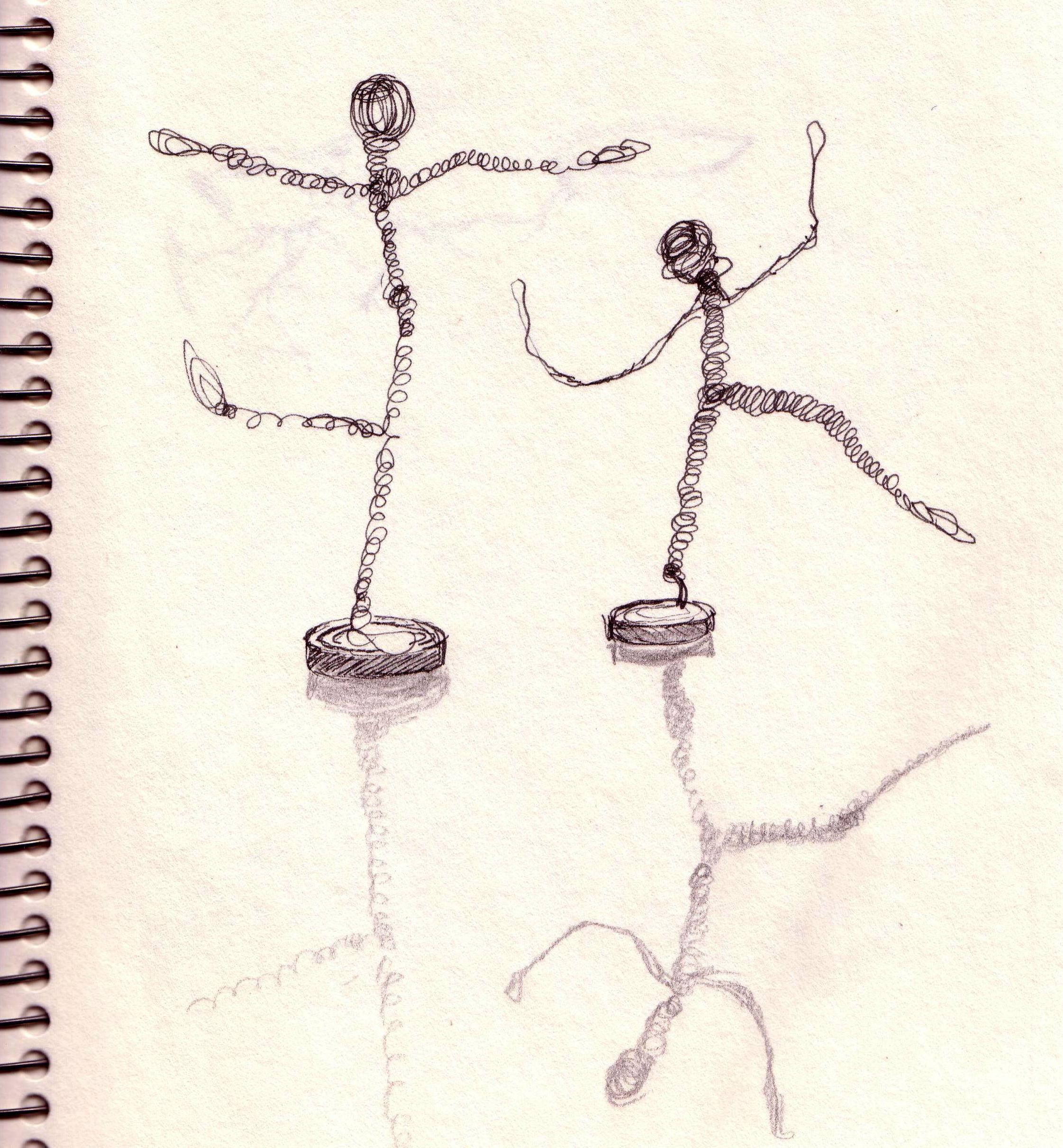
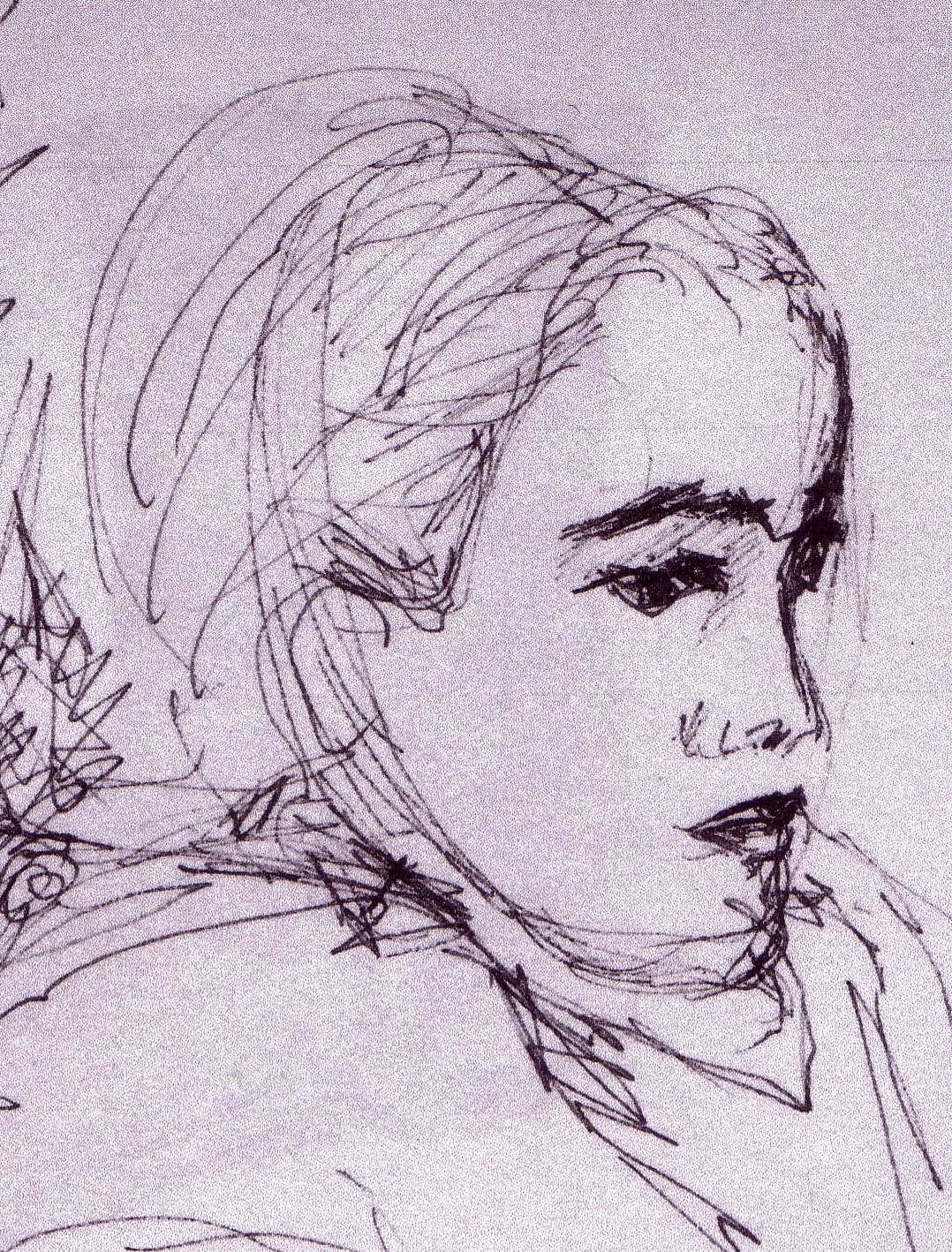
wire sculptures narrowerThe sketches are in thanks and praise for another teacher, Marjorie Weed, who came to volunteer at Touchstone after a long career as a public high school art teacher. She helped me encourage my students as creators and composers, by working with them herself, while I watched and learned along. Mrs. Weed inspired me to give kids time for sketching during our settling time, almost every morning. I was her “oldest and most improved student,” one of many who still value her influence.

Troubles with Writing

According to family stories, I composed mangled (but apparently highly expressive) Christmas carols, almost as soon as I could talk. I used those little wooden alphabet blocks to build my own typewriter, and then imitated my mom, tap tap tap. I was getting a kick out of writing before I could write.

Year by year, in school, I loved most the teachers who assigned the most writing. Mrs. Duleba, second grade, shared her invaluable confidence that meaning mattered more than spelling. I’m forever grateful to George Batchelder, who thought English class should be fun, and to the State of New York for saying (in 1960) that seventh and eighth grade students should have two periods of English, every day—which gave us room and time to do actual writing, as well as diagramming sentences. Oh, and to the school administrators, for letting Mr. Batchelder be my English teacher for two full years of essays with titles like “When Mother Drives Father’s Car.”

Early attempts at humor aside, all my life I have thought more clearly with a pen in my hand or a keyboard under my fingers. In a rough stretch in college, I kept myself going by writing about why I couldn’t write what I was supposed to be writing. Writing has helped me survive many kinds of hard times, and it has been a source of joy, and a vehicle for joy, a way to let joy travel into other lives, or into my own life, later.

When I started teaching, I thought, “Aha, I finally have full right to read all the papers being passed towards the front of the room,” something I got in trouble for when I was younger. Gradually, though, I realized that the hardest thing to teach can be what comes naturally to you. I struggled to understand why writing was so hard for some of my students.

StefanI didn’t take photographs of kids not writing–too mean. Sometimes, though, when I was supposedly writing along with them, I did quick sketches. So this is Stefan (now a thoroughly successful adult) curled into a pretzel to hold himself still for long enough to get a few words onto paper.

Classes and conferences and reading have helped me understand better. I’ve also extrapolated, sideways, from the many other things that challenge me, and I’ve looked carefully at my own bouts with writer’s block. As teachers, we have to value whatever we know in our own learning selves about our students’ challenges. Above all, fortunately, the circumstances of my teaching let me learn from students.

Talking with kids, all kinds of kids, it came clear to me that written language is both commonplace and tricky in human experience.

Books and a long string of PBS documentaries told me that we haven’t been using written language very long, in the evolution of the human tool set. (By tool set, I mean both our physical equipment and coordination, and our cognitive abilities.) We’ve evolved to shout, to sing, to run, to dance. Also to gossip; to complain; to give praise. (So happy, for me, to visualize young adolescents doing all those things!) What comes naturally for us can overflow usefully into writing, can claim writing as tool. Still, we haven’t evolved to write.

Writing is complicated. I once heard Mel Levine make a powerful case for this. (Like many other teachers and parents and kids who learned from Levine, I’m trying to let his wisdom survive his wrongdoing.) Levine listed things a writer has to think about, all at once: ordering sentences; spelling individual words; forming letters; using the tiny, powerful signals of punctuation; structuring paragraphs; choosing between similar words that mean different things, or different words that mean similar things.

Listening to Levine, I thought: well, that makes bowling seem simple. For me, bowling is a nightmare. I stop looking at the pins to think about my feet, and suddenly my hand is no longer holding the ball reliably, and I’m liable to drop it. I’m easily distracted by the conversation of the people bowling in the next lane. (Are they sisters? Friends? Co-workers? What’s this they keep saying about horses?) I haven’t bowled in years, but I remember clearly the sensation of trying to solve the Rubik’s Cube of my own body, to do everything right at once, with all my limbs—especially while other more interesting things were claiming my attention.

I’ve come to understand that for many kids, that’s how it feels to write, either physically or cognitively.

Bearing in mind the evolutionary novelty of it all, and grateful for the supplement of human culture (including technology), I’ve watched some kids discover that they feel fine writing on a keyboard, which removes the difficulty with forming each letter—just a keystroke does it—and makes it so much easier to control spacing and organization on a page. I’ve watched other kids get a crucial power assist from software that translates a voice into written text.

Those bypass strategies for physical challenge don’t necessarily simplify complex cognitive challenges. Writing demands enormous coordination of attention and memory, enormous stamina for making choices and weaving them together. Pre-writing activities can help to some degree. Still, like me eavesdropping on the people in the next lane at the bowling alley, a kid can very easily be distracted by what’s going on in her head, including the other way she considered phrasing whatever she started to say. Kaboom—the two phrasings have a crash collision, and the reader is left to pick over the pieces.

In one of my favorite examples of the ways kids can advocate for each other, an eleven-year-old born writer once said to me, ‟You really can’t ask R. to worry about punctuation yet. He’s trying hard just to keep the beginning of the sentence in mind while he writes the end.”

sad girlThen there’s the endless circus of early puberty, easy to dismiss as generic, but in fact a different journey, with different rewards and different obstacles for each child. There’s also emotional trouble: for example, the kid who is keeping a scary secret so huge she can barely think, let alone write spontaneously or thoughtfully, since both of those require some inner freedom.

Sometimes I watched the struggles of the child who’d been told too many times that he was a good writer, who became, with the self-consciousness of early puberty, his own impossibly hard act to follow.

That brings me back to my own experience: writing helped heal emotional wounds, helped make sense of confusing changes and challenges, helped hold and channel euphoria. Wisely or foolishly, I wanted the powers of writing to be available to every child with whom I worked–wanted that just as intensely as I wanted the magic wand that could remove all their troubles. (Not a good idea, of course.)

I cared a lot about kids, and I had faith in the power of language—and that meant I had a huge incentive to figure out the strategies I’ll write about next time, for how to help kids just get words on the page.

Chasing the River

As a teacher learning along with my students, I met Donna Williams, watershed wizard at the Massachusetts Audubon Broad Meadow Brook Conservation Center and Wildlife Sanctuary. She told us that the word watershed means the area from which rainwater or snowmelt drains into a particular body of water. You’re always standing in a watershed, even if your feet are dry.

Watersheds are often split by town or state boundaries, complicating efforts to protect them. Before the Blackstone River could be cleaned up in any significant way, the watershed of the river, draining large areas of both Rhode Island and Massachusetts, had to get over those political identities, and some economic rivalries, too, and start thinking like a watershed, an area with a lot to gain by working together. Knowing about watersheds can help us understand both the organization of ecosystems, and the impact of environmental damage–and environmental improvement.

To make it even more interesting, we live in watersheds within watersheds.

When my hillside gets a heavy rainfall, whatever doesn’t soak into the ground runs downhill into one of several small brooks which braid together to be called Indian Brook. So I live in the Indian Brook watershed.

A couple miles downstream, Indian Brook runs up against a dam and forms the Hopkinton Reservoir, in Hopkinton State Park, which looked like this on September 18, 2013, at a time of low water and not much color yet in the leaves.

Hopkinton Reservoir cropped

After it emerges from the reservoir, Indian Brook twists and turns some before it runs into the Sudbury River, near the tracks for the MBTA train to Boston. Meandering through Ashland and Framingham, the Sudbury runs beside the Massachusetts Turnpike briefly, then heads north, through the marshes of the Great Meadows National Wildlife Refuge. In Concord, the Sudbury joins up with the Assabet River at a place called Egg Rock, to become—presto change-o—the Concord River.

This photo of Egg Rock was taken in 1904 by Alfred Sereno Hudson [Public domain, via Wikimedia Commons] from the very beginning of the Concord River, with the Assabet to the right, and the Sudbury out of sight to the left.

Egg_Rock_1904

By the time it gets to the Concord River, my backyard runoff is traveling with that of many of my past students, from Hopkinton and Southborugh and also from Westborough, Marlborough, Northborough, Sudbury, and Wayland. The story isn’t over, though, until we get to the ocean.

In Lowell, the Concord joins the Merrimack River, saying hello to a tremendous share of the runoff water from New Hampshire and central Massachusetts. Go check on Wikipedia: http://en.wikipedia.org/wiki/Merrimack_River, and you’ll see what I mean, unless someone takes the map down. Hundreds of thousands of people live with me in the Merrimack watershed. Of course, for a humbling comparison, you could check out how much of North America is drained by the Mississippi.

Anyway, back to New England, all these waters head for Newburyport and the Atlantic, shouting for glory as they go, especially in flood season.

Many explorations opened up this story for me: walking parts of my watershed pathway, canoeing other parts—swimming in some places!—and tracing all of it on maps.

Like so many explorations in my life, this one started with something a student wanted to do. For a big individual report, David Gelman wanted to ‟chase” his own watershed pathway. Here’s something interesting: although David and his family lived only a couple of miles from me, his pathway was completely different, and led to the Atlantic via Narragansett Bay in Rhode Island.

While everyone else was reading books, David and I sprawled on the floor to read topographic maps. Step by step we figured out which body of water led to which, using the topographic contour lines to make sure we were headed steadily downhill, the way water does. At the same time, we figured out all the places where roads followed, or where bridges crossed, the succession of brooks and ponds that led David’s backyard runoff to the Mill River and then the Blackstone River.

Armed with that information, David and yet another amazing Touchstone parent, his mother Rosemary, went adventuring, ‟chasing the river.” They managed to find almost every road crossing of their watershed pathway. At each stop they did simple visual tests for water quality, and took photographs. Their thoroughness was inspiring to everyone else, and deeply satisfying for them.

David wound up knowing something about his place in the world that I wanted more kids to have a chance to know–and more grown-ups, for that matter, beginning with myself.

This stream of thought (I couldn’t resist) could go on for quite a while–It would take much more than one blogpost to tell about everywhere that led. Think of your power, David, wherever you are!

Next time, finally, I’ll jump forward to the 2012-2013 year, when we were studying New England, and did some work with watersheds using Topo software. Down by the virtual riverside.

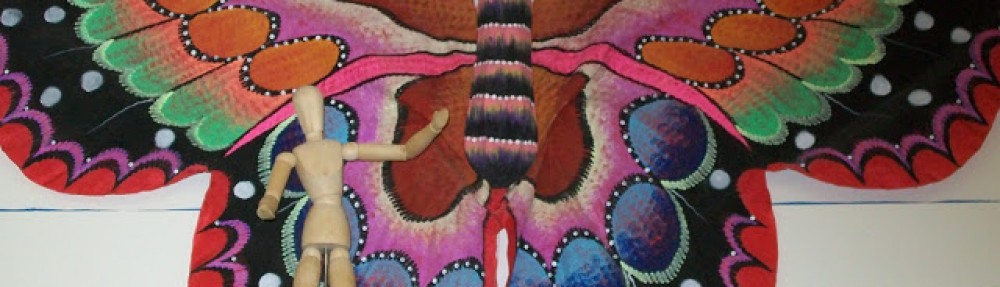
The butterfly

John Hildebidle, a dear friend from my poetry life, wrote to ask, ‟What about the butterfly?”

Sheryl Erickson and Martin Fuchs gave me the butterfly, which is a kite, at the beginning of their daughter Sophie’s time with me.

It felt like an apt emblem for everything parents gave, year after year, to the life of the class:

  • the gossamer but tough, often hard-won strength of parents’ faith in our mission and methods;
  • the powerful, buoyant, transforming lift given by parents’ contributions of time,  patience, shared skills and new ideas;
  • the brightness of parents’ joy whenever students shared their learning– enthusiasm not just for their own child’s efforts but for every child’s.

That last one seemed especially apt. In classes before mine, Sheryl had put lots of volunteer energy into exactly that, to strengthen parents’ care for each others’ children.

I hung the butterfly high on the classroom wall, and waited to see what else it would mean for us.

butterfly smaller detail sharpenedFor some students, the butterfly was above all a rich collection of colors. During morning sketching, over the years, many students chose to draw the butterfly, reproducing all its shades and shadings with our markers or colored pencils, as faithfully as they could. In this way the butterfly multiplied and flew away, onto shelves and into closets, but also into hearts–the way things can, even when they seem to disappear.

Meanwhile, gradually, privately, the butterfly became a reminder for me, to try to be fierce in moderation, as wacky as that may sound. I had had teachers myself who cared enormously about their subjects or their students or all of it, as I did. I knew that to venture into a classroom with the passion I brought inevitably carried some risks. Day after day, I looked at the butterfly and told myself to breathe, to ask questions and listen, to have faith in the fullness of time. To try, as much as I could and when I could, for a light touch. Of course, I often had to forgive myself and start over, every day, as all of us must.

None of that was what I wrote back to John, because ultimately all of that combined with something more, and the butterfly became, in the words of my email to him, ‟a sort of guiding spirit for the classroom, encouragement to use whatever freedom we had, to be vivid and colorful.”

The life of a progressive school is full of determination to do the right thing, to ‟make meaningful things happen,” as one past head of Touchstone School, Steve Dannenberg, used to say. Teachers and staff, parents and grandparents, all carry a profound sense of responsibility: to students, to the spirit of learning, to the truth of the world. None of that intends to be grim–or fierce–but it can become so, as the things most important to us can.

Early in my teaching career, I explained to a friend that I felt weighed down by the incredible opportunity, the freedom, to teach exactly the way I believed. If I could do that, I had to do that, and I was getting very little sleep in the effort, straining too hard.

I can’t say that ever completely changed. Still, here’s what I’ve learned about freedom: We never have as much freedom as we want, for pursuing what matters to us–and yet we never actually use all the freedom we have. But there’s also this: the more earnestly we try to inhabit our freedom, the more we become like butterflies whose wings have grown too heavy.

So the butterfly kite is flying high on the virtual wall of my blog, to remind me that yes, I want to be true to many important things; yes, I want to make meaningful things happen, in what I explore and write about in this “year to think it over.” But I want to do that with the wind in my sails, with the wonderful colors of classroom life in my heart, with a grin and a whistle when that’s called for. With joy. manikin sharpened

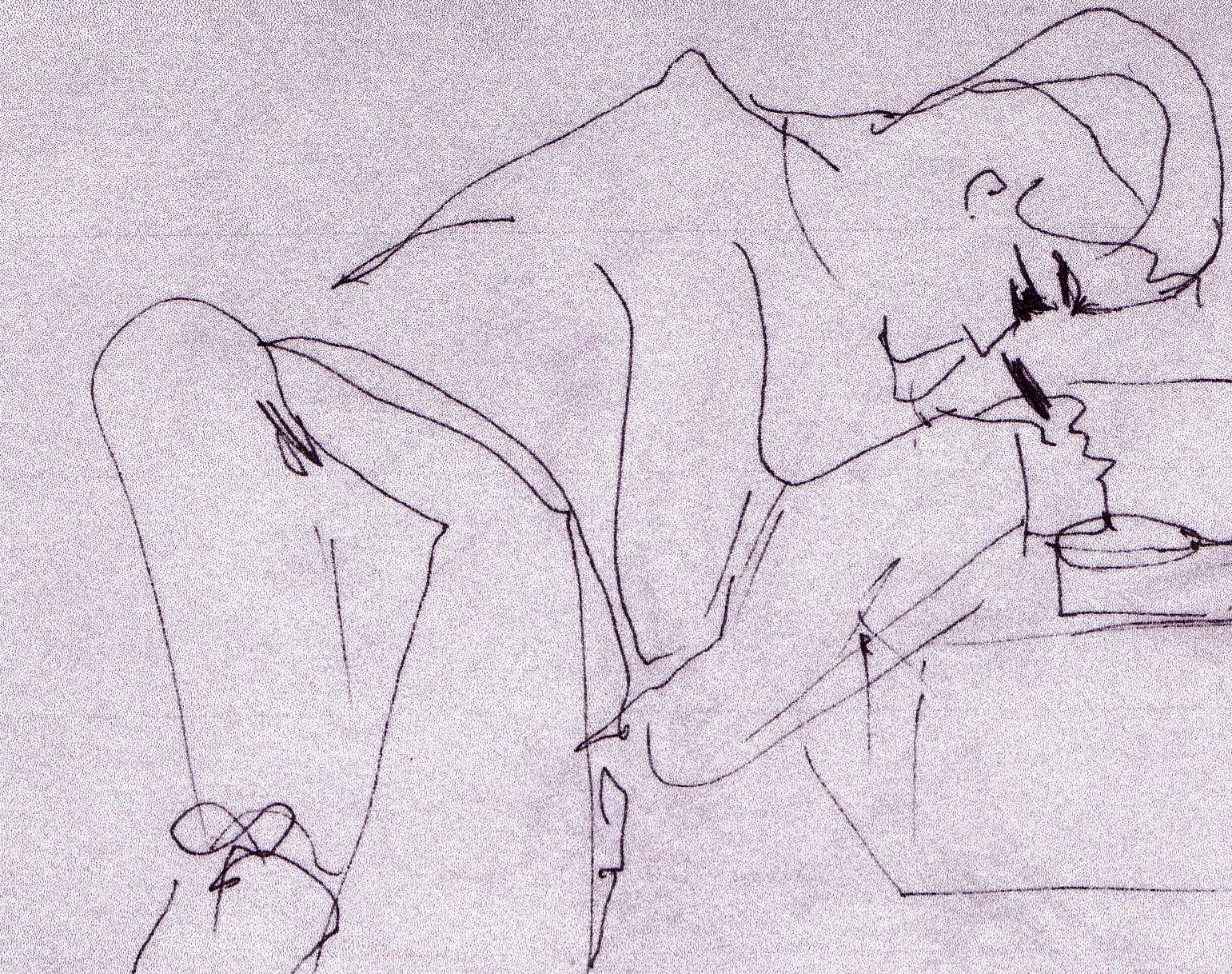
As for the artist’s model with her arms spread wide, gesturing: it’s possible that you just had to be there.

Building Average

I’m here to confess: I’ve spent a good portion of my teaching career guiding students in freaking out the cleaning staff.

Each year, in Level 6 math, we built a model of the Average Student, statistically accurate, earnestly assembled, vaguely lifelike. We set it up in a chair toward the back of the room. Usually the students chose a book to balance on its lap. I myself sometimes entered the room, at the end of a long meeting after school, and did a double take.

Traditionally, we took a group photo of the assembled class, with the dummy. Here, for example, is an unusually small class, from the fall of 2010. (Clockwise from the top, Kelly, Ben, Seth, Anna, Lydia, and Gianna,)

average 2010 better

A few weeks post-portrait, when stray arms or eyebrows began to fall off and litter the classroom floor, we held a funeral, usually with dual caskets–since one cardboard box couldn’t hold it all. We paraded more-or-less solemnly to the dumpster, and gave heartfelt testimonials about everything Average had helped us learn–

–which was a lot. If you ask a typical adult what an average is, chances are you’ll get the series of steps followed to find the mean of a set of numbers: add up all the numbers; then divide by the number of numbers.

That’s not wrong, as directions. But what does an average really mean? What can it tell you about a situation or a set of data? What can it not tell?

MathLand­—a wonderful math curriculum no longer in print—gave Level 6 students a chance to explore the idea of ‟average” from the inside. Many years after we had shifted to another curriculum, I kept starting the year with this unit, because it was perfect from so many points of view.

Setting a goal

You could build an average kitten, or an average bookbag–but it worked really well to build an average math class student. Kids took it all more personally, and paid more attention to interesting questions: Is Average identical to any individual in the group? How does the model represent each person’s data?

MathLand provided a data sheet which included a variety of measurable attributes—such as the girth of the neck, or the length of the upper leg from the hip to the knee. The sheet also asked about attributes that had to be described in other ways—such as the color of eyes or hair.

Some questions were yes or no: Do you wear a watch most days? Some questions had been wisely left out. Average was always just Average, neither he nor she. We weren’t asked to measure around the waist, or chest, just shoulder to shoulder.

Some questions deliberately provoked discussion. How do you measure the length of the neck? From the bottom of the ear? From the hairline? The whole class had to stop and decide, together, or the data would be meaningless.

Gathering and recording data

Before we could begin collecting data, we had to choose an appropriate unit of measurement, and an appropriate degree of precision. I did specify metric units, partly because I wanted students to get some practice with decimal numbers. The kids agreed that the measurements had to be at least as precise as the nearest centimeter. Even that could result in very unrealistic hands, though; so we almost always wound up agreeing it should be to the nearest millimeter, which we recorded as a tenth of a centimeter. (Fertile fields, of course, all of this.)

Boys helped boys measure, and girls helped girls. All the data was kept anonymous—and we said that the study subjects were unreachable for clarification of messy handwriting, so the recorded data had to be both readable and reliable.

Working with data

On the other hand, the occasional inscrutable handwriting also offered a relevant opportunity, once we reached the computation stage: If you can only read the data for 11 of the 12 members of the group, what should you use to divide the total? What would happen to the mean if you divided by 12 instead of 11?

Also, once you got your mean, would it tell you anything about the huge variation in sizes of kids this age? No–only if you added information about the range, which wouldn’t actually get built into our model.

Could a very long-legged class member and a very short-legged class member cancel each other out? Yes, in effect. But in a class with several unusually long-legged people, would the mean probably be affected? Yes, again.

Meanwhile, what about the attributes described by words? For those, we found the mode, the most common answer or value, with interesting results. A math class with only 4 out of 13 blue-eyed students could wind up building a blue-eyed Average, if the rest of the kids were divided evenly among brown, green, and hazel. ‟So my brown eyes have disappeared from our Average representation?” a certain kind of kid would ask, even without being paid or prompted.

Representing data:

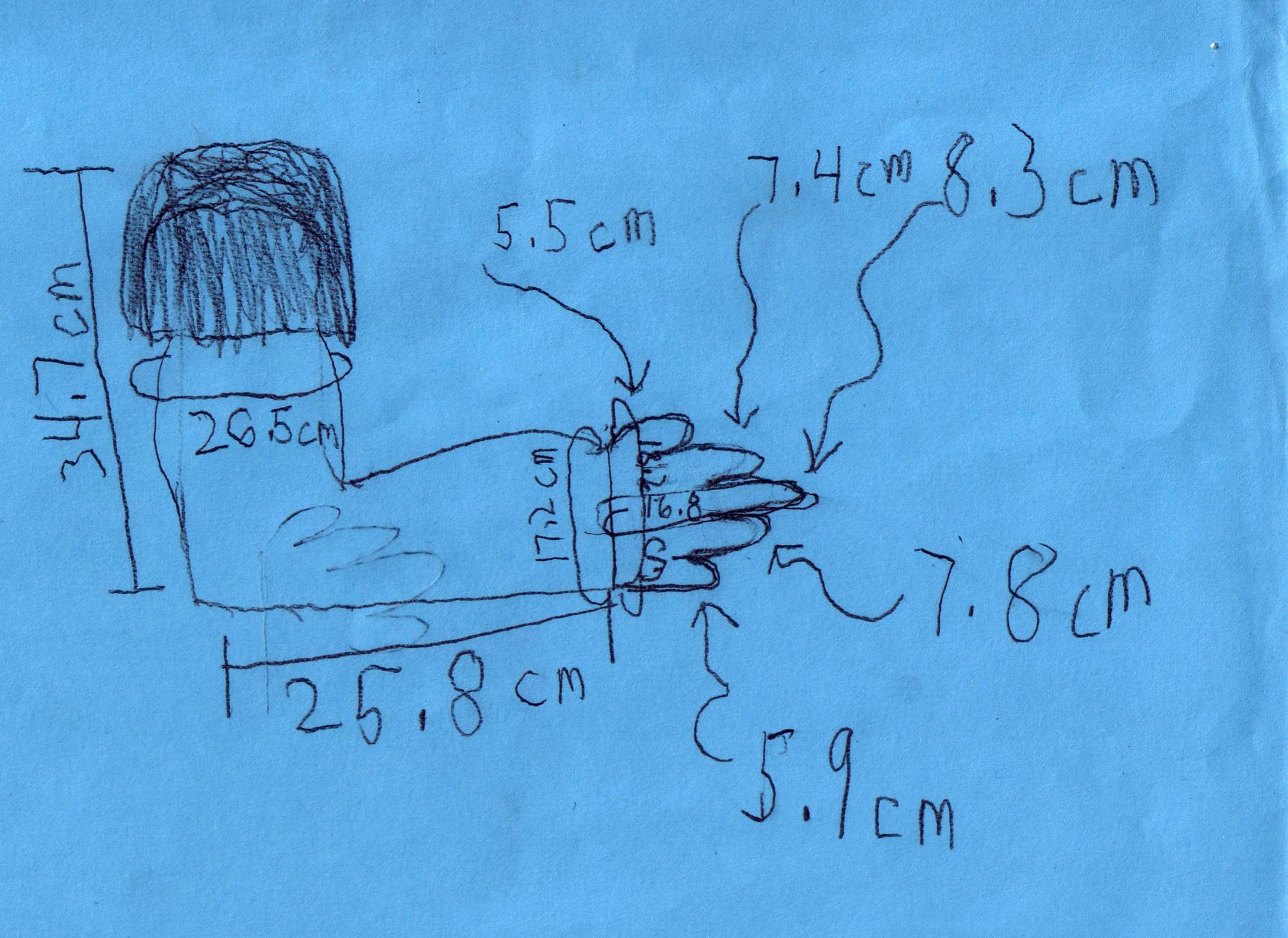
Ed's arm blueprint croppedAlthough they were working together, every child measured, and recorded measurements. Every child took part in finding the mean or mode for the attributes of his or her team’s assigned body part. Finally, every child drew a “blueprint.” Here’s Ed Pascoe’s blueprint for the arm and fingers.

Julia's face blueprintEach person on the team assigned to manufacture the head and facial features, for example, started out by making a basic sketch of a face, and then labeled the mouth with the mean width of the mouth, the eyes with the color of the mode for eyes, and so on. Here’s Julia Bertolet’s blueprint for the head.

Then, following the suggestion of the curriculum, but apparently against common practice in most places using MathLand, we actually built our model. We were armed:

  • with blueprints, measuring tapes and invaluable partners, for quality control;
  • with brown grocery bags for skin, crumpled newspaper for insides, Sculpey for ears and nose, and miles of masking tape to hold it all together;
  • with paper fasteners for knee and elbow joints and a meter stick taped to the back of the chair to make this character a vertebrate, able to sit up proudly;
  • with the almost invariable blue jeans and t-shirt that fulfilled those modal mandates;
  • and with endless jokes. “Where did you put our torso now?” Etc.

Being mathematicians

All this took time, it’s true. Gobs of time, all of it worthwhile. As teacher, I could observe difficulties with measuring technique, awkwardness with calculators, challenges maintaining focus even with the physical reminder of the unfinished body part. I could identify unusual ability to ask the salient questions, or to solve construction problems, or unusual gracefulness in helping a partner stay on task. The kids could figure out what to expect from, and give to, each other. I could cheer on strengths, provide the necessary re-teaching or skill-building support, and encourage insight—and kids could do all that for each other—within an atmosphere of fun.

We were having fun. We were also thinking about questions central to so many math applications: questions about reliability of data; questions about precision; and questions about whether a calculated answer fits an intuited estimate, given the range of the data. We were doing what many adult users of mathematics do: using that language to explore the world.

And of course, we were united, and found truly memorable group satisfaction, in making life more interesting for the cleaning staff. Or anyone else who wandered by.

average 2010 goofy

Hummanacrafts and the spirit of invention

It’s not some fictitious contraption. The drawing below, made by Justin McCarthy sometime in the fall of 1990, advertises something real. It represents a retooling, a chopping and channeling, of a small paperboard tray, the kind in which take-out french fries used to be served. It’s a design for a hummanacraft, a vehicle that could hover gracefully, thrillingly, along the updraft  from our classroom air vent.

hummanacraft3edit

That classroom’s air intake occupied a shallow metal box under the windows along the outer wall, like an over-sized radiator. The grated vent on the top, about 6 inches wide and 6 feet long, worked perfectly for hummanacrafts.

What gave the hummanacrafts direction along the vent? What kept them from just getting blown off?

Justin now lives in California and works as an engineer, a developer of ideas. If you knew him in his hummanacraft phase, you are not surprised. Colby Brown, another hummanacrafter, grew up to be a transportation planning technologist—obviously as a result of this early influence. Recently, Colby heard the word “hummanacrafts” and had a lot to say.

We’d cut one of the short flaps of the little tray, and bend it up or remove it. The air flowing out that end, the back, propelled the craft forward. The front end just barely touched the top surface of the vent, and that provided stability.

Colby went on to remind me that this particular class had operated as a design workshop for years. For example, several years before the hummanacraft phase (and before organized paper recycling) members of the class had engineered long cardboard chutes to carry crumpled waste paper to the wastebasket.

That group of students were entrepreneurs, also, with a thriving economy on the playground, buying and selling real estate, using all sorts of natural objects as currency. (Kate and I had to ban the indoor stockpiling of pine cone currency in paper bags under desks, because they got buggy.)

IMG_20130824_221010

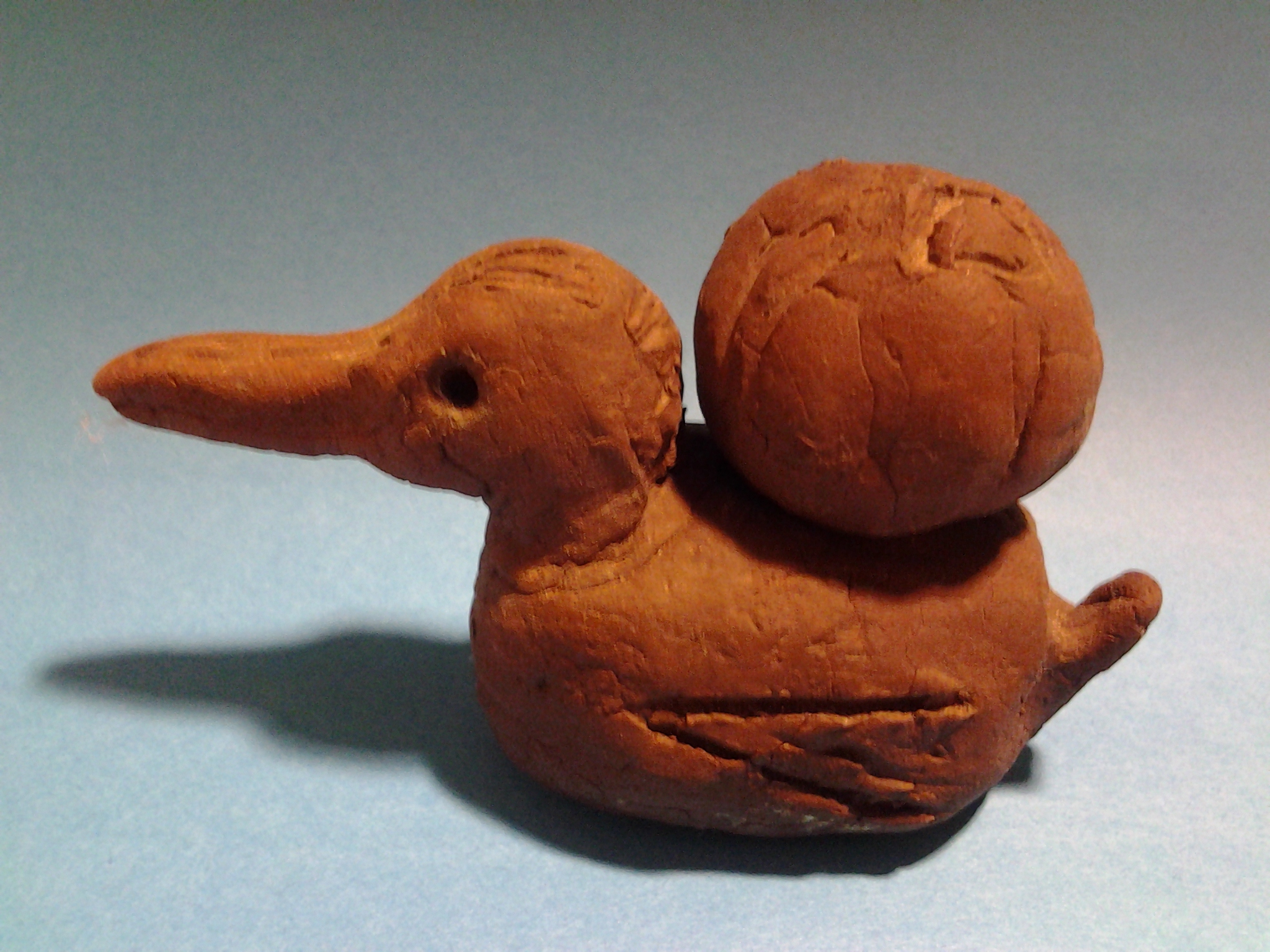
Not everything these kids made involved a cash exchange. Colby made and gave as gifts a whole series of ducks carrying marbles. (Nobody remembers why.)

The hummanacrafts fit into a proud tradition.

I’m pretty sure the kids first invented hummanacrafts with Kate, in the mornings. She would have been the one to ask, ‟What if you make the vent flap smaller?” Or ‟What if you add some weight?”

Justin and Colby were both talkers. Some of their classmates weren’t, at least not in the same way. Watching the evolution of the hummanacrafts in all their hands, listening to their explanations, triggered my first deep awareness that some kids make a lot more sense in motion. I’d read Howard Gardner. I knew, from the experience of my own family, that there are many kinds of intelligence. But hummanacrafts, crazy little paperboard crafts for imaginary drivers the size of mice, convinced me, to the soles of my feet and the outer margins of my plan book, that kids could be smart in ways that had nothing to do with my own.

In fact, some of my students, I saw, would do their best work only if I arranged (or permitted) the sort of learning experience that might have terrified me, or at least intimidated me, when I was a student myself.

And that was the beginning of many stories.

Hooray for hummanacrafts! Hooray for their engineers and operators! Hooray for many things slightly illegal, happening off on the edges of classrooms; things that can teach the teacher, if she’s lucky. (And I was.)

I’m going to try again to get other people to commit themselves in writing. (It’s free, after all, and it can be really short.) (Or long, too.) Did you ever invent or create something on the edges of  classroom culture? What was it? And–I always want to know this: then what happened?

Losing and Keeping Dana

On a mid-November night in 1992, I received a phone call from Dick Zajchowski, the Head of my school. One of my students, Dana, ten years old, had been hit by a van while crossing a busy road through that wet and foggy night. She was badly hurt; she had been taken by helicopter to the teaching hospital nearby; nobody knew whether she could recover.

Dana lasted about ten days, in a coma from which she never emerged, although there were times when she seemed to lift, and our hopes lifted. When I visited and sat with her, reading aloud to her some of the book we were sharing in class, I watched the traces on the machines attached to her body. The electronic lines jumped up and down whenever she heard my voice. Was that good? Was that bad?

I had taught Dana for only a few months, but I had known her in the school community since she was very small. Her older sister, Megan, was also in my class.  Dana, so vivid, so full of life, full of opinions, full of energy—how could she not survive?

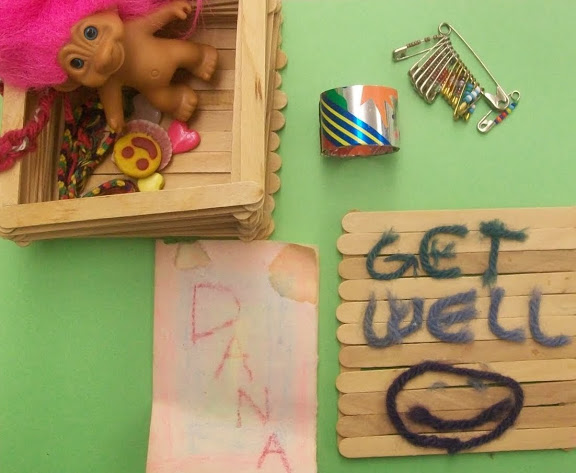
treasures for DanaWhen I cleaned out my desk this spring, I found the small box made of popsicle sticks, full of tiny things kids wanted me to take to Dana in the hospital when—we held on, so hard, to the idea of ‟when”—she woke up: braided wristbands, a tiny troll with long magenta hair, small folded notes.

IMG_20130815_100624 - Copy-001But the injury to her brain was too severe. Here’s one of the hardest things I’ve ever done as a teacher: calling the families of my students, family by family, to tell them that all of us working and wishing, all of us folding small paper origami cranes, hoping to save Dana–all of us had to let all that go. She had gone from us.

Dana and Megan’s parents knew immediately that they would need to find counseling to help Megan. Some of her healing happened out of our sight, though with all of our thoughts and prayers.

Meanwhile, a wonderful grief counselor visited the school to help the faculty help the other kids. Wisely, Dick Zajchowski arranged for Maria, the grief counselor, to come into my own class to work with us directly. She talked us through the stages of grief as she had come to understand them.

  • First, we each needed just to tell our individual versions of how it had happened, or how the news had happened to each of us.
  • Then we needed to confess and work through the universal inclination to blame ourselves, irrationally.
  • We needed to share memories and images of Dana, as she lived.
  • Finally we needed to share our ideas about ways we would carry her forward.

It was true: every single child needed to tell both how he or she imagined the event of the accident, and how his or her parent had relayed the news. One child wished he’d told Dana that the movie she was going to see was a waste of time; if he had, she wouldn’t have been crossing that street. I myself had thought, ‟If only I’d assigned more homework that night…” But when I said that out loud, one of the students said, ‟No, that wouldn’t have stopped her…” All of us worked together to face the truth: this was something we couldn’t have controlled, and didn’t.

One child felt Dana’s death as a blow to his own body. He became physically ill whenever we talked about her in any way, and several times had to go home. Still, it was important for us to talk about Dana, not too much, but enough. We couldn’t just dodge what had happened. I struggled to find the right balance.

One girl, Kerry, seemed to have no defense, no delaying numbness, no way to hide from the events or her feelings about them. Again and again, even when we were doing something with no direct relation to Dana’s death, Kerry broke down and cried. But she was touchingly brave in facing and experiencing those feelings and letting them be, crying and then recovering, moving forward. Each time, I felt her carry the rest of us with her.

Whatever we felt, and however we felt it or expressed it, each of us was a resource to the others.

Months went by. I had known enough of other griefs to recognize, in myself, the feeling of trying to walk underwater; a deep weariness. Maria, the grief counselor, had told me to expect some regression from the kids: neediness, crabbiness, helplessness. All that happened. No way out but through.

At home, I worked on a poem based on Maria’s four stages of grief. That helped me move forward, in the way Kerry’s tears had helped her. In school, off and on, I worked with individual kids to write their own letters to Dana, or short accounts of what had happened.

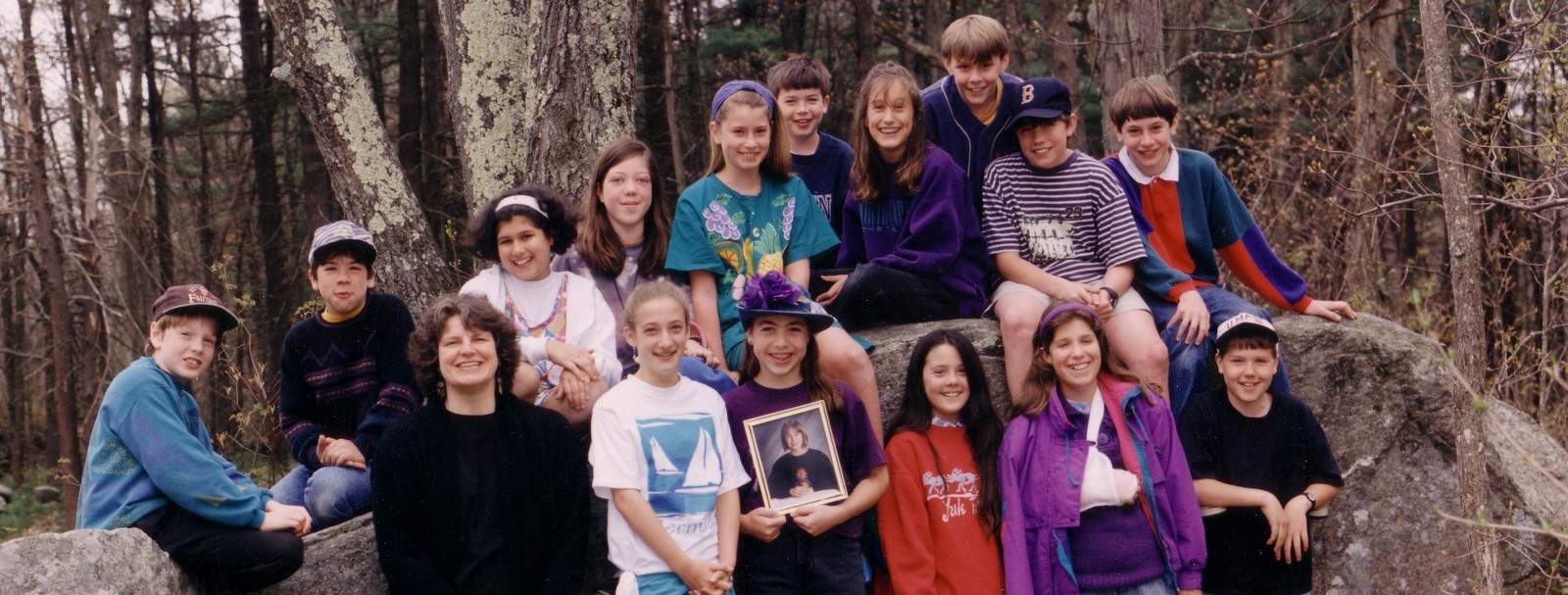
When our class picture was taken, one of the girls held a photo of Dana.

blog photos

Late that spring, Dick asked me to lead the rest of the faculty in writing through that same sequence of parts, the stages of grief, which Maria had explained to us and which I had used in my own poem. Like so much about that whole chapter in my teaching, the memory of my colleagues, crying as they wrote, will never leave me–and I will always be grateful to Dick for discerning, step by step, how our mutual caring could help each of us.

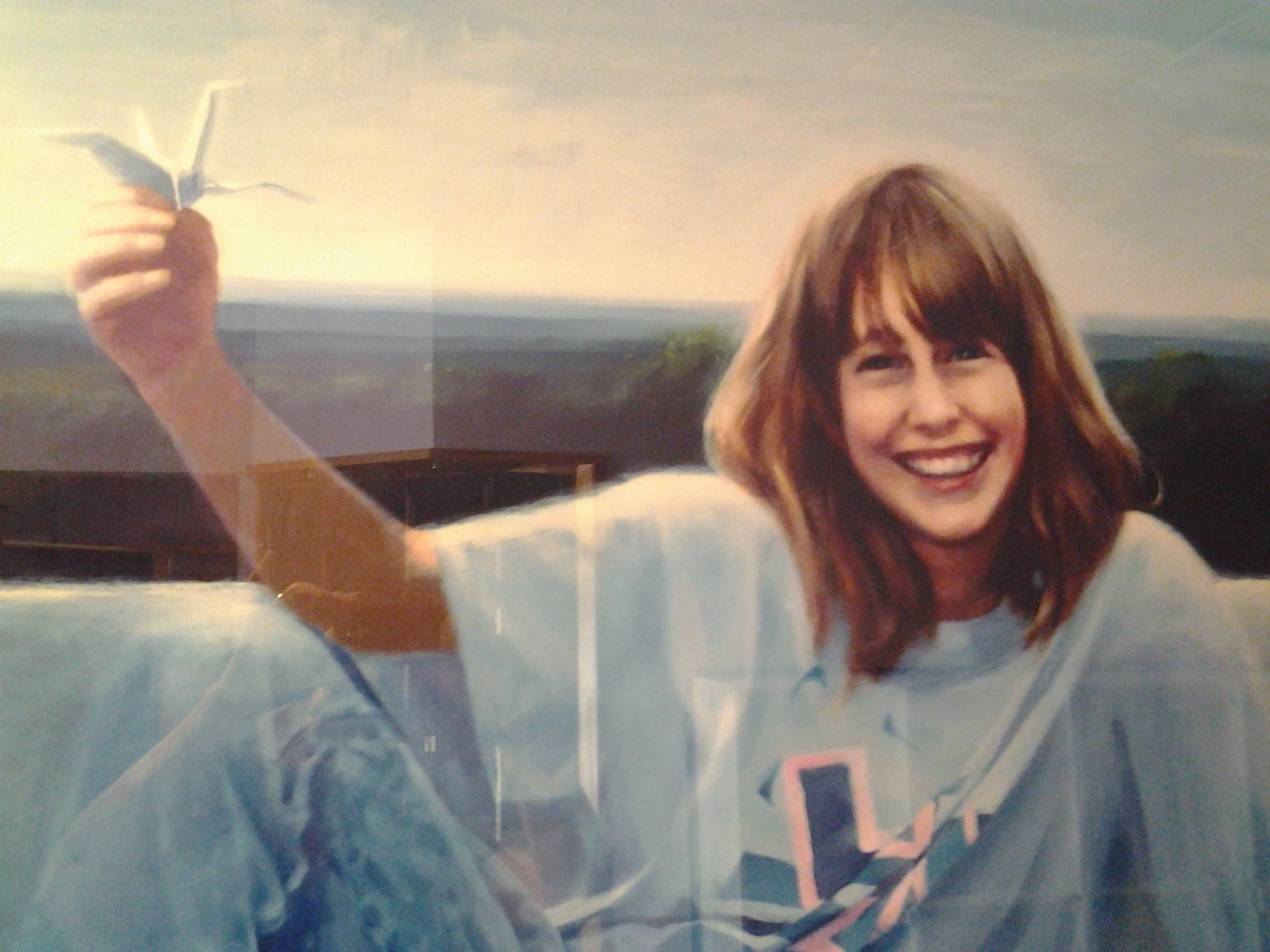
Over the next year, in Dana’s memory, her parents and many of their friends donated the seed money for a new wing to our school. On the wall in that hallway, a painting shows her grinning her inimitable grin, holding one of the cranes we had folded in hope for her. IMG_20130815_100624

Maria, the grief counselor, said that the children who’d been close to Dana could not truly process their shock and loss right away. At ten, or even at twelve, they were too young. ‟Every transition they make,” she said, ‟they will come back to process it again. With any luck they’ll stay in touch with each other, and do some of that together.”

In fact, many of those students have stayed in touch. Many of them, including both Megan and Kerry, are my own Facebook friends. In a way especially needed, somehow, I treasure every smiling photograph they post.